Medically, burnout is a defined syndrome but not a disease. In ICD-11, which took effect on 1 January 2022, the World Health Organization lists burn-out under code QD85 in the chapter on factors influencing health status, not among medical conditions. WHO describes it as a syndrome resulting from chronic workplace stress that has not been successfully managed, with three dimensions: feelings of energy depletion or exhaustion; increased mental distance from one's job, or negativism and cynicism about it; and reduced professional efficacy. WHO says the term applies specifically to the work context, not to other areas of life. The three dimensions come from decades of research by psychologist Christina Maslach, whose Maslach Burnout Inventory (1981) is the most widely used research measure. Burnout is not a diagnosis in the American Psychiatric Association's DSM-5-TR, and research shows substantial overlap with depressive symptoms, so clinicians check for depression, anxiety and physical causes of fatigue such as thyroid problems or anemia. A 2018 JAMA review of 182 physician studies found 142 different definitions of burnout and prevalence estimates ranging from 0% to 80.5%, which shows how measurement drives the numbers. A 2017 systematic review of 61 prospective studies linked burnout to later health problems including coronary heart disease, type 2 diabetes, insomnia and depressive symptoms. Mayo Clinic advises talking to a doctor or mental health provider when symptoms persist.
Reading time
— 5 min
Updated
— Oct 2, 2026
Fact-reviewed
— Oct 2, 2026
This entry explains how burnout is defined and studied. It is not medical advice and can't diagnose or treat any condition. Exhaustion and low mood can have many causes, including depression and physical illness. If you're struggling, talk to a doctor or a mental health professional. In the U.S., if you're in crisis, call or text 988.
Key Takeaways
Key Takeaways
1The WHO's ICD-11 lists burnout (code QD85) as an occupational phenomenon, not a medical condition or a mental disorder.
2It is defined by three dimensions: exhaustion, mental distance or cynicism about the job, and reduced professional efficacy.
3The definition applies only to work. It is not a DSM-5-TR diagnosis, and it overlaps heavily with depressive symptoms.
4Because exhaustion has many causes, a clinician rules out depression, anxiety and physical problems before calling it burnout.
The concept
"Burnout" gets used for everything from a bad week to a breakdown, but the World Health Organization uses it in a narrow, specific way. Think of a phone battery that never gets a full charge: each day starts a little lower, until it dies by mid-morning. In WHO's definition, burnout is what happens when stress at work goes on for a long time without being brought under control. It shows up as three things together: you feel drained, you start to feel detached or cynical about your job, and you feel less able to do it well. WHO calls it an "occupational phenomenon", which means it's a recognized reason people seek health care, but it isn't classed as a disease. That's why a doctor will usually check for other causes of exhaustion, such as depression or a thyroid problem, rather than stopping at the word burnout.
Quick check
In WHO's ICD-11, what kind of entry is burnout (QD85)?
Worked examples
Example 1: The nurse with all three dimensions (baseline case)
A hospital nurse has worked short-staffed for eighteen months. She wakes up tired even after a day off (exhaustion). She has started thinking of patients as "bed 12" and feels numb about the work she once loved (mental distance, which Maslach called depersonalization). And she's sure she's making more mistakes and achieving less (reduced efficacy). The stress is tied to her job, has lasted a long time and hasn't been managed by changes at work. All three dimensions are present, in the occupational context, which is exactly the pattern ICD-11 describes. Her doctor would still check her sleep, mood and blood tests, because the label describes a pattern; it doesn't rule out anything else.
Example 2: Exhausted everywhere, not just at work (edge case)
An office worker says he's "burned out". But on questioning, he's lost interest in his hobbies, his weekends feel as flat as his workdays, and he's been sleeping badly for two months. Under ICD-11, that wider picture doesn't fit burnout, which is limited to work and excludes mood disorders. Pervasive low mood and loss of interest across life are hallmarks of depression, which is a diagnosable, treatable condition. This is why the burnout-depression overlap matters: Bianchi and colleagues found that people with high burnout scores often also have significant depressive symptoms. Calling it burnout can delay the right evaluation. The useful question isn't "is it burnout?" but "what else could this be?", which is a question for a clinician.
Example 3: Reading a "half of doctors are burned out" headline (applied case)
Headlines often report one burnout percentage as if it were fixed. Rotenstein and colleagues' 2018 JAMA review pooled 182 studies of 109,628 physicians in 45 countries. Prevalence estimates ranged from 0% to 80.5%, and the authors found 142 unique definitions of burnout across those studies. Some counted anyone high on a single dimension; others required all three. Change the cutoff and the same doctors can score as 10% or 60% burned out. That doesn't mean burnout isn't real. A 2017 review of 61 prospective studies (Salvagioni and colleagues) linked it to later coronary heart disease, type 2 diabetes, insomnia, depressive symptoms and absenteeism. It means any single percentage only makes sense alongside the definition behind it.
Quick check
A coworker feels exhausted and hopeless at work, at home and in every hobby. What's the most accurate reading?
How it works (visual)
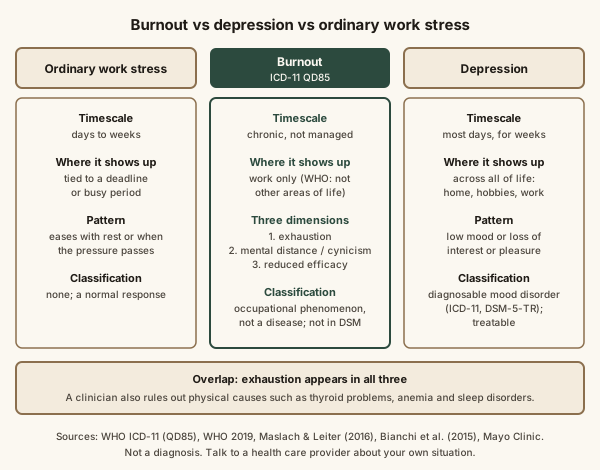
Burnout vs depression vs ordinary work stress
The middle column is narrower than everyday use suggests. Burnout requires a work source, a long timescale and all three dimensions, and the overlap bar is why a proper evaluation looks beyond the label.
Common mistakes
Common Mistakes
✕
Using burnout to mean any tiredness or stress.
→ ICD-11 means chronic, unmanaged workplace stress with exhaustion, cynicism about the job and reduced efficacy together.
✕
Assuming burnout is an official medical diagnosis.
→ WHO classes it as an occupational phenomenon, and it isn't in the DSM-5-TR. Rules on sick leave vary by country and employer.
✕
Self-labeling and skipping a check-up.
→ Depression, anxiety, thyroid problems, anemia and sleep disorders can all look like burnout. A doctor can rule them out.
✕
Treating burnout as purely a personal weakness.
→ Maslach's research points to workload, lack of control, insufficient reward, unfairness, poor community and values conflict at work.
✕
Quoting a single burnout percentage as fact.
→ Estimates swing widely with the definition and cutoff used; check how a study measured it.
Common misconception
“In 2019, WHO officially recognized burnout as a medical disease.”
That was a widely repeated misreading. In May 2019, WHO clarified that burnout is included in ICD-11 as an occupational phenomenon and is "not classified as a medical condition". What changed was a more detailed definition, built around three work-related dimensions, replacing the vaguer ICD-10 entry.
What to do next
What to do next
Check whether all three dimensions are present: exhaustion, growing cynicism about the job, and a sense of reduced effectiveness.
Notice whether the symptoms are tied to work or show up across your whole life, and share that detail with a clinician.
Talk to a doctor if exhaustion, sleep problems or low mood last for weeks, so physical and mental health causes can be checked.
Use the workplace steps Mayo Clinic describes, such as discussing workload and options with a supervisor or using an employee assistance program if one is available.
Protect basics such as sleep, physical activity and time with people you trust, which Mayo Clinic lists among coping steps.
In the U.S., if you're in crisis, call or text 988.
FAQ
FAQ
Related terms
Related terms
Burnout (ICD-11 QD85)
WHO's term for a syndrome resulting from chronic workplace stress that has not been successfully managed, classified as an occupational phenomenon rather than a medical condition.
Occupational phenomenon
A work-related state that can lead people to seek health care, listed in ICD-11's chapter on factors influencing health status rather than as a disease.
Exhaustion
The first burnout dimension: feeling drained of emotional and physical energy, the most commonly reported component.
Depersonalization / cynicism
The second dimension: mental distance from the job, or a negative, detached attitude toward the work and the people it serves.
Reduced professional efficacy
The third dimension: a sense of reduced competence, achievement and productivity at work.
Maslach Burnout Inventory (MBI)
A questionnaire developed by Christina Maslach and Susan Jackson (1981) that measures the three burnout dimensions; the most widely used research tool for burnout.
Differential diagnosis
The process a clinician uses to rule other conditions in or out when symptoms could have several causes, such as depression or anemia.
This entry was researched from public sources and drafted with AI-assisted tools, then edited — errors are still possible. Spot one, or want a topic covered? Read our disclaimer.
 KnowThis