Understanding Stress and the Body (General Overview)
The body's stress response is coordinated by the hypothalamic-pituitary-adrenal (HPA) axis, which releases cortisol and other hormones to prepare the body for short-term physical demand — a mechanism well-suited to brief physical threats, but one that can remain activated by ongoing, non-physical stressors in a way linked to documented negative health effects when sustained over time.
Reading time
— 4 min
Updated
— Oct 10, 2026
Fact-reviewed
— Aug 22, 2026
This entry explains the general biology of the stress response — it is not a mental health diagnosis or treatment resource. If stress is significantly affecting your wellbeing, consult a doctor or mental health professional.
Key Takeaways
Key Takeaways
1The body's stress response is coordinated by the HPA axis, a hormonal signaling pathway ending in the release of cortisol, which prepares the body for short-term physical demand.
2This system evolved to handle brief physical threats — the same hormones now activate for non-physical stressors like work pressure or financial worry, per NIH's National Institute of Mental Health.
3Sustained activation of the stress response (chronic stress) is linked by Mayo Clinic and CDC to documented negative effects on the body over time, distinct from the effects of a single brief stress episode.
The concept
When the brain perceives a threat, it triggers the HPA axis, a signaling chain that ends with the adrenal glands releasing cortisol and related hormones. This raises heart rate and blood sugar and sharpens alertness — useful for handling a brief physical threat, which is what this system evolved for.
Because the same hormonal system handles both a brief physical scare and an ongoing work deadline, the distinction that matters for health outcomes is largely about duration — brief versus chronic — not whether stress occurs at all.
Quick check
Is experiencing a stress response itself considered inherently unhealthy?
Worked examples
Example 1: The HPA axis relay during an acute stressor (baseline case)
Someone nearly steps in front of a car. The hypothalamus signals the pituitary, which signals the adrenal glands, releasing cortisol and adrenaline within seconds — heart rate spikes, alertness sharpens, and once the immediate danger passes, hormone levels return toward baseline within a relatively short period. This complete cycle — activation, response, and return to baseline — is the acute stress response working as designed.
Example 2: A non-physical stressor triggering the same physical system (edge case / variation)
An ongoing, demanding work situation — no physical danger at all — still activates the same HPA axis and cortisol release as a physical threat would, per NIH's framing. Unlike the near-miss example, this stressor doesn't resolve within seconds; it can persist for weeks or months, meaning the hormonal response that evolved for brief physical demand instead stays partially activated over an extended period, a mismatch between the system's original design and how modern non-physical stressors actually behave.
Quick check
Does the body's stress response distinguish between a physical threat (like a near car accident) and a non-physical one (like ongoing work pressure)?
Example 3: Documented effects linked to chronic stress (real-world / applied case)
Mayo Clinic's guidance on chronic stress lists documented associations including disrupted sleep, headaches, elevated blood pressure, and altered immune function with prolonged stress exposure. These are framed as associations tied to sustained HPA axis activation over time, not effects seen from a single brief stressful event — reinforcing that duration, not the mere presence of a stress response, is the key variable in these documented health effects.
How it works (visual)
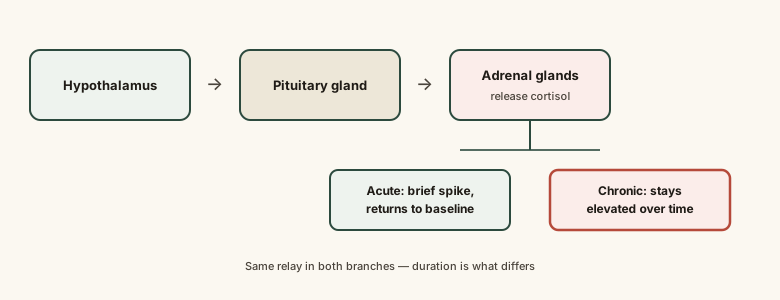
The HPA axis: hormonal relay behind the stress response
The same three-step relay runs in both branches — what differs is whether the trigger resolves quickly (acute, returning to baseline) or persists (chronic, staying elevated), which is the documented distinction behind differing health effects.
Common mistakes
Common Mistakes
✕
Treating all stress as uniformly harmful, regardless of duration.
→ Recognize the acute-versus-chronic distinction — brief, resolved stress is a normal adaptive function, per NIH; chronic stress is the documented health concern.
✕
Assuming stress from non-physical sources (like work) doesn't produce real physiological effects.
→ Understand the same HPA axis and cortisol mechanism activates for both physical and non-physical stressors.
✕
Ignoring persistent stress symptoms because 'it's just stress, not a real health issue.'
→ Chronic stress has documented physiological associations (sleep, blood pressure, immune function per Mayo Clinic) — a doctor or mental health professional can help address ongoing stress.
Common misconception
“Stress is purely psychological and has no real physical effects on the body.”
The stress response is a measurable, hormonal, physiological process — the HPA axis releases real hormones (cortisol among them) that produce documented physical effects: raised heart rate, elevated blood sugar, and changes in immune activity. NIH and Mayo Clinic both describe stress in terms of these concrete biological mechanisms, not as a purely mental phenomenon separate from the body.
Quick check
Is stress purely a mental or emotional experience with no measurable physical component?
What to do next
What to do next
Recognize the difference between brief, resolved (acute) stress and ongoing (chronic) stress — the latter is the documented health concern.
Use general stress-management approaches recommended by CDC, such as regular physical activity and adequate sleep, which support overall stress regulation.
Pay attention to persistent symptoms (sleep disruption, headaches, sustained tension) as possible signs of chronic stress worth addressing.
Consult a doctor or mental health professional if stress is significantly or persistently affecting your wellbeing.
FAQ
FAQ
Related terms
Related terms
HPA axis
The hypothalamic-pituitary-adrenal axis — the hormonal signaling pathway that coordinates the body's stress response, ending in the release of cortisol from the adrenal glands.
Cortisol
A hormone released during the stress response that raises blood sugar and heart rate and suppresses non-urgent functions, preparing the body for short-term physical demand.
This entry was researched from public sources and drafted with AI-assisted tools, then edited — errors are still possible. Spot one, or want a topic covered? Read our disclaimer.
 KnowThis