Published physical activity guidelines from the CDC and WHO recommend adults get roughly 150 minutes of moderate-intensity aerobic activity per week (or 75 minutes of vigorous activity), plus muscle-strengthening activity on 2 or more days — general population benchmarks that a target-heart-rate calculation can help translate into a felt intensity level during exercise.
Reading time
— 4 min
Updated
— Aug 22, 2026
Fact-reviewed
— Aug 22, 2026
This entry explains published population-level activity guidelines — it is not personalized exercise or medical advice. Consult a doctor before starting a new exercise program, especially with an existing health condition.
Key Takeaways
Key Takeaways
1CDC and WHO both publish a similar general benchmark: about 150 minutes per week of moderate-intensity aerobic activity (or 75 minutes of vigorous activity), plus muscle-strengthening activity on 2 or more days.
2'Moderate intensity' is commonly defined by a felt-effort test — noticeably raised heart rate and breathing while still able to hold a conversation — rather than a single universal number.
3A target-heart-rate range, estimated from age, is a commonly used proxy for translating 'moderate' or 'vigorous' intensity into a number that can be checked during exercise.
The concept
CDC's published adult activity guideline is roughly 150 minutes a week of moderate-intensity activity, like brisk walking, plus strength activity on 2 or more days. WHO publishes a closely aligned global recommendation. These are population-level benchmarks, not individualized prescriptions — a doctor can adjust guidance for a specific person's health status.
Because the age-based formula is a population approximation, it's best used alongside — not instead of — the simple, subjective conversational test CDC describes for gauging real-time intensity.
Quick check
Is the 220-minus-age formula for estimated maximum heart rate a precise measurement of any individual's actual maximum heart rate?
Worked examples
Example 1: Estimating a moderate-intensity target heart rate (baseline case)
A 40-year-old's estimated maximum heart rate: 220 − 40 = 180 beats per minute. Moderate intensity at roughly 50-70% of that: 90 to 126 beats per minute, per American Heart Association's general framing — an illustrative range, not a precise individual prescription.
Example 2: Meeting the weekly guideline with different activity splits (edge case / variation)
CDC's 150-minutes-a-week moderate-activity benchmark doesn't require one long session — it can be split as 30 minutes, 5 days a week, or as three 50-minute sessions, or any other combination that reaches the weekly total, per CDC's own guidance. A person choosing 75 minutes of vigorous activity instead of 150 minutes of moderate activity is also meeting the same published guideline, since CDC frames vigorous minutes as counting at roughly double the intensity-weighted rate of moderate minutes.
Quick check
Does CDC's 150-minute weekly activity guideline require one continuous 150-minute session?
Example 3: Strength activity as a separate, additional guideline (real-world / applied case)
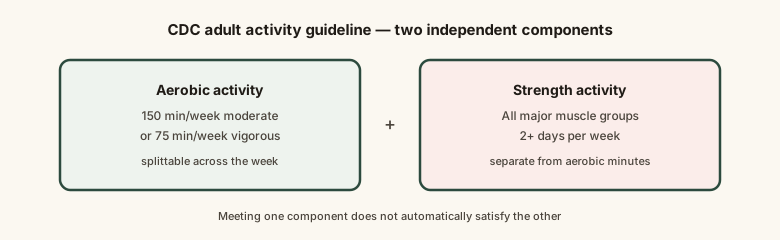
CDC's guidance includes a second, separate component: muscle-strengthening activity involving all major muscle groups on 2 or more days a week. This is distinct from the 150-minute aerobic-activity benchmark — someone who walks briskly for 150 minutes weekly but does no strength activity has met the aerobic component but not the strength component, since CDC's guidance treats them as two separate, both-recommended parts of the overall picture.
How it works (visual)
CDC's weekly adult activity guideline has two separate components
Keeping the two components visually separate matters because meeting one doesn't automatically satisfy the other — CDC recommends both the aerobic minutes and the strength-activity days as independent parts of the overall guideline.
Common mistakes
Common Mistakes
✕
Treating the 220-minus-age heart-rate formula as an exact individual measurement.
→ Use it as a rough estimate alongside the simpler conversational (felt-effort) test, per American Heart Association guidance.
✕
Assuming the 150-minute guideline must be done in one continuous session.
→ Split activity across the week in any combination — CDC's guidance explicitly allows this.
✕
Meeting the aerobic-minutes guideline and assuming that also covers the strength-activity guideline.
→ Remember these are two separate, independently recommended components — both matter.
CDC's guideline is centered on moderate-intensity activity like brisk walking as the primary benchmark, with vigorous activity offered as a faster-counting alternative (75 minutes instead of 150) — not a requirement. Moderate-intensity activity, defined by CDC's own conversational test, is deliberately framed as achievable and sustainable, not as requiring exhaustion.
Quick check
Does CDC's activity guideline require intense, exhausting exercise to count toward the weekly benchmark?
Try it yourself
This calculator uses the widely cited age-based approximation — treat the result as a rough estimate, not a precise individual figure.
Estimate a target heart rate at a given exercise intensity
Estimated target heart rate (bpm)108
What to do next
What to do next
Aim for CDC's general benchmark of 150 minutes of moderate activity (or 75 vigorous) weekly, split however fits your schedule.
Add muscle-strengthening activity on 2 or more days a week as a separate, additional goal.
Use the conversational felt-effort test alongside any heart-rate estimate to gauge real intensity.
Consult a doctor before starting a new exercise program, especially with an existing health condition.
FAQ
FAQ
Related terms
Related terms
Moderate-intensity activity
Physical activity that noticeably raises heart rate and breathing while still allowing conversation — CDC's benchmark example is brisk walking.
Target heart rate
A heart-rate range, estimated from age, used as a rough proxy for exercise intensity level during aerobic activity.
A bag of chips lists 'Serving size: 15 chips, Servings per container: 3' and 150 calories per serving. If someone eats the whole bag, how many calories have they eaten?
This entry was researched from public sources and drafted with AI-assisted tools, then edited — errors are still possible. Spot one, or want a topic covered? Read our disclaimer.
 KnowThis