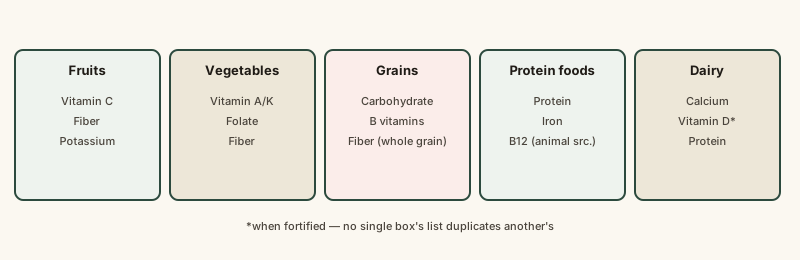
USDA's MyPlate organizes food into five groups — fruits, vegetables, grains, protein foods, and dairy — because each group tends to supply a different, only partially overlapping profile of nutrients, which is the structural reason dietary variety across groups (not just within one group) is emphasized in dietary guidance.
Reading time
— 4 min
Updated
— Aug 22, 2026
Fact-reviewed
— Aug 22, 2026
This entry explains general nutrition literacy — it is not personalized dietary advice. Individual dietary needs vary, including for those with allergies or medical restrictions; consult a doctor or registered dietitian for a specific plan.
Key Takeaways
Key Takeaways
1USDA's MyPlate organizes food into five groups — fruits, vegetables, grains, protein foods, and dairy — because each group tends to supply a different, only partially overlapping nutrient profile.
2No single food group is nutritionally complete on its own; dietary variety across groups exists specifically to cover nutrient gaps that any one group leaves.
3Variety also matters within a group — different vegetables, for instance, supply different specific micronutrients, so eating the same one repeatedly still leaves gaps a different choice would fill.
The concept
USDA's MyPlate divides food into five food groups: fruits, vegetables, grains, protein foods, and dairy. Each group tends to be a strong source of certain nutrients and a weaker source of others — grains are a strong source of carbohydrate and some fiber, protein foods for protein and iron, dairy for calcium, and fruits and vegetables for a wide range of vitamins, minerals, and fiber depending on the specific item.
Because different food groups specialize in different nutrients, thinking of a day's meals in terms of "which groups did I include" is a more direct check on nutritional coverage than thinking only in terms of total calories.
Quick check
If someone eats enough total calories every day, but almost exclusively from grains, are they likely getting complete nutrition?
Worked examples
Example 1: What each food group tends to specialize in (baseline case)
Grains: carbohydrate and some fiber (more in whole grains). Protein foods: protein and iron. Dairy: calcium and often vitamin D (when fortified). Fruits and vegetables: a wide, item-specific range of vitamins, minerals, and fiber. Recognizing these five general specializations is the starting mental model for checking whether a day's meals cover the bases.
Example 2: Variety within a group, not just across groups (edge case / variation)
Within the vegetable group alone, carrots are a strong source of vitamin A (as beta-carotene), while bell peppers are a strong source of vitamin C, and leafy greens like spinach are a strong source of vitamin K and folate — three different vegetables covering three largely different micronutrients. Eating "vegetables" every day but always the same one vegetable still leaves gaps that a different vegetable would fill — variety matters within a food group, not just between the five groups.
Quick check
Does eating vegetables every day guarantee good micronutrient coverage, regardless of which specific vegetables are chosen?
Example 3: A specific documented cross-group nutrient gap (real-world / applied case)
Vitamin B12, essential for nerve function and red blood cell formation, is reliably found in animal-based protein foods and dairy but is largely absent from plant foods, per NIH's Dietary Reference Intakes. Someone following an exclusively plant-based diet needs a specific plan — fortified foods or a supplement, guided by a doctor or dietitian — to cover this particular gap, since no combination of grains, fruits, and vegetables reliably substitutes for it. This is a concrete, well-documented case of why food-group awareness has real practical stakes, not just theoretical ones.
How it works (visual)
Five food groups, five different nutrient specializations
The five boxes are deliberately non-identical — the whole point of the diagram is that no single box's list of nutrients duplicates another's, which is the structural reason variety across all five groups is the guidance, not just adequate intake from a preferred one or two.
Common mistakes
Common Mistakes
✕
Assuming any food group can nutritionally substitute for another as long as calories match.
→ Recognize each group specializes in a different, only partially overlapping set of nutrients — calorie matching doesn't guarantee micronutrient matching.
✕
Treating 'eating vegetables' as a single checkbox rather than varying which vegetables are chosen.
→ Rotate choices within a food group, since different specific foods concentrate different micronutrients even within the same group.
✕
Not planning around known cross-group nutrient gaps, such as vitamin B12 on an exclusively plant-based diet.
→ Identify documented gaps for your specific eating pattern and address them with fortified foods, supplements, or professional guidance as appropriate.
Common misconception
“A 'superfood' from one food group can cover for skipping other food groups entirely.”
No single food, however nutrient-dense, supplies the full range of nutrients spread across all five USDA food groups — an item praised as a "superfood" is still concentrated in the nutrient profile of its own food group and doesn't substitute for the others. USDA's Dietary Guidelines frame nutritional adequacy around variety across groups, not around finding one uniquely complete food.
Quick check
Can a single 'superfood' realistically replace the need for dietary variety across all five food groups?
What to do next
What to do next
Check which of the five MyPlate food groups (fruits, vegetables, grains, protein foods, dairy) show up across a typical day, not just total calories.
Rotate specific food choices within each group rather than repeating the same item, since different foods within a group specialize differently.
If following a restricted diet (such as exclusively plant-based), identify documented nutrient gaps like vitamin B12 and address them with a doctor or dietitian's guidance.
Treat any single food marketed as nutritionally complete with skepticism — no one food replaces variety across all five groups.
FAQ
FAQ
Related terms
Related terms
Food group
A category of foods (such as fruits, vegetables, grains, protein foods, or dairy) grouped together because they tend to share a similar nutrient profile.
Micronutrient
A vitamin or mineral the body needs in smaller amounts than macronutrients, but that is still essential for specific bodily functions.
This entry was researched from public sources and drafted with AI-assisted tools, then edited — errors are still possible. Spot one, or want a topic covered? Read our disclaimer.
 KnowThis