Portion control distinguishes between a labeled serving size (a fixed reference amount set for label comparability) and the actual portion eaten, which can differ substantially — USDA's MyPlate model offers a simple visual method for balancing portions across food groups without requiring exact measurement.
Reading time
— 4 min
Updated
— Aug 22, 2026
Fact-reviewed
— Aug 22, 2026
This entry explains general nutrition literacy — it is not personalized dietary advice. Individual portion needs vary; consult a doctor or registered dietitian for a specific eating plan.
Key Takeaways
Key Takeaways
1A labeled 'serving size' is a fixed reference amount set for comparing products on nutrition labels — it is not a recommendation for how much a person should eat.
2A 'portion' is the amount actually eaten, which research (including NIH's own Portion Distortion materials) shows has grown noticeably larger than labeled serving sizes for many common foods over recent decades.
3USDA's MyPlate offers a simple visual method — dividing a plate into food-group sections — for balancing portions without needing to weigh or measure anything.
The concept
A serving size printed on a nutrition label is a fixed, standardized amount used so labels can be compared fairly between products — it isn't telling you how much to eat. A portion is whatever amount actually ends up on your plate, which can be more, less, or the same as the labeled serving.
Because the labeled serving size and the real portion eaten are two different numbers, reading a label accurately means checking both — the nutrient content shown, and how many labeled servings your actual portion represents.
Quick check
A bag of chips lists 'Serving size: 15 chips, Servings per container: 3' and 150 calories per serving. If someone eats the whole bag, how many calories have they eaten?
Worked examples
Example 1: Serving size vs. portion eaten (baseline case)
A cereal's labeled serving size is 3/4 cup (about 30g). Someone pours what feels like a normal bowl and it turns out to be 1.5 cups when measured — exactly double the labeled serving. Every nutrient and calorie figure on the label needs doubling to reflect what was actually eaten.
Example 2: The MyPlate visual method instead of measuring (edge case / variation)
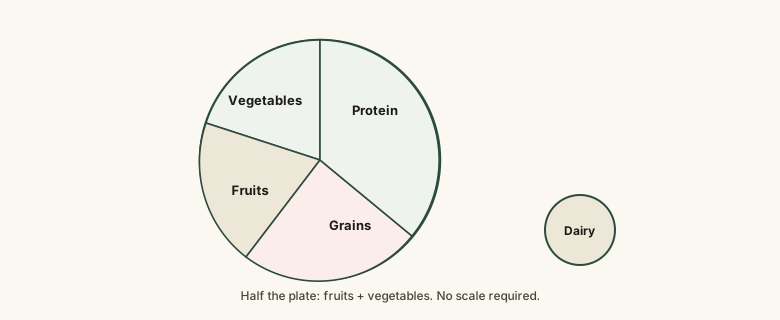
Rather than weighing food, USDA's MyPlate model suggests visually filling half a plate with fruits and vegetables, a quarter with grains, and a quarter with protein foods, alongside a side of dairy. This sidesteps precise measurement entirely by using plate proportions as the portioning method — a genuinely different approach from reading labeled serving sizes, useful for meals that don't come with a label at all, like a home-cooked dinner or a restaurant plate.
Quick check
Does the MyPlate method require weighing or measuring food precisely?
Example 3: Portion creep at a restaurant (real-world / applied case)
NIH's Portion Distortion comparisons note that a fast-food cheeseburger and a soft drink have, in documented cases, grown by roughly 2 to 3 times their size from several decades ago to today, alongside proportional calorie increases. A person ordering "a burger and a soda" today, without realizing the reference size itself has shifted, may be eating a meaningfully larger portion than the same order decades ago — illustrating why portion awareness matters even without changing what's ordered.
How it works (visual)
USDA MyPlate: portioning by plate proportion
The proportions, not exact weights, are the entire method — the same plate-division approach scales naturally to a small or large plate, which is part of why it's designed as a mental model rather than a measuring exercise.
Common mistakes
Common Mistakes
✕
Assuming a labeled serving size is the recommended amount to eat.
→ Remember a serving size is a fixed reference unit for label comparison, not a recommendation — check servings-per-container against what's actually eaten.
✕
Not accounting for portion creep at restaurants or with packaged snacks.
→ Recognize that many common portions have grown larger than decades-old reference sizes, per NIH's Portion Distortion research.
✕
Believing portion control requires weighing and measuring every meal.
→ Use a visual method like USDA's MyPlate proportions for unlabeled meals — precision measurement is one option, not the only one.
Common misconception
“If a food is 'healthy,' portion size doesn't matter.”
Portion size affects total calorie and nutrient intake regardless of how a food is otherwise categorized — a larger portion of any food, including a nutrient-dense one, still delivers proportionally more calories and nutrients. USDA's MyPlate guidance addresses both food choice and portion balance together, not food choice alone.
Quick check
If a food is generally considered nutritious, does that mean portion size stops mattering for it?
What to do next
What to do next
Check 'servings per container' on a label, not just calories per serving, before estimating a whole-package total.
Try USDA's MyPlate plate-proportion method for unlabeled meals like home cooking or restaurant food.
Be aware that many common restaurant and packaged portions have grown larger than older reference sizes.
For personalized portion guidance tied to specific health goals, consult a doctor or registered dietitian.
FAQ
FAQ
Related terms
Related terms
Serving size
A standardized reference amount of food set for nutrition-label purposes, used for comparing products — not a recommendation for how much to eat.
Portion
The actual amount of food a person chooses to eat at one time, which can be larger, smaller, or equal to a labeled serving size.
This entry was researched from public sources and drafted with AI-assisted tools, then edited — errors are still possible. Spot one, or want a topic covered? Read our disclaimer.
 KnowThis