 KnowThis
Key Takeaways
Key Takeaways
- 1The Percent Daily Value (%DV) column shows how much one serving of a nutrient contributes toward a standardized full day's amount — it is not a percentage of the whole package unless the package is one serving.
- 2FDA's published rule of thumb: 5% DV or less per serving is considered low for a nutrient, and 20% DV or more is considered high.
- 3%DV is calculated the same simple way for every nutrient: (amount in serving ÷ daily value reference) × 100 — the same arithmetic whether the nutrient is one to limit or one to get more of.
The concept
Because %DV always uses the same formula, comparing two products' %DV numbers for the same nutrient is a fast, apples-to-apples comparison — even without knowing the raw milligram or gram amounts.
A label shows sodium at 15% DV per serving. What does that number mean?
Worked examples
Example 1: Calculating %DV from a nutrient amount (baseline case)
Example 2: The same %DV logic applied to a nutrient you want more of (edge case / variation)
Is a high %DV always something to avoid?
Example 3: Comparing two products by %DV without needing raw numbers (real-world / applied case)
How it works (visual)
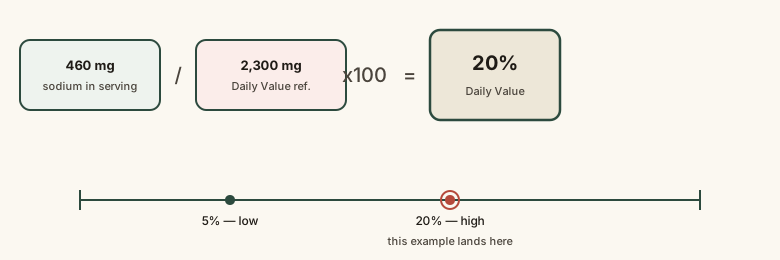
The same three-step calculation — amount, divided by Daily Value, times 100 — sits behind every %DV number on every label, which is why the 5%/20% thresholds work as a universal quick-read tool across any nutrient.
Common mistakes
Common Mistakes
Assuming %DV is a percentage of the whole package rather than one serving.
→ Check the stated serving size first — %DV is always per serving, and a package can contain multiple servings.
Treating every high %DV as bad or every low %DV as good.
→ Consider which nutrient it is — a high %DV is favorable for nutrients like fiber and unfavorable for nutrients like sodium or added sugars.
Ignoring %DV and only looking at raw gram or milligram numbers.
→ Use %DV for quick comparisons between products, since it normalizes different serving sizes to the same daily reference scale.
Common misconception
“The 2,000-calorie reference diet behind %DV is a recommendation for how much everyone should eat.”
The 2,000-calorie figure is a standardized reference point the FDA uses so labels are comparable across products — it is explicitly not a personal calorie recommendation. Actual calorie needs vary by age, sex, size, and activity level, which is why the label itself states the %DV values "may be higher or lower depending on your calorie needs," per FDA's own label text.
Does the 2,000-calorie reference used to calculate %DV mean everyone should eat exactly 2,000 calories a day?
Try it yourself
What to do next
What to do next
- Check the serving size first — every other number on the label, including %DV, is relative to it.
- Use the 5%/20% rule of thumb: 5% DV or less is low, 20% DV or more is high, per FDA guidance.
- Use %DV, not just raw grams or milligrams, when comparing two similar products quickly.
- Remember the 2,000-calorie reference is a labeling standard, not a personal target — ask a registered dietitian for individualized numbers.