Daily hydration needs are commonly estimated from body weight using a rough milliliters-per-kilogram guideline, but the true requirement varies with activity level, climate, and individual health factors — published general guidelines exist as a starting reference point, not a fixed target.
Reading time
— 4 min
Updated
— Aug 22, 2026
Fact-reviewed
— Aug 22, 2026
This entry explains general hydration literacy — it is not personalized medical advice. Fluid needs vary by individual health conditions (including kidney or heart conditions), medications, pregnancy, and climate. Consult a doctor for guidance specific to you.
Key Takeaways
Key Takeaways
1There is no single universal daily water number — published guidance frames fluid needs as a range influenced by body size, activity, climate, and diet, not a fixed target for everyone.
2A common rough estimation method scales fluid needs with body weight (milliliters per kilogram), used as a starting reference point rather than a precise prescription.
3A meaningful share of daily fluid intake comes from food, not just drinking water directly — fruits, vegetables, and soups all contribute measurable water content.
The concept
The body constantly loses water through urine, sweat, and breathing, and needs to replace it to maintain fluid balance. Rather than a single fixed number of glasses, health sources like Mayo Clinic and the NIH describe hydration needs as a range that depends on body size, activity level, and climate — a larger, more active person in a hot climate needs meaningfully more fluid than a smaller, sedentary person in a mild one.
The weight-based estimate below is exactly that: a simple starting reference for understanding how hydration guidance is often framed, not a personalized prescription.
Quick check
Is there one single fixed daily water amount (like exactly 8 glasses) that applies to every adult?
Worked examples
Example 1: Estimating fluid needs from body weight (baseline case, general reference only)
Using a commonly cited rough guideline of about 35 mL per kilogram of body weight: a 70 kg adult's estimated fluid reference is 70 × 35 = 2,450 mL (about 2.45 liters). This is a general starting reference, not a personal target — actual needs shift with the factors above.
Example 2: How activity changes the picture (edge case / variation)
The same 70 kg adult, after an hour of vigorous exercise in warm weather, can lose roughly 1 to 2 liters of fluid through sweat alone, according to general exercise physiology guidance — a loss that isn't captured by the simple weight-based estimate above at all, since that estimate assumes a baseline, non-strenuous day. This is exactly why fitness and health guidance treats the weight-based figure as a floor to build on, not the whole picture, once real activity or heat is added.
Quick check
Does a weight-based hydration estimate (like mL per kg) already account for extra fluid lost during exercise?
Example 3: Fluid from food, not just drinks (real-world / applied case)
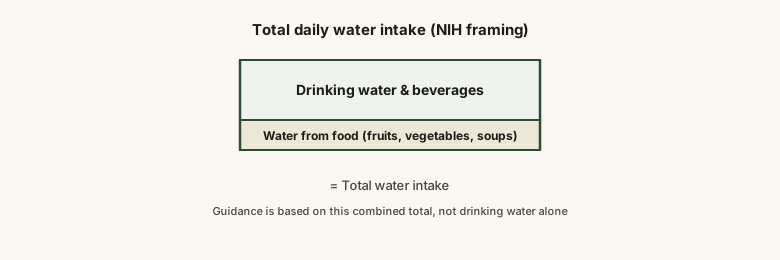
Watermelon and cucumber are both over 90% water by weight, per general nutrition data — a person eating a large helping of water-rich fruit or vegetables that day is already contributing measurable fluid volume toward their total intake before counting a single glass of water. This is exactly why NIH's water intake guidance is framed around total water intake (food plus drink) rather than drinking-water volume alone.
How it works (visual)
Total daily fluid intake comes from two sources
The stacked-bar framing matters because health guidance measures total water intake, not drinking-water volume in isolation — a day heavy in water-rich foods genuinely shifts how much additional drinking water is needed.
Common mistakes
Common Mistakes
✕
Treating '8 glasses a day' as a precise, universally correct requirement.
→ Use it only as a rough, easy-to-remember starting point — real needs vary by body size, activity, and climate, per NIH and Mayo Clinic.
✕
Ignoring exercise- and heat-related fluid losses when estimating daily needs.
→ Add extra fluid intake around exercise or hot conditions, since sweat losses aren't captured in a simple baseline estimate.
✕
Assuming only drinking water counts toward hydration.
→ Remember that water-rich foods like fruits, vegetables, and soups meaningfully contribute to total water intake, per NIH's own framing.
Common misconception
“Drinking as much water as possible is always better for health.”
More is not automatically better — NIH and medical sources note that fluid needs vary and that drinking far beyond what the body can process (a real, documented condition called hyponatremia, or dangerously diluted blood sodium) is a genuine risk in unusual cases, such as extreme endurance events. Hydration guidance is about matching intake to real physiological need, not maximizing volume — a doctor should be consulted for anyone with kidney, heart, or other conditions affecting fluid regulation.
Quick check
Is drinking as much water as physically possible always the safest, healthiest approach?
Try it yourself
This calculator illustrates a commonly cited rough weight-based estimation method — it is a general starting reference, not a personalized target.
Estimate a general fluid reference from body weight
Illustrative fluid reference (mL)2,450
What to do next
What to do next
Treat any weight-based water estimate as a starting reference, not a fixed daily prescription.
Increase fluid intake around exercise, heat, or illness, since these all increase real fluid loss.
Remember that water-rich foods contribute to total daily fluid intake, not just drinks.
If you have a kidney, heart, or other condition affecting fluid balance, follow your doctor's specific guidance rather than general estimates.
FAQ
FAQ
Related terms
Related terms
Fluid balance
The body's regulation of water intake versus water loss (through urine, sweat, breath, and other routes) to maintain stable hydration.
Electrolytes
Minerals like sodium and potassium dissolved in body fluids that help regulate hydration, nerve signaling, and muscle function.
This entry was researched from public sources and drafted with AI-assisted tools, then edited — errors are still possible. Spot one, or want a topic covered? Read our disclaimer.
 KnowThis