 KnowThis
Key Takeaways
Key Takeaways
- 1A balanced plate contains all three macronutrients — protein, carbohydrate, and fat — each doing a different job the other two can't fully substitute for.
- 2Each macronutrient supplies a fixed number of calories per gram: 4 for protein, 4 for carbohydrate, and 9 for fat — these are the real, published Atwater general factors used on every nutrition label.
- 3Because fat supplies more than double the calories per gram of protein or carbohydrate, small differences in fat content can shift a meal's total calories far more than the same gram difference in the other two.
The concept
Once the three per-gram rates are memorized, it becomes possible to reconstruct — or sanity-check — a food's total calorie count directly from its macronutrient breakdown, which is the exact arithmetic behind the calculator further down this page.
A snack contains 10g of protein, 10g of carbohydrate, and 10g of fat. Do all three contribute equally to its total calories?
Worked examples
Example 1: Computing total calories from a macronutrient breakdown (baseline case)
Example 2: Two meals with the same total grams but different calorie counts (edge case / variation)
Why can two foods with the same total weight in grams have very different calorie counts?
Example 3: Sanity-checking a nutrition label against its stated calorie count (real-world / applied case)
How it works (visual)
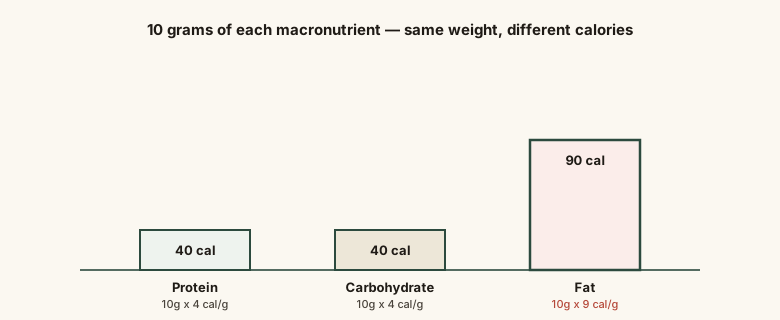
The visual point is the height difference at equal gram weight — fat's bar reaches more than double the height of protein's or carbohydrate's, which is the entire reason fat content moves a food's total calorie count more than the same weight of the other two macronutrients.
Common mistakes
Common Mistakes
Assuming equal gram amounts of different macronutrients contribute equal calories.
→ Remember the 4/4/9 rule — fat's calories-per-gram rate is more than double protein's or carbohydrate's.
Judging a food as 'healthy' or 'unhealthy' from its calorie count alone, ignoring which macronutrients make up those calories.
→ Look at the full macronutrient breakdown, not just the total calorie number, since USDA's MyPlate guidance emphasizes variety across all three, not minimizing any one outright.
Treating a label's stated calorie count and a hand-calculated 4/4/9 total as if they must match exactly.
→ Expect small gaps from fiber accounting and rounding — the FDA permits both, so an exact match isn't required for the label to be accurate.
Common misconception
“Fat is 'bad' and should be minimized as much as possible on a balanced plate.”
Fat is one of three macronutrients the body needs — USDA's MyPlate and NIH dietary guidance both include fat as part of a balanced diet, not as something to eliminate. The literacy point of the Atwater factors isn't that fat is undesirable; it's that fat's higher calories-per-gram rate means its proportion has an outsized effect on a food's total calorie count, which is useful to know, not a reason to avoid it entirely.
Does understanding the 4/4/9 calorie rule mean fat should be avoided entirely on a balanced plate?
Try it yourself
What to do next
What to do next
- Next time you check a nutrition label, try the 4/4/9 math yourself against the stated calorie count as a literacy exercise.
- Use USDA's MyPlate model as a mental checklist for including all three macronutrients across a day's meals, not just one.
- Remember fat's higher calories-per-gram rate when comparing two foods by weight alone — weight isn't calories.
- For any personalized calorie or macronutrient target, consult a doctor or registered dietitian rather than a general reference figure.