A public health campaign is an organized, evidence-based effort — run by agencies like the CDC or WHO — to change a population-level health outcome, such as raising vaccination coverage or reducing smoking rates, using tools like surveillance data, public communication, and access programs, with success measured against defined population metrics rather than any single person's outcome.
Reading time
— 4 min
Updated
— Aug 21, 2026
Fact-reviewed
— Aug 21, 2026
This entry explains how public health campaigns are designed and measured at the population level — it is not personal medical guidance. Individual health decisions belong with a doctor.
Key Takeaways
Key Takeaways
1A public health campaign targets a population-level outcome — like raising vaccination coverage or reducing smoking rates — and is judged by measurable population metrics, not any single person's individual outcome.
2Disease surveillance data is the feedback loop that tells public health agencies whether a campaign is working and where to focus resources next.
3Smallpox eradication in 1980, achieved through a coordinated global vaccination campaign, remains the only human disease ever fully eradicated — a real, documented benchmark for what sustained public health campaigns can accomplish.
The concept
A public health campaign is an organized effort by an agency like the CDC or WHO to change a specific health outcome across a whole population — not to treat any one individual. A campaign to raise measles vaccination coverage, for example, tracks a population-level number (what percentage of children are vaccinated) and uses tools like public communication, access programs, and disease surveillance to move that number.
Understanding this population-level framing also explains why public health messaging sometimes looks different from individual medical advice — a campaign optimizes for the biggest measurable improvement across an entire population, which isn't always phrased the same way a doctor would phrase individual guidance.
Quick check
How is a public health campaign's success typically measured?
Worked examples
Example 1: Smallpox eradication (baseline case)
The global smallpox eradication campaign combined mass vaccination with a targeted strategy called ring vaccination — vaccinating everyone in close contact with a confirmed case to contain outbreaks — plus intensive disease surveillance to find remaining cases. The campaign's clear, measurable target (zero smallpox cases worldwide) was reached in 1977 for the last naturally occurring case, and the WHO formally certified global eradication in 1980, following years of confirmed zero-case surveillance data.
Example 2: A campaign that adjusts strategy based on surveillance data (edge case / variation)
If disease surveillance data shows measles vaccination coverage is high nationally but a specific region or demographic group has a notably lower rate, a well-run campaign redirects resources — targeted outreach, improved access, localized communication — toward that specific gap rather than continuing a uniform national approach. This adaptive redirection, based on real surveillance data rather than assumption, is a defining feature of an evidence-based public health campaign as opposed to a static messaging effort.
Quick check
Why would a public health campaign redirect resources toward a specific region with lower vaccination coverage rather than maintaining a uniform national strategy?
Example 3: Why disease surveillance alone doesn't equal a campaign (real-world / applied case)
Simply collecting disease data without an organized response effort attached to it — funding, communication strategy, access programs, a defined target — is surveillance, not a campaign. A real public health campaign uses that surveillance data as an input to an active intervention effort, and then measures the intervention's effect using the same surveillance system as a feedback loop. The distinction matters because a country can have excellent disease surveillance without necessarily having a well-resourced or well-targeted response campaign built on top of it.
How it works (visual)
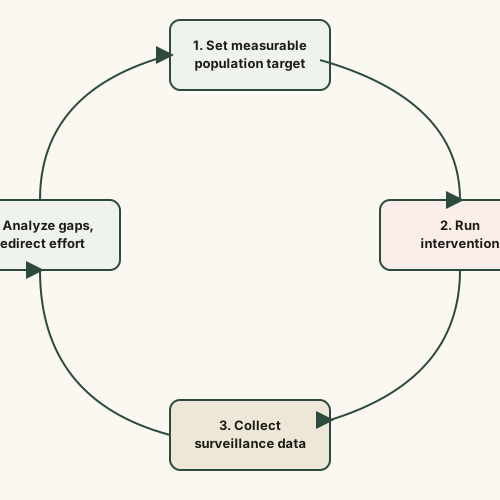
The public health campaign feedback loop
This loop is what makes a campaign adaptive rather than static — each cycle through surveillance data can reshape where and how the next round of intervention effort is spent.
Common mistakes
Common Mistakes
✕
Judging a public health campaign's success by anecdote rather than the actual population-level metric it targeted.
→ Look at the campaign's defined metric (coverage rate, incidence rate) and its trend over time in official surveillance data, not individual stories alone.
✕
Assuming disease surveillance data collection by itself constitutes a public health campaign.
→ Surveillance is the feedback and targeting input — a real campaign also includes an organized intervention effort (communication, access, resources) built on top of it.
✕
Expecting a public health campaign's messaging to read like individualized medical advice.
→ Campaign messaging is optimized for the largest measurable population-level improvement, which can differ in framing from advice tailored to one person's specific situation — for that, see a doctor.
Common misconception
“Public health campaigns are just broad awareness messaging with no measurable way to know if they actually worked.”
Well-run public health campaigns are built around a specific, measurable population target and continuous disease surveillance data — smallpox eradication is a real, fully documented case where a campaign's progress was tracked against a concrete target (zero remaining cases) until that target was formally verified as met in 1980. This data-driven structure, not just awareness messaging, is the actual mechanism.
Quick check
What made the smallpox eradication campaign's success formally verifiable, rather than just an impression that things had improved?
What to do next
What to do next
When evaluating a public health campaign's claims, look for the specific population-level metric it targets and its documented trend, not just anecdote.
Understand that campaign messaging is designed for population-level impact and can look different from individualized medical advice — for personal decisions, talk to a doctor.
Check official sources like CDC or WHO surveillance dashboards for real, current data on a specific disease or coverage metric you're curious about.
Recognize disease surveillance and an active intervention campaign as two connected but distinct things — surveillance alone isn't a campaign.
FAQ
FAQ
Related terms
Related terms
Disease surveillance
The ongoing, systematic collection and analysis of health data to track how a disease is spreading through a population, used to guide public health response.
Vaccination coverage
The percentage of a target population that has received a given vaccine, a key population-level metric public health campaigns track and try to raise.
Eradication (disease)
The permanent, worldwide reduction of a disease's incidence to zero, achieved for smallpox in 1980 through a coordinated global vaccination campaign — the only human disease eradicated so far.
This entry was researched from public sources and drafted with AI-assisted tools, then edited — errors are still possible. Spot one, or want a topic covered? Read our disclaimer.
 KnowThis