A vaccination schedule is a published sequence of recommended ages and intervals for each vaccine, timed around two biological facts: how long a newborn's temporary, maternally-inherited antibodies last, and how much spacing between doses of the same vaccine produces the strongest, most durable immune memory.
Reading time
— 4 min
Updated
— Aug 21, 2026
Fact-reviewed
— Aug 21, 2026
This entry explains how and why published vaccination schedules are structured — it is health literacy, not a personal recommendation. A real, current schedule for a specific person should always come from a doctor or pediatrician, since actual guidance changes over time and by individual health history.
Key Takeaways
Key Takeaways
1Vaccination schedules are timed around two biological facts: how long a newborn's temporary maternal antibodies last, and how much spacing between doses of the same vaccine builds the strongest, longest-lasting immune memory.
2Public health agencies like the CDC and WHO publish real, detailed schedules by age — this entry explains the reasoning behind how such schedules are built, using the CDC's published schedule as an example of what a real one looks like.
3A 'catch-up schedule' exists specifically because missing a dose doesn't mean starting over — it means resuming a modified timeline designed to still reach full protection.
The concept
A vaccination schedule lists which vaccines are recommended at which ages, and how far apart doses of the same vaccine should be spaced. The timing isn't arbitrary: very young infants still carry some maternal antibodies that can interfere with a vaccine's effectiveness if given too early, and doses of the same vaccine are spaced weeks or months apart because giving them too close together doesn't give the immune system time to build its strongest memory response.
None of this is about memorizing a specific schedule from a reference article — it's about understanding that the ages and gaps in a real schedule reflect actual immunology and epidemiology, not administrative convenience.
Quick check
Why might a vaccine be scheduled for, say, 6 months of age rather than at birth?
Worked examples
Example 1: Reading a real published schedule's structure (baseline case, illustrative)
The CDC's published child immunization schedule lists specific vaccines at specific age ranges — for example, certain vaccines given as a series starting around 2 months, with additional doses at defined later ages. The structure (age, vaccine, dose number, minimum interval to the next dose) is exactly the kind of information a real schedule communicates. This entry explains why that structure exists; the actual current recommendations should always be read from CDC.gov or a pediatrician directly, since they're reviewed and can be updated by public health authorities.
Example 2: A catch-up schedule doesn't mean starting over (edge case / variation)
If a dose is missed at the standard recommended age, published catch-up schedules specify how to resume — often simply giving the missed dose as soon as reasonably possible and continuing the remaining series with the standard minimum intervals, rather than restarting the entire sequence from dose one. This exists precisely because immune memory from earlier doses doesn't disappear just because a later dose was delayed.
Quick check
If a child misses a scheduled vaccine dose at the recommended age, does the vaccination series typically need to restart completely?
Example 3: Why adult and child schedules look different (real-world / applied case)
Adult immunization schedules differ from child schedules because the underlying situation differs: adults aren't affected by fading maternal antibodies, may need boosters as childhood-era immunity wanes over decades, and may need additional vaccines based on occupation, travel, age-related risk, or health conditions not relevant to most children. This is why "the schedule" isn't one single document — CDC publishes separate child/adolescent and adult schedules that reflect these different real-world situations.
How it works (visual)
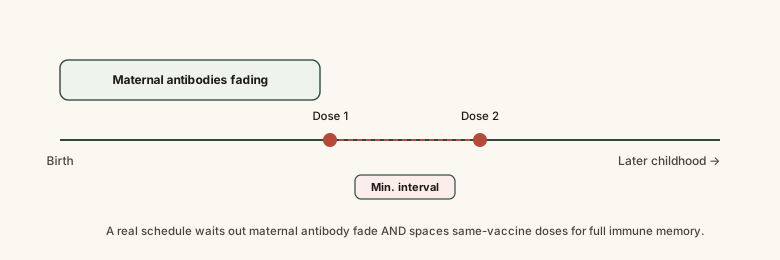
Why schedule timing matters: two overlapping biological windows
A real schedule has to satisfy both timing constraints shown here at once — old enough that maternal antibodies have faded enough not to interfere, and spaced far enough apart between doses of the same vaccine for the immune system's memory response to fully develop.
Common mistakes
Common Mistakes
✕
Assuming a missed dose means restarting an entire vaccine series from scratch.
→ Check the published catch-up schedule (or ask a doctor) — most series can resume from where they left off.
✕
Assuming schedules are identical in every country.
→ National schedules vary based on local disease patterns and health authority guidance — check the specific country's own published schedule when it matters (see the travel health entry).
✕
Treating a schedule found on a general reference site (including this one) as a personal medical recommendation.
→ Always confirm actual current recommendations with a doctor, pediatrician, or the relevant national health authority's own published schedule.
Common misconception
“Vaccination schedules are arbitrary bureaucratic timetables with no real biological reasoning behind them.”
Schedule timing is set by public health authorities based on documented immunology (like the maternal antibody window and dose-spacing effects on immune memory) and ongoing surveillance of disease patterns — it's revised periodically as new evidence emerges, which is itself evidence the schedules are evidence-based rather than fixed by convention.
Quick check
What are the two main biological factors that shape when vaccine doses are scheduled, according to this entry?
What to do next
What to do next
Understand the two biological reasons behind schedule timing: maternal antibody fade and dose-spacing for immune memory.
Check CDC.gov or your national health authority's own published schedule for real, current recommendations — not a general reference article.
If a dose was missed, ask a doctor about catch-up guidance rather than assuming a restart is needed.
Bring any personal scheduling question — for yourself, a child, or before travel — to a doctor or pediatrician.
FAQ
FAQ
Related terms
Related terms
Maternal antibodies
Temporary antibodies passed from a mother to her baby (via the placenta and breastfeeding) that protect the newborn for a limited period before fading, typically within the first several months of life.
Catch-up schedule
An adjusted vaccination timeline used when a person has missed one or more recommended doses at the standard age, designed to restore protection without simply restarting the whole series.
This entry was researched from public sources and drafted with AI-assisted tools, then edited — errors are still possible. Spot one, or want a topic covered? Read our disclaimer.
 KnowThis