A vaccine introduces a piece or a weakened/inactivated form of a pathogen — its antigens — so the immune system can build antibodies and memory cells against it without the person having to survive the actual disease first, which is why a vaccinated immune system can respond within hours to days instead of the week or more a first-time natural infection takes.
Reading time
— 5 min
Updated
— Aug 21, 2026
Fact-reviewed
— Aug 21, 2026
This entry explains the general biology of how vaccines work — it is health literacy, not medical advice. Questions about a specific vaccine, timing, or medical history belong with a doctor or pharmacist.
Key Takeaways
Key Takeaways
1A vaccine introduces antigens — pieces or weakened/inactivated forms of a pathogen — so the immune system can build a defense without the person having to get sick from the real disease first.
2The immune system's first real response to any new antigen (the primary response) is slow, often taking one to two weeks to peak — a vaccinated immune system uses that same slow first pass, but on a harmless training version of the pathogen instead of the real, disease-causing one.
3Memory cells left over from that first response are what make the second response — to a real infection later — dramatically faster and stronger, often shutting an infection down before it causes noticeable illness.
The concept
Every pathogen carries molecular markers on its surface called antigens. A vaccine shows the immune system those same antigens — using a weakened version of the pathogen, a killed version, just a piece of it, or genetic instructions that make the body produce the antigen itself — without the part of the pathogen that actually causes disease. The immune system reacts to the antigen either way, building antibodies and, more importantly, memory cells that stick around for years.
None of these platforms skip the immune system's own two-phase logic — they're different delivery methods for the same underlying antigen-recognition-and-memory process the body already uses against real infections.
Quick check
Why does a vaccinated person's immune system typically respond to a real infection faster than an unvaccinated person's?
Worked examples
Example 1: An inactivated flu vaccine (baseline case)
An inactivated influenza vaccine contains flu virus particles that have been killed and can't replicate or cause infection, but still display the same surface antigens (hemagglutinin and neuraminidase proteins) real flu virus carries. The immune system mounts a primary response against those antigens over one to two weeks, producing antibodies and memory cells — the same response it would eventually mount against a real flu infection, just without the days of fever and illness a real infection would cause along the way.
Example 2: An mRNA vaccine uses a different delivery route to the same goal (edge case / variation)
An mRNA vaccine doesn't contain any part of the actual pathogen at all — it carries a fragment of genetic instructions (mRNA) that tells the recipient's own cells to temporarily manufacture a single harmless piece of the pathogen's antigen (commonly a surface protein). Those cells display the antigen, the immune system reacts to it exactly as it would to an antigen delivered by any other vaccine platform, and the mRNA itself breaks down within days — it never enters or alters the cell's own DNA. The delivery mechanism is different from an inactivated-virus vaccine, but the immunological outcome (antigen recognition, antibody production, memory cells) is the same category of event.
Quick check
Does an mRNA vaccine work by a fundamentally different immune mechanism than a traditional inactivated-virus vaccine?
Example 3: Why some vaccines need more than one dose (real-world / applied case)
A first vaccine dose triggers the slow primary response and leaves behind some memory cells, but that initial memory population is often smaller and less mature than what a second exposure produces. A second dose, given weeks to months later, re-exposes the immune system to the same antigen while those first memory cells are still present — triggering something closer to a secondary response: faster, and producing a larger, more durable population of memory cells and higher antibody levels than the first dose alone. This is the immunological reasoning behind multi-dose schedules for many vaccines, covered in more detail in the companion entry on vaccination schedules.
How it works (visual)
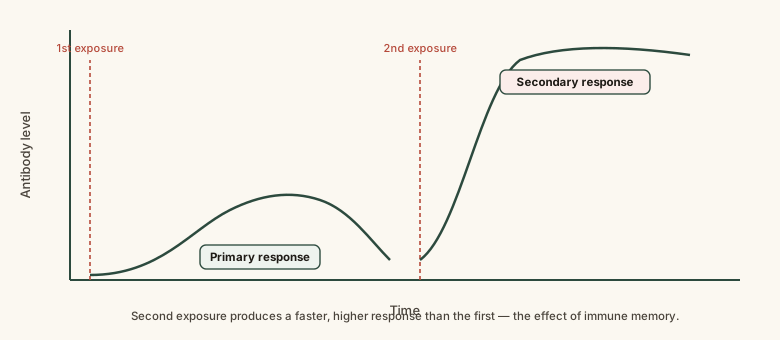
Primary vs. secondary immune response: antibody levels over time
The gap between the two curves is the entire practical value of vaccination: the same biological process happens either way, but a vaccine lets the slow, modest first curve happen safely, ahead of time, so any real exposure later gets the fast, tall second curve instead.
Common mistakes
Common Mistakes
✕
Assuming every vaccine contains a live, full-strength version of the disease-causing pathogen.
→ Vaccine platforms vary — inactivated, subunit, and mRNA vaccines contain no live pathogen at all, and live-attenuated vaccines use a deliberately weakened strain that isn't capable of causing the disease in a person with a normal immune system.
✕
Expecting full protection immediately after a single dose.
→ The primary immune response takes one to two weeks to build meaningfully, and some vaccines are specifically designed as multi-dose series for that reason — check the specific product's timeline.
✕
Treating 'the immune system' as a single generic strength that vaccines boost overall.
→ Immune memory from a vaccine is antigen-specific — it strengthens the response to that particular pathogen, not general immune function against unrelated illnesses.
Common misconception
“Surviving a disease naturally always gives stronger, safer immunity than a vaccine against the same disease.”
For several diseases, the immune memory from natural infection and from vaccination are broadly comparable in the antigen-specific response they produce — but getting there via natural infection means risking the disease's real complications (which, for diseases like measles, polio, or diphtheria, include serious and sometimes fatal outcomes) to reach that immunity. A vaccine is designed to trigger the same antigen-recognition process without that risk. CDC and WHO both state plainly that the risks of vaccine-preventable diseases significantly outweigh the risks of the vaccines that prevent them, based on decades of surveillance data.
Quick check
What is the main immunological reason a vaccine can 'prepare' the immune system without causing the actual disease?
What to do next
What to do next
Understand the two-phase response pattern (slow primary, fast secondary) — it's the mechanism behind why multi-dose schedules and timing matter.
If curious which platform a specific vaccine uses, check CDC or WHO's public vaccine-specific pages rather than assuming from the name alone.
Bring specific questions about a vaccine's mechanism, timing, or your own situation to a doctor or pharmacist — this entry covers the general biology only.
Read the companion entries on vaccination schedules and herd immunity for how this mechanism scales from one person to a whole population.
FAQ
FAQ
Related terms
Related terms
Antigen
A molecule on the surface of a pathogen (or introduced by a vaccine) that the immune system recognizes as foreign and mounts a response against.
Antibody
A Y-shaped protein made by the immune system that binds to a specific antigen, marking it for destruction or blocking it from infecting cells.
Memory cell
A long-lived immune cell that persists after an infection or vaccination and 'remembers' a specific antigen, allowing a much faster response on future exposure.
Adaptive immune response
The immune system's targeted, antigen-specific response involving B cells (antibodies) and T cells, which is slower to build the first time but leaves lasting memory.
This entry was researched from public sources and drafted with AI-assisted tools, then edited — errors are still possible. Spot one, or want a topic covered? Read our disclaimer.
 KnowThis