Herd immunity occurs when enough of a population is immune to a disease that sustained person-to-person transmission can no longer continue, indirectly protecting those who aren't immune — the exact coverage threshold needed is calculated directly from a disease's basic reproduction number (R0), using the formula 1 minus 1 divided by R0, expressed as a percentage.
Reading time
— 4 min
Updated
— Aug 21, 2026
Fact-reviewed
— Aug 21, 2026
This entry explains the epidemiological concept and math behind herd immunity — it is general science literacy, not medical advice. Personal vaccination decisions belong with a doctor.
Key Takeaways
Key Takeaways
1Herd immunity happens when enough of a population is immune to a disease that sustained transmission chains can no longer continue, indirectly protecting even the people who aren't immune.
2The exact coverage level needed — the herd immunity threshold — is calculated directly from a disease's basic reproduction number (R0) using the formula 1 minus 1/R0, expressed as a percentage.
3More contagious diseases (higher R0) require a higher vaccination coverage to reach herd immunity — measles, with an unusually high R0, needs roughly 92 to 95 percent population immunity, far higher than many less contagious diseases.
The concept
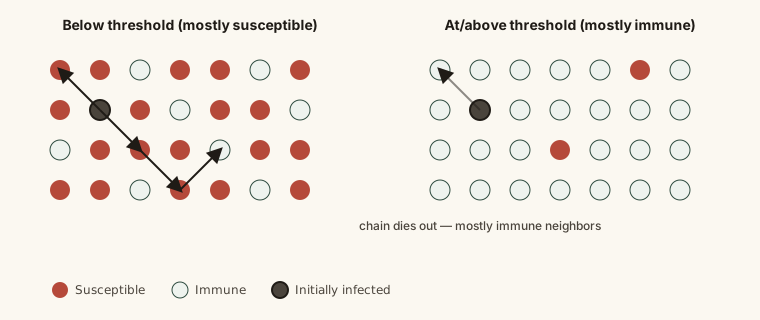
A contagious disease spreads by jumping from an infected person to a susceptible individual. If enough people around an infected person are already immune, the chain of transmission runs out of new people to infect and dies out — even the few people who aren't immune benefit, because the disease simply doesn't reach them as often. That protective effect for the whole population, once enough people are immune, is herd immunity.
This math also explains why herd immunity isn't an all-or-nothing switch — coverage below the threshold still reduces transmission and outbreak size compared to no immunity at all, even if it doesn't fully stop sustained spread.
Quick check
Why does measles require a much higher vaccination coverage percentage for herd immunity than many other diseases?
Worked examples
Example 1: A disease with R0 of 2 (baseline case)
For a disease with R0 of 2, the herd immunity threshold is 1 − 1/2 = 0.5, or 50%. Once half the population is immune, each infected person, on average, encounters fewer than one new susceptible person to infect, and sustained transmission chains can no longer continue indefinitely.
Example 2: Measles, with a much higher R0 (edge case / variation)
Using an R0 of 15 (within measles' commonly cited range), the threshold is 1 − 1/15 ≈ 0.933, or about 93.3%. This is why public health targets for measles vaccination coverage are set around 95% — a small buffer above the calculated threshold, since real-world vaccine effectiveness isn't 100% and population mixing isn't perfectly uniform.
Quick check
If a community's actual measles vaccination coverage is 85%, below the roughly 93-95% herd immunity threshold, what does the math predict?
Example 3: Why indirect protection matters for people who can't be vaccinated (real-world / applied case)
Some people — including infants too young for a given vaccine, and people with certain medical conditions — cannot receive some vaccines themselves. When population immunity around them is at or above the herd immunity threshold, they benefit indirectly: an infected person is statistically unlikely to encounter enough susceptible people to sustain a transmission chain that reaches them. This indirect protection is a documented, real epidemiological effect and one of the main public health justifications for population-level vaccination coverage targets, not just individual protection.
How it works (visual)
Transmission chains below vs. at the herd immunity threshold
The visual difference between the two grids is the entire mechanism of herd immunity — the same disease, with the same inherent contagiousness, produces very different real-world spread depending on how many of its potential next hops are already immune.
Common mistakes
Common Mistakes
✕
Treating herd immunity as a single fixed percentage that applies to every disease.
→ The threshold is disease-specific, calculated from that disease's own R0 — a highly contagious disease needs a much higher threshold than a less contagious one.
✕
Assuming coverage slightly below the threshold provides no protective benefit at all.
→ Protection scales continuously with coverage — being below the threshold means sustained transmission chains remain possible, not that vaccination up to that point did nothing.
✕
Assuming herd immunity from natural infection and from vaccination are interchangeable strategies with equal cost.
→ Both can theoretically reach the same immunological threshold, but reaching it via natural infection means the population pays the price of the disease's real complications along the way — vaccination reaches the same threshold without that cost.
Common misconception
“Herd immunity means a disease simply disappears once 'enough' people have been exposed or vaccinated, regardless of which specific disease it is.”
The coverage level required is not a single universal number — it is calculated directly from each disease's own basic reproduction number using 1 − 1/R0. A less contagious disease (lower R0) may only need 40-60% immunity, while an unusually contagious disease like measles needs closer to 95%. Treating "herd immunity" as one fixed percentage across all diseases is a direct math error, not just an oversimplification.
Quick check
Two diseases have R0 values of 3 and 10 respectively. Which requires a higher vaccination coverage to reach herd immunity, and why?
Try it yourself
Calculate the herd immunity threshold from a disease's R0
Herd immunity threshold (%)93.33
What to do next
What to do next
Remember that the herd immunity threshold is disease-specific, calculated from that disease's own R0 — not a single universal number.
Use the calculator above to see how the threshold changes across different R0 values, from a mildly contagious disease to a highly contagious one like measles.
Recognize that coverage below the threshold still reduces transmission, even though it doesn't fully stop sustained spread.
Bring personal vaccination questions to a doctor — this entry covers the population-level epidemiological math, not individual medical decisions.
FAQ
FAQ
Related terms
Related terms
Basic reproduction number (R0)
The average number of new infections one contagious person generates in a completely susceptible population, with no immunity or control measures in place.
Herd immunity threshold
The proportion of a population that needs to be immune for sustained transmission of a disease to stop, calculated as 1 minus 1 divided by R0.
Susceptible individual
A person with no immunity to a given disease, who can be infected and can transmit it to others if exposed.
This entry was researched from public sources and drafted with AI-assisted tools, then edited — errors are still possible. Spot one, or want a topic covered? Read our disclaimer.
 KnowThis