A handful of vaccine myths circulate persistently despite being directly contradicted by large-scale, published research — including the vaccines-cause-autism claim (traced to a single retracted, fraudulent 1998 study), the idea that natural infection is always safer than vaccination, and the belief that vaccine ingredients like adjuvants are unsafe at the doses used, each of which has real, citable evidence against it from CDC, WHO, and independent research bodies.
Reading time
— 6 min
Updated
— Sep 27, 2026
Fact-reviewed
— Sep 27, 2026
This entry states the current scientific evidence on vaccine safety claims, cited to CDC, WHO, and peer-reviewed research — it is health literacy, not personalized medical advice. Questions about a specific vaccine or medical history belong with a doctor.
Key Takeaways
Key Takeaways
1The vaccines-cause-autism claim traces to a single 1998 study by Andrew Wakefield, which was later found to involve falsified data and undisclosed financial conflicts of interest — it was fully retracted by The Lancet in 2010, and Wakefield lost his medical license.
2Multiple large cohort studies since then, some following over a million children, have found no link between vaccines and autism — this isn't a close or ongoing debate in the scientific literature.
3Vaccine ingredients like adjuvants and preservatives are tested at the doses actually used in vaccines, not at arbitrary high doses — several commonly repeated ingredient-safety claims compare doses that don't match real vaccine formulations.
The concept
Some vaccine claims that still circulate widely have been directly tested by real research and found to be false. The most well-known is the vaccines-and-autism claim, traced to one small, later-discredited 1998 study. Since then, much larger studies — some following over a million children — have specifically looked for a link and consistently found none. When evidence this strong and this repeated exists, stating the conclusion plainly is more accurate than treating it as an open question.
None of this means every question about vaccines is settled — new vaccines and formulations are continuously monitored for safety signals through real surveillance systems. It specifically means this particular, widely repeated claim has been tested extensively and not supported by the evidence.
Quick check
Why do CDC and WHO state the vaccine-autism question as settled rather than as an open scientific debate?
Worked examples
Example 1: The Wakefield study and its retraction (baseline case)
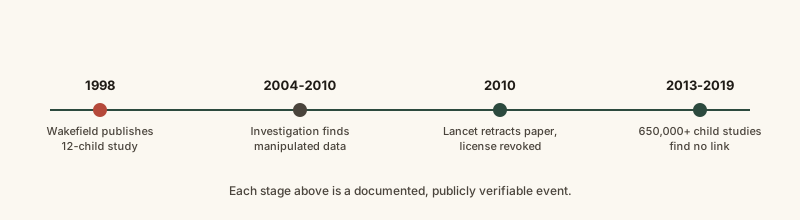
Wakefield's 1998 study examined 12 children and suggested a link between MMR vaccination and autism-like symptoms. Journalistic and regulatory investigation later revealed he had received funding from lawyers building litigation against vaccine manufacturers, had not disclosed this conflict, and had manipulated case data. The Lancet retracted the paper in 2010, and the UK's General Medical Council struck Wakefield off the medical register for ethical violations — a documented, public record, not a disputed claim.
Example 2: A large-scale cohort study specifically re-testing the claim (edge case / variation)
A 2019 study published in the Annals of Internal Medicine followed over 650,000 Danish children over more than a decade, comparing autism rates between vaccinated and unvaccinated children, including children considered at higher genetic risk for autism. The study found no increased risk of autism associated with MMR vaccination in any subgroup studied. This is a far larger and more rigorously controlled dataset than the original 12-child study, specifically designed to test the same hypothesis, and it found the opposite result.
Quick check
Why does a study following 650,000+ children provide stronger evidence than the original 12-child study, beyond just being bigger?
Example 3: The "too many vaccines overwhelm the immune system" claim (real-world / applied case)
A commonly repeated claim holds that the number of vaccines on a modern childhood schedule "overwhelms" or "overloads" a child's immune system. Immunological research has found that the immune system encounters and responds to a vastly larger number of distinct antigens from ordinary daily environmental exposure than it does from the entire recommended vaccine schedule combined — a point the American Academy of Pediatrics and CDC both cite directly when addressing this specific claim. The immune system's capacity to respond to multiple antigens simultaneously is not the limiting factor this claim assumes it to be.
Example 4: "Autism rose at the same time vaccines did" (correlation vs cause)
Autism diagnoses really have risen a lot over the past few decades, and so has the number of routine childhood vaccines. Two things rising together doesn't mean one causes the other, and most of the rise in diagnoses has a documented explanation. The definition widened: the DSM-IV in 1994 added Asperger's disorder, and the DSM-5 in 2013 folded several diagnoses into a single autism spectrum. Screening expanded too, with U.S. pediatricians advised since 2007 to screen every child for autism at 18 and 24 months, and awareness among parents and teachers grew. There's also a direct test of the vaccine explanation: thimerosal, the preservative most blamed at the time, was taken out of routine U.S. childhood vaccines around 2001, and autism cases in California kept rising afterward. If vaccines were driving the trend, removing the suspected ingredient should have bent the curve. It didn't.
Example 5: "Aluminum is a neurotoxin" (dose matters)
Aluminum can harm nerve tissue at high enough exposures, which is where this claim starts. Some non-live vaccines use a small amount of an aluminum salt as an adjuvant, while live vaccines such as MMR contain none at all. The amounts matter: according to the Children's Hospital of Philadelphia, a baby receives about 4.4 milligrams of aluminum from vaccines in the first six months, compared with about 7 milligrams from breast milk, about 38 milligrams from standard formula, and about 117 milligrams from soy-based formula over the same period. An FDA analysis of infant aluminum exposure from both vaccines and diet found the combined amount stayed below the federal minimal risk level, a deliberately conservative safety threshold, throughout the first year. A substance being toxic at high doses doesn't make every amount of it dangerous. The dose is what decides.
How it works (visual)
Timeline: the Wakefield claim, investigation, and retraction
Each stage of this timeline is independently documented and publicly verifiable — the retraction, the license revocation, and the subsequent large-scale studies are all real, citable events, not a matter of interpretation.
Common mistakes
Common Mistakes
✕
Treating the vaccine-autism question as an ongoing, unresolved scientific debate.
→ The originating study was retracted for fraud, and multiple large independent studies since then have consistently found no link — this is settled by the evidence, not an open question.
✕
Assuming vaccine ingredient safety claims that reference very high doses apply to actual vaccine formulations.
→ Check whether a cited dose actually matches what's used in real vaccines — several circulating claims compare doses far higher than what's actually administered.
✕
Assuming a personal or anecdotal timing coincidence (a symptom appearing near a vaccination date) proves causation.
→ Large controlled studies exist specifically to distinguish real causal links from coincidental timing — a single anecdote can't do this, which is exactly why population-level research is the stronger evidence.
Common misconception
“Since some people still debate vaccine safety, the scientific evidence itself must be genuinely mixed or inconclusive.”
Public debate and scientific consensus are not the same thing. On the specific, well-studied claims covered here — the vaccine-autism link and the immune-overload claim — the published evidence from multiple large, independent studies points in one consistent direction. Ongoing public debate reflects the persistence of a claim in public discussion, not genuine uncertainty in the underlying research.
Quick check
Does the existence of ongoing public debate about vaccine safety mean the underlying science is also unsettled?
What to do next
What to do next
Check the primary source behind any vaccine safety claim — is it a large, peer-reviewed study, or a single small or retracted one?
Look at CDC's and WHO's vaccine safety pages, which directly address and cite evidence against many commonly circulated claims.
Be skeptical of ingredient-dose comparisons that don't specify the actual dose used in real vaccines.
Bring specific personal or medical-history questions about a vaccine to a doctor rather than resolving them from general claims online.
FAQ
FAQ
Related terms
Related terms
Adjuvant
An ingredient added to some vaccines to boost the strength of the immune response they generate, used in carefully studied, regulated amounts.
Retraction (scientific publishing)
A formal withdrawal of a published study by a journal, usually due to serious errors, fraud, or ethical violations, meaning the study's findings are no longer considered valid evidence.
Aluminum adjuvant
A small amount of an aluminum salt added to some non-live vaccines to strengthen the immune response. Live vaccines such as MMR don't contain it.
Cohort study
A research design that follows a large group of people over time to compare outcomes between those exposed to a factor (like a vaccine) and those who weren't — one of the main study types used to evaluate vaccine safety at scale.
This entry was researched from public sources and drafted with AI-assisted tools, then edited — errors are still possible. Spot one, or want a topic covered? Read our disclaimer.
 KnowThis