 KnowThis
Key Takeaways
Key Takeaways
- 1The United Nations has no standing army of its own — peacekeeping forces are troops voluntarily loaned by member states for a specific UN-mandated mission, not UN-owned soldiers.
- 2Citizens in a representative democracy almost never vote directly on individual laws — they elect representatives who debate and pass legislation on their behalf, with direct referendums reserved for rare, specific questions.
- 3Economic sanctions are designed to pressure a government's decision-making, but in practice their economic weight frequently falls hardest on the general population rather than the officials the sanctions target.
The concept
Correcting a misconception isn't about memorizing a counter-fact — it's about swapping the mental model for the actual mechanism, since the same wrong model tends to keep generating new wrong conclusions until it's replaced.
Someone claims 'the UN sent its army to enforce a ceasefire.' What's the more accurate way to describe what actually happened?
Worked examples
Example 1: "The UN can force countries to comply" (baseline case)
Example 2: "My vote decides this specific law" (edge case / variation)
Example 3: "Sanctions only hurt the targeted leaders" (real-world / applied case)
Why do broad, country-wide sanctions often affect ordinary citizens more directly than the political leaders they're intended to pressure?
How it works (visual)
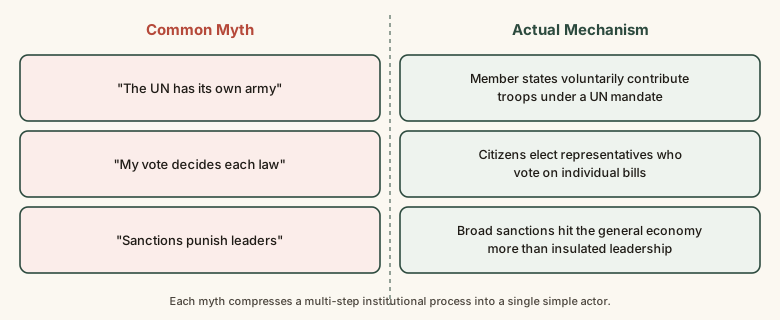
Laid out side by side, each row shows the same pattern: the myth compresses a multi-step institutional process into a single simple actor, while the actual mechanism routes through intermediate steps — contributed troops, elected representatives, economy-wide effects — that change what conclusions are actually justified.
Common mistakes
Common Mistakes
Assuming a global institution like the UN has direct enforcement power comparable to a national government.
→ Check whether the mechanism actually described requires member-state cooperation (as UN peacekeeping and most enforcement does) rather than independent UN action.
Treating 'voting' as a single undifferentiated act that always means directly deciding a specific outcome.
→ Distinguish electing a representative (the vast majority of votes) from a referendum on a specific proposal (a distinct, rarer mechanism) before drawing a conclusion.
Assuming sanctions' stated target and their actual economic impact are the same thing.
→ Look for coverage distinguishing broad national sanctions from targeted 'smart sanctions' aimed at specific individuals — the distinction exists precisely because impact and intent often diverge.
Common misconception
“Global institutions and democratic processes work the way their simplest, most intuitive description suggests.”
Nearly every durable civic misconception traces back to collapsing a multi-actor institutional process into a single simplified actor or action. The UN's real power runs through member-state cooperation, not independent command; democratic lawmaking runs through elected representatives, not direct votes on each law; and sanctions' real economic impact runs through the broader economy, not a precisely aimed strike on specific leaders. In each case, the intuitive shortcut isn't malicious — it's just missing an intermediate step that changes the actual conclusion.
Try it yourself
Before accepting a current-affairs claim built on a cited poll or survey, checking what sample size a stated margin of error implies is one concrete way to sanity-check whether the underlying data supports the confidence of the claim being made.
What to do next
What to do next
- When a claim describes a global institution 'ordering' or 'forcing' a country to do something, check whether the actual mechanism requires member-state cooperation.
- When a claim describes 'voting' deciding a specific policy, check whether it's describing a referendum (rare, specific) or ordinary representative elections (the norm).
- When a claim describes sanctions 'punishing leaders,' look for reporting distinguishing broad national sanctions from targeted individual sanctions.
- Treat any simplified one-sentence description of an institutional process as a starting point to verify, not a finished conclusion.