The United Nations is an intergovernmental organization of 193 member states built around six principal organs — most notably the General Assembly, where every country gets one equal vote, and the Security Council, where 15 members (5 of them permanent, veto-holding) handle matters of international peace and security.
Reading time
— 5 min
Updated
— Aug 21, 2026
Fact-reviewed
— Aug 21, 2026
Key Takeaways
Key Takeaways
1The UN is not a world government — it has no independent police force or lawmaking power over member states; it functions through six principal organs, each with a distinct and deliberately limited scope.
2The General Assembly gives every one of the 193 member states one equal vote, but its resolutions are recommendations, not binding law — the Security Council is the only organ whose resolutions member states are legally obligated to follow.
3The Security Council's five permanent members (the US, UK, France, Russia, and China) each hold a veto that can single-handedly block any substantive resolution, a structural feature baked in at the UN's founding in 1945 and still unchanged today.
The concept
The United Nations is an organization of 193 General Assembly member countries, built to give governments a standing place to talk, negotiate, and coordinate instead of only communicating through one-off diplomacy or war. It doesn't have its own army or the power to overrule a country's laws. Its real authority is split across a handful of separate bodies — a debating chamber where every country has an equal vote, a much smaller security-focused council with real binding power, a court, and an administrative staff that carries out what the other parts decide.
Understanding the UN mostly comes down to understanding which of its parts can actually force a country to do something, and which parts can only ask.
Quick check
A country votes against a resolution in the General Assembly, but the resolution still passes 140–40 with the rest abstaining or absent. Is that country now legally required to comply?
Worked examples
Example 1: How a General Assembly resolution actually passes (baseline case)
Any of the 193 member states can propose a resolution. It gets debated, often revised through informal negotiation to broaden support, then put to a vote where each country — from the largest by population to the smallest island nation — casts exactly one vote. Most resolutions need only a simple majority; a smaller set of "important questions" (admitting new members, budget matters, peace and security recommendations) need a two-thirds majority. Once passed, the resolution is published and becomes part of the UN's political record, but no country can be compelled to act on it — its force comes from diplomatic pressure and the reputational cost of ignoring a widely-supported global position, not from enforcement.
Example 2: A Security Council resolution and the veto (edge case / variation)
Contrast that with the Security Council. A substantive resolution needs at least 9 of the 15 votes in favor — but critically, if even one of the five permanent members (the US, UK, France, Russia, or China) votes no, the resolution fails outright, no matter how many of the other 14 members support it. A resolution backed 14–1, with the lone "no" coming from a permanent member, dies exactly the same way a resolution backed 3–12 does. This single-vote veto power is why the Security Council can be paralyzed on exactly the disputes where a permanent member has a direct stake — the design trades effectiveness for keeping all five original great powers inside the tent.
Example 3: How the UN's regular budget gets funded (real-world / applied case)
The UN doesn't tax anyone — its regular budget is funded by assessed contributions from member states, set by a formula based mainly on a country's share of the world economy (gross national income), adjusted for debt burden and per-capita income, and capped so no single country can be assessed for more than 22% of the total. This formula is renegotiated periodically by the General Assembly's budget committee, which is exactly the kind of internal administrative matter where — unlike most General Assembly resolutions — the outcome genuinely does bind every member state to pay their assessed share.
Quick check
Why can a UN Security Council resolution on a conflict directly involving one of the five permanent members almost never pass, even with broad international support?
How it works (visual)
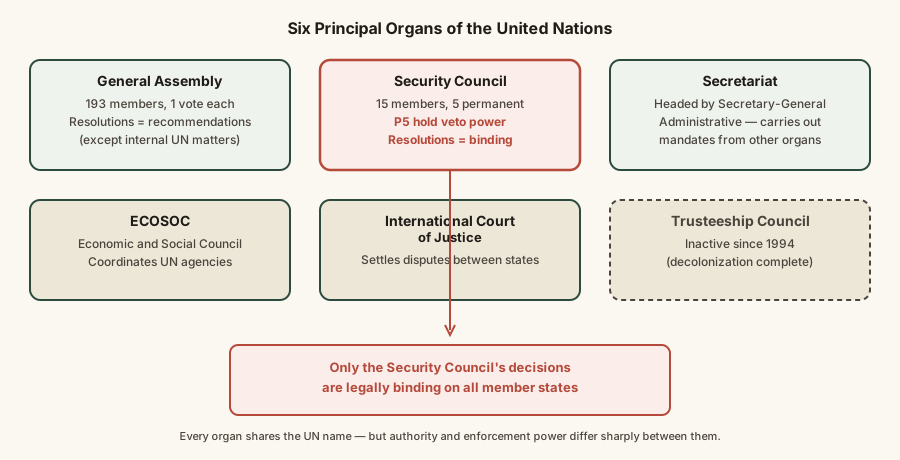
The UN's six principal organs and where real authority sits
Laid out this way, the UN's structure reads less like a single institution and more like six separate bodies sharing a name and a headquarters — each with a different membership rule, a different vote-counting method, and critically, a different answer to the question "can this actually force a country to do something?"
Common mistakes
Common Mistakes
✕
Treating a General Assembly resolution as if it were binding international law simply because it passed with a large majority.
→ Check which organ passed it — only the Security Council's resolutions are legally binding on member states; General Assembly resolutions are influential but non-binding, regardless of vote margin.
✕
Assuming the UN Secretary-General has independent decision-making power comparable to a national head of state.
→ Remember the Secretariat carries out mandates set by the General Assembly and Security Council — the Secretary-General's real power is largely diplomatic and administrative, not a standalone executive authority.
✕
Confusing 'permanent member' (a Security Council-only status) with general UN membership.
→ All 193 countries are General Assembly members; only 5 of them hold the additional, separate status of permanent, veto-holding Security Council member.
Common misconception
“The United Nations is a kind of world government that can override national laws or enforce its decisions on any country.”
The UN has no independent enforcement mechanism of its own — no UN army, no power to overturn a national law or court ruling. Its only binding authority runs through Security Council resolutions, and even those depend on member states choosing to enforce them (often through their own militaries or sanctions regimes) rather than the UN compelling compliance directly. Sovereignty over domestic law remains entirely with individual countries.
Quick check
If the Security Council passes a binding resolution imposing sanctions on a country, who actually enforces those sanctions?
What to do next
What to do next
Next time you see a UN resolution reported in the news, check whether it came from the General Assembly (non-binding) or the Security Council (binding) before assuming it changes anything legally.
Look up how your own country's UN dues are calculated (un.org publishes the assessment scale) to see the gross-national-income formula in action.
If you want to follow real Security Council votes, the UN's own press releases (press.un.org) record exactly how each of the 15 members voted, including any vetoes.
Read the UN Charter's short preamble (un.org/en/about-us/un-charter) — it's a quick, primary-source way to see the founding intent behind the organs described here.
FAQ
FAQ
Related terms
Related terms
General Assembly
The UN's main deliberative body, where all 193 member states each hold one vote regardless of size or wealth; its resolutions are recommendations, not binding law, except on internal UN matters like its own budget.
Security Council
The 15-member UN organ responsible for international peace and security, the only UN body whose resolutions are legally binding on all member states, and the only one where five permanent members can block action with a single veto.
P5 veto
The power held by the Security Council's five permanent members (US, UK, France, Russia, China) to single-handedly block any substantive resolution by voting no, regardless of how the other 14 members vote.
Secretariat
The UN's administrative arm, headed by the Secretary-General, responsible for carrying out the day-to-day work mandated by the other organs rather than setting policy itself.
This entry was researched from public sources and drafted with AI-assisted tools, then edited — errors are still possible. Spot one, or want a topic covered? Read our disclaimer.
 KnowThis