The G7 is a forum of seven major advanced economies (plus the EU) that meets to coordinate economic and foreign policy, while the G20 is a larger, broader forum of 19 countries plus the EU and African Union covering roughly 85% of world economic output — both are informal groupings with no treaty basis and no power to pass binding law.
Reading time
— 4 min
Updated
— Aug 21, 2026
Fact-reviewed
— Aug 21, 2026
Key Takeaways
Key Takeaways
1The G7 and G20 are separate forums, not the same group at two different sizes — the G7 is limited to seven major advanced economies plus the EU, while the G20 is a broader group covering roughly 85% of world economic output.
2Neither group has a treaty, a charter, or a permanent secretariat — both are informal forums whose summit statements are political commitments, not legally binding law.
3Membership logic differs: the G7 selects by long-standing advanced-economy status, while the G20 was built specifically to include major emerging economies alongside the G7 members and the EU.
The concept
The G7 is a group of seven of the world's major advanced economies — Canada, France, Germany, Italy, Japan, the UK, and the US — that meets regularly to talk about the global economy and major world events. The G20 includes those same seven countries plus major emerging economies like China, India, and Brazil, along with the European Union and African Union, covering a much larger share of the world's population and economic output. Neither group can pass binding laws — they issue joint statements, but it's up to each country's own government to actually follow through.
The practical difference between the two groups comes down to what each was actually built to solve — the G7 for coordination among long-standing advanced economies, the G20 for coordination broad enough to matter on genuinely global economic questions.
Quick check
Is the G20 simply a larger version of the G7 with more advanced economies added?
Worked examples
Example 1: How a G7 summit unfolds (baseline case)
Each year, one G7 member hosts, setting the agenda and inviting leaders of the other six plus the EU. Over several days, leaders and their staffs negotiate the wording of a closing communiqué covering that year's priority issues — often economic policy coordination, sanctions positions, or responses to a specific global event. Once issued, the communiqué reflects a shared political position, but each government still has to separately enact anything through its own domestic legislative or executive process — the G7 itself has no mechanism to make any of it binding.
Example 2: Why the G20 was elevated to leader-level in 2008 (edge case / variation)
Before 2008, the G20 operated mainly at the finance-minister and central-bank-governor level. When the global financial crisis hit in 2008, the scale of coordinated response needed — stabilizing banking systems, coordinating stimulus, avoiding a wave of competing protectionist policies — was judged to require heads-of-government-level agreement, not just finance-ministry coordination. The first G20 leaders' summit was convened in Washington in November 2008, and the leaders'-level format has continued as the primary G20 meeting ever since, showing how the group's format itself adapted to the scale of the problem it needed to address.
Example 3: A country that's in the G20 but not the G7 (real-world / applied case)
India is a G20 member but not a G7 member — reflecting India's large and growing economy and population, which the G20's broader membership logic was specifically designed to capture, but which falls outside the G7's narrower "major advanced economy" criteria as historically defined. This is the clearest illustration of the two groups' different membership logic: economic scale and global weight qualify a country for the G20 in a way that doesn't automatically extend to G7 membership.
Quick check
If the G7 issues a joint statement committing to a specific economic policy, is any member country legally required to implement it?
How it works (visual)
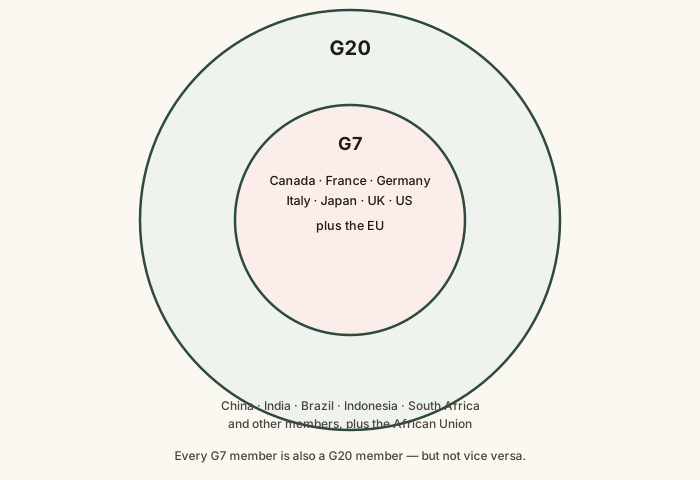
G7 membership nested inside the broader G20
Every G7 member is also a G20 member, but the reverse isn't true — the G20 was built as a broader circle around the G7's original membership, not a separate, unrelated group.
Common mistakes
Common Mistakes
✕
Assuming G7 or G20 communiqués are legally binding international agreements.
→ Treat them as political statements of shared intent — actual implementation depends entirely on each member's own separate domestic process.
✕
Assuming the G20 simply replaced the G7.
→ Both groups still meet independently today — the G20's creation broadened global economic coordination without retiring the G7's own separate summits.
✕
Confusing G7/G20 membership with UN Security Council permanent membership.
→ These are entirely separate systems — G7/G20 membership is based on economic scale and historical grouping, unrelated to the UN's Security Council veto structure.
Common misconception
“The G7 and G20 are formal international organizations with their own charters, like the UN or WTO.”
Neither the G7 nor the G20 has a founding treaty, permanent charter, or standing secretariat comparable to the UN. Both are informal forums that rely on a rotating annual presidency to organize each year's summit and issue that year's joint communiqué — their influence comes from the economic weight of their members' coordinated positions, not from any formal legal authority.
Quick check
Does the G7 or G20 have a permanent headquarters or secretariat comparable to the United Nations?
What to do next
What to do next
Next time a G7 or G20 summit is in the news, check the year's host country and rotating presidency — it explains who set that year's agenda.
Compare the G7's seven members against the G20's fuller list to see exactly which major economies the G20 adds.
Read a real G7 or G20 closing communiqué (both groups publish them) to see firsthand how a political statement differs from binding treaty language.
Note that the G20 also includes the African Union as an institutional member alongside individual countries — a structural feature the G7 doesn't have.
FAQ
FAQ
Related terms
Related terms
G7
An informal forum of seven major advanced economies — Canada, France, Germany, Italy, Japan, the UK, and the US — plus the EU as a non-enumerated participant, that meets to coordinate economic and foreign policy positions.
G20
A broader informal forum of 19 countries plus the European Union and African Union, representing roughly 85% of global economic output, focused primarily on international economic and financial cooperation.
Communiqué
The joint statement issued at the end of a G7 or G20 summit summarizing the group's shared positions — a political statement, not a legally binding agreement.
Rotating presidency
The G7 and G20 practice of a different member hosting and chairing the group each year, setting that year's agenda and summit location.
This entry was researched from public sources and drafted with AI-assisted tools, then edited — errors are still possible. Spot one, or want a topic covered? Read our disclaimer.
 KnowThis