 KnowThis
Key Takeaways
Key Takeaways
- 1NATO's core mechanism is Article 5 — an armed attack on one member is treated as an attack on all — but the treaty text lets each member choose its own response, including but not requiring armed force.
- 2NATO decisions are made by consensus among all member states, not majority vote, meaning any single member can block a proposed collective action.
- 3Article 5 has been formally invoked only once in NATO's history, following the September 11, 2001 attacks on the United States — a useful real-world data point for how the mechanism actually operates.
The concept
The gap between "an attack on one is an attack on all" as a slogan and the treaty's actual flexible, consensus-based mechanism is exactly where most misunderstandings about NATO's obligations come from.
If a NATO member is attacked and Article 5 is invoked, are all other members legally required to send troops?
Worked examples
Example 1: How a routine NATO decision gets made (baseline case)
Example 2: The one real historical invocation of Article 5 (edge case / variation)
Example 3: How consensus can slow down or block a proposed collective action (real-world / applied case)
Why can a single NATO member state block a proposed collective alliance decision, even if every other member supports it?
How it works (visual)
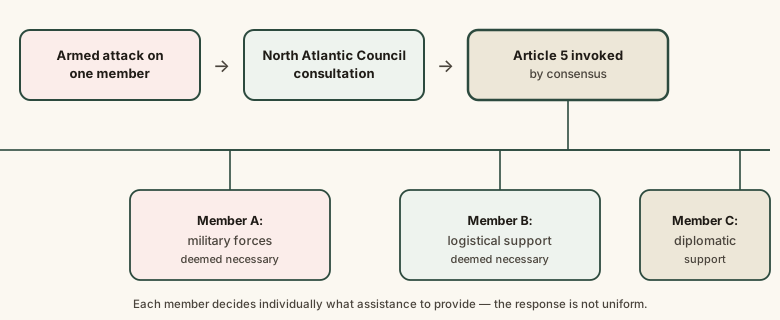
The branching at the bottom is the key structural detail — Article 5 produces a shared political determination that an attack occurred, but the actual response splits into as many separate decisions as there are member states.
Common mistakes
Common Mistakes
Assuming Article 5 automatically triggers a joint NATO military deployment.
→ Remember the treaty text leaves each member's specific response to its own judgment — Article 5 guarantees a collective political response, not an automatic uniform military one.
Assuming NATO decisions are made by majority vote like many national legislatures.
→ Check whether the decision-making process described is consensus-based (NATO's actual standard) rather than majority voting.
Treating NATO as a single unified military force with one chain of command over all members' militaries at all times.
→ Distinguish NATO's coordinating and planning role from each member state's own sovereign control over its own armed forces outside of specific joint operations.
Common misconception
“Article 5 means NATO automatically goes to war the moment any member is attacked.”
Article 5 obligates each member to respond in some form — but the treaty text explicitly leaves the specific nature of that response (military, economic, diplomatic) to each member's own judgment. The only real-world invocation of Article 5, following the September 11 attacks, resulted in a range of different member contributions rather than a single uniform joint military mobilization, which is a direct, historical illustration of how the mechanism actually functions in practice.
What to do next
What to do next
- When reading about a NATO decision, check whether it went through the consensus-based North Atlantic Council process described here.
- If a news story references 'Article 5,' check what specific member response it's actually describing rather than assuming automatic joint military action.
- Read NATO's own short explainer on collective defense (nato.int) as a primary source for how the alliance describes its own core mechanism.
- Distinguish NATO (a specific treaty alliance) from broader references to 'the West' or general international security cooperation, which aren't the same thing.