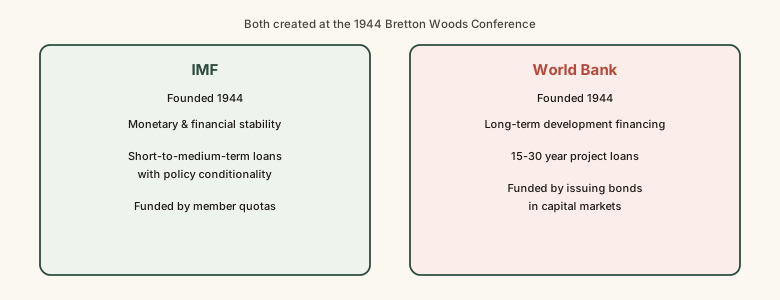
The IMF and World Bank were both created at the 1944 Bretton Woods conference but serve different purposes: the IMF focuses on short-to-medium-term monetary and financial stability, including crisis lending, while the World Bank focuses on long-term development financing for infrastructure, education, and poverty reduction projects.
Reading time
— 5 min
Updated
— Aug 21, 2026
Fact-reviewed
— Aug 21, 2026
Key Takeaways
Key Takeaways
1The IMF and World Bank were created at the same 1944 Bretton Woods conference but were deliberately given different jobs: the IMF handles short-to-medium-term monetary stability and crisis lending, while the World Bank handles long-term development project financing.
2An IMF loan is almost always tied to conditionality — policy reforms the borrowing country agrees to as part of the loan — because the Fund's core concern is restoring a country's ability to meet its international financial obligations, not funding a specific project.
3A World Bank loan is typically tied to a specific, identifiable project or program — a power grid, a school system, a health infrastructure upgrade — with a much longer repayment horizon than a typical IMF facility.
The concept
Think of the difference as timeframe and purpose. The IMF is like an emergency lender for countries running short on the foreign currency they need to pay for imports or service debt — a short-term fix meant to stabilize a currency or financial system quickly, usually attached to conditions about how the country will get its finances back in order. The World Bank is more like a development bank, lending money over many years for specific projects — building roads, power grids, schools, or hospitals — that are expected to grow a country's economy or improve living standards over the long run, not put out a financial fire today.
The clearest way to keep the two straight is to ask what problem a country is actually trying to solve — a today-and-tomorrow cash shortage, or a multi-year development goal.
Quick check
A country is building a new national electrical grid, a multi-year infrastructure project. Is this a typical IMF loan or a typical World Bank loan?
Worked examples
Example 1: A balance-of-payments crisis and an IMF standby arrangement (baseline case)
A country's foreign currency reserves run critically low — it can't cover upcoming import bills or debt payments in foreign currency. It approaches the IMF for a standby arrangement: a loan disbursed in installments, usually conditional on the country adopting specific policy reforms (like reducing a budget deficit, adjusting an overvalued exchange rate, or tightening monetary policy) meant to restore financial stability and its own ability to repay. The loan is measured in months to a few years, and its purpose is stabilization, not funding any particular project.
Example 2: A development project and a World Bank loan (edge case / variation)
A different country, with a stable currency and no immediate financial crisis, wants to expand rural electrification to communities that have never had reliable power. It approaches the World Bank (through the IBRD, or IDA if it's a low-income country) for project financing, tied specifically to that electrification program, with disbursements released as project milestones are met and repayment stretched over 15–30 years. There's no expectation the country is in financial distress — this is ordinary long-term development lending, not crisis response.
Example 3: Why Bretton Woods created two institutions instead of one (real-world / applied case)
At the 1944 conference, delegates from 44 Allied nations were trying to solve two related but distinct postwar problems at once: preventing the kind of competitive currency devaluations and monetary chaos that had worsened the Great Depression, and financing the physical reconstruction of war-devastated economies (the World Bank's original name, the International Bank for Reconstruction and Development, reflects this founding purpose directly). Rather than build one institution to do both, the conference split the mandate — the IMF to police and stabilize the monetary system, the World Bank to raise and lend long-term capital for rebuilding — a division of labor that has persisted, with the Bank's mission gradually shifting from postwar reconstruction toward broader development financing as its original purpose became less urgent over the following decades.
Quick check
If both institutions were founded at the same conference to help stabilize the postwar economy, why does the IMF avoid making long-horizon project loans?
How it works (visual)
IMF vs World Bank, side by side
Laid side by side, the two institutions look far more like specialized siblings than overlapping competitors — same birth year, same founding conference, but built around genuinely different timeframes and financial tools from day one.
Common mistakes
Common Mistakes
✕
Treating 'IMF' and 'World Bank' as interchangeable names for the same institution.
→ Keep the timeframe test in mind: IMF for short-term monetary/financial stability and crisis lending, World Bank for long-term development project financing.
✕
Assuming an IMF loan comes with no strings attached, the way many development grants do.
→ Remember IMF lending is almost always tied to policy conditionality — specific reforms the borrowing country agrees to as a condition of the loan.
✕
Assuming the World Bank is a single organization rather than a group of several related institutions.
→ The World Bank Group includes the IBRD, IDA, IFC, MIGA, and ICSID — each with a distinct role, from government project lending to private-sector investment to dispute arbitration.
Common misconception
“The IMF and World Bank are the same kind of institution, just with different names, and either one could fund any kind of loan a country needs.”
They were deliberately built with different mandates from the same founding conference. The IMF's Articles of Agreement center it on international monetary cooperation and short-to-medium-term financial stability; the World Bank's founding purpose centers on long-term financing for reconstruction and development. A country facing a currency crisis and a country building a national highway system are, structurally, looking for help from two different kinds of institutions — even though both trace back to the same 1944 conference.
Quick check
A country wants a loan explicitly tied to reforming its central bank policy to stop a currency crisis, with fast disbursement. Which institution's core mandate does this match?
What to do next
What to do next
Next time you read about a country getting an 'IMF bailout' versus a 'World Bank loan,' use the timeframe test — crisis stabilization vs long-term project — to sanity-check which institution actually makes sense for the story.
Look up your own country's IMF quota (imf.org) to see how voting power and borrowing capacity are calculated.
Browse a few real World Bank project pages (worldbank.org/projects) to see how specific and concrete typical development financing actually is, compared to a general-purpose IMF loan.
Read the short official histories of both institutions from the Bretton Woods conference to see, in their own words, why the founders split the mandate in two.
FAQ
FAQ
Related terms
Related terms
Bretton Woods Conference
The 1944 international conference in New Hampshire, USA, where 44 Allied nations agreed to create both the IMF and the World Bank as part of a new postwar economic order.
Balance of payments
A country's record of all its financial transactions with the rest of the world; a balance-of-payments crisis (running out of foreign currency reserves to pay for imports and debts) is the classic reason a country turns to the IMF.
IMF quota
Each IMF member's financial contribution to the fund, which determines both its voting power and how much it can potentially borrow — roughly scaled to the size of a country's economy.
IBRD
The International Bank for Reconstruction and Development, the founding and largest institution of the World Bank Group, lending to middle-income and creditworthy lower-income countries for development projects.
This entry was researched from public sources and drafted with AI-assisted tools, then edited — errors are still possible. Spot one, or want a topic covered? Read our disclaimer.
 KnowThis