The World Trade Organization, founded in 1995 as the successor to the GATT, is a member-run system of trade rules built around non-discrimination between trading partners, with a structured dispute settlement process for resolving disagreements over whether a member has broken those rules.
Reading time
— 4 min
Updated
— Aug 21, 2026
Fact-reviewed
— Aug 21, 2026
Key Takeaways
Key Takeaways
1The WTO is a rules-based system members agreed to, not a body that sets tariffs or trade policy itself — its two core jobs are hosting negotiations over trade rules and running a structured process for resolving disputes about whether those rules were broken.
2The Most-Favored-Nation principle is the WTO's foundational rule: whatever trade advantage a member gives one trading partner, it generally must give to every other WTO member too — the name is misleading, since it's actually a non-discrimination rule, not a special favor.
3The WTO grew out of the GATT (General Agreement on Tariffs and Trade), formed in 1947, and only became a formal organization with its own dispute settlement machinery in 1995, after the Uruguay Round of negotiations.
The concept
The WTO is where countries negotiate the rules of international trade and go to settle disagreements about whether another country broke those rules — like a shared rulebook plus a referee. It doesn't set any single country's tariffs directly; each government still sets its own trade policy, but member countries agree to keep those policies within limits negotiated at the WTO. The headline rule is Most-Favored-Nation treatment: if a country lowers a tariff for one trading partner, it generally has to offer that same lower tariff to every other WTO member too, so trade advantages can't normally be handed out selectively.
Once the non-discrimination principle is clear, the more practically useful part is understanding what actually happens when one member believes another has broken it.
Quick check
Country A negotiates a special trade deal lowering tariffs on cars only from Country B. Under WTO's Most-Favored-Nation principle, what would normally be required?
Worked examples
Example 1: How Most-Favored-Nation treatment plays out in practice (baseline case)
Suppose a WTO member sets a 5% tariff on imported steel from most countries but only 2% from one specific trading partner, without a qualifying free trade agreement in place. Under MFN, every other WTO member is entitled to demand that same 2% rate — the exporting country can raise the issue at the WTO, and if the discrepancy isn't resolved, it can become the basis for a formal dispute. This is why genuine tariff preferences for specific countries are almost always wrapped inside a recognized free trade agreement (an explicit MFN exception) rather than handed out informally.
Example 2: Walking through the dispute settlement process (edge case / variation)
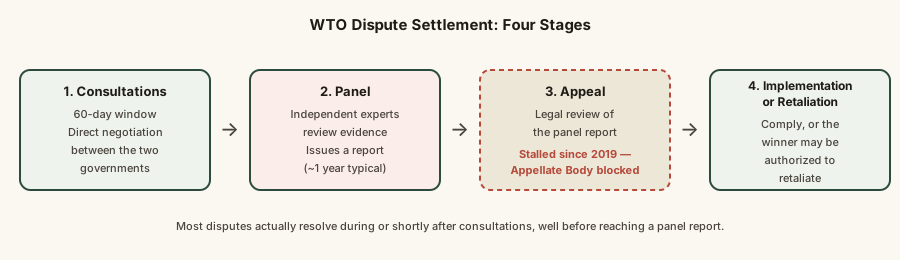
One member believes another has imposed an import restriction that breaks WTO rules. The process starts with mandatory consultations — the two governments have 60 days to try to settle it directly. If that fails, the complaining member can request a panel of independent trade experts, who review the evidence and issue a report, typically within about a year. Either side can appeal on legal grounds — though since 2019, an unresolved appeal effectively stalls final resolution, since the Appellate Body that would normally hear it isn't functioning. If a panel ruling stands and the losing member doesn't bring its policy into compliance, the winning member can eventually get authorization to impose proportionate retaliatory tariffs.
Example 3: From GATT to WTO — the Uruguay Round (real-world / applied case)
The GATT operated from 1947 as a provisional agreement, not a formal organization, running periodic negotiating "rounds" to lower tariffs. The Uruguay Round, launched in 1986 and concluded in 1994 after eight years of negotiation among over 120 countries, extended trade rules well beyond tariffs on goods — covering services, intellectual property, and agriculture for the first time — and created the WTO as a permanent institution with real dispute settlement machinery, which GATT had lacked. The WTO formally began operating on January 1, 1995, inheriting GATT's core rules while adding the binding, structured dispute process described above.
Quick check
Why did the Uruguay Round matter enough to justify replacing GATT with a formal organization?
How it works (visual)
The WTO dispute settlement process, step by step
Each stage is meant to resolve the dispute before it needs to escalate further — most WTO disputes actually settle during or shortly after consultations, well before reaching a panel report, let alone the currently-stalled appeal stage.
Common mistakes
Common Mistakes
✕
Assuming the WTO itself sets or caps individual countries' tariff rates directly.
→ Remember each member government still sets its own tariffs — the WTO enforces the negotiated rules and limits those tariffs operate within, not the specific numbers themselves.
✕
Reading 'Most-Favored-Nation' as some special preferential status, rather than what it actually means.
→ MFN is a non-discrimination baseline that applies to virtually all WTO members by default — it's the opposite of an exclusive favor, despite the name.
✕
Assuming a WTO dispute panel ruling automatically and immediately changes the losing country's law.
→ A panel ruling creates an obligation to bring policy into compliance, with a negotiated timeline — actual enforcement, if a member doesn't comply, comes through authorized retaliatory tariffs from the winning member, not an automatic legal override.
Common misconception
“The WTO can force a country to change its trade laws the way a domestic court can strike down a national statute.”
A WTO dispute ruling doesn't directly repeal or override any country's domestic law. It creates an international obligation to bring the disputed measure into compliance, and if a country doesn't, the main consequence is that the winning member can be authorized to impose retaliatory tariffs of proportionate value — real economic leverage, but not a legal override of the losing country's own legislation.
Quick check
A WTO panel rules against Country X's trade policy, but Country X simply doesn't change it. What typically happens next?
What to do next
What to do next
Next time you read about a country 'violating WTO rules,' check whether a formal panel has actually ruled on it, or whether it's still just an allegation at the consultation stage.
Look at the WTO's own dispute settlement database (wto.org) to see real, resolved cases and how long each stage actually took.
When you see news about tariffs on a specific trading partner, consider whether it's covered by a recognized MFN exception like a free trade agreement, since that's what makes selective tariffs WTO-compliant.
Read a short primer on the Uruguay Round on wto.org to see, in the WTO's own words, what actually changed between GATT and the modern WTO.
FAQ
FAQ
Related terms
Related terms
Most-Favored-Nation (MFN) treatment
A core WTO rule requiring a member to extend any trade advantage (like a lower tariff) it grants one trading partner to all other WTO members equally, with specific carve-outs like free trade agreements.
Dispute Settlement Body
The WTO's General Council, acting in a specific capacity to adopt panel and appeal reports and authorize retaliation when a member is found to have broken trade rules and hasn't corrected it.
Ministerial Conference
The WTO's top decision-making body, bringing together trade ministers from all member countries, required to meet at least once every two years.
Panel (WTO dispute)
A group of independent trade-law experts convened to examine a specific trade dispute between members and issue a report on whether the disputed measure violates WTO rules.
This entry was researched from public sources and drafted with AI-assisted tools, then edited — errors are still possible. Spot one, or want a topic covered? Read our disclaimer.
 KnowThis