The World Health Organization is a specialized UN health agency governed by the World Health Assembly (all member states), implemented by a 34-member Executive Board, and run day-to-day by a Secretariat and six regional offices — its main tools are technical standard-setting and the International Health Regulations, not enforcement power.
Reading time
— 5 min
Updated
— Aug 21, 2026
Fact-reviewed
— Aug 21, 2026
Key Takeaways
Key Takeaways
1WHO is a UN specialized agency, not a global health regulator with enforcement power — its authority is technical (setting standards, guidelines, and disease classifications) rather than legal command over any country's health policy.
2Its one genuinely binding tool is the International Health Regulations (IHR), a treaty-like framework member states agreed to that sets rules for reporting and responding to outbreaks — even this depends on countries actually complying, since WHO has no way to force compliance.
3A Public Health Emergency of International Concern (PHEIC) is WHO's highest alert level, declared by the Director-General on the advice of an independent expert committee — it's a formal alarm, not an order that triggers automatic international action.
The concept
WHO is the United Nations' specialized agency for health, founded in 1948 and based in Geneva. All UN member states can join, and together they form the World Health Assembly, which sets WHO's priorities and budget once a year. Between those annual meetings, a smaller elected board and a staff-run Secretariat carry out the actual work — publishing health guidance, tracking disease outbreaks, and running technical programs like vaccination campaigns. WHO can't force any country to follow its advice; its influence comes from being the most widely trusted source of health data and standards that governments, doctors, and other agencies choose to rely on.
The recurring theme across WHO's structure is the same one that shows up across most UN specialized agencies: broad membership and real technical authority, paired with almost no independent enforcement power over sovereign countries.
Quick check
WHO's Director-General declares a Public Health Emergency of International Concern (PHEIC) for a new outbreak. Does this legally require every country to close its borders or take specific containment measures?
Worked examples
Example 1: How the World Health Assembly sets global health guidance (baseline case)
A health issue — say, updated childhood immunization guidance — is researched and drafted by WHO technical staff and outside expert advisory groups, reviewed by the Executive Board at one of its twice-yearly sessions, then brought to the full World Health Assembly the following May. Delegations from all member states debate and can amend the text before it's adopted, typically by consensus rather than a formal vote. Once adopted, it becomes WHO's official guidance — highly influential with national health ministries, but not a law any country is compelled to follow, unlike a Security Council resolution at the UN.
Example 2: Declaring a Public Health Emergency of International Concern (edge case / variation)
When an outbreak with cross-border risk emerges, the Director-General convenes an Emergency Committee of independent public-health experts under the International Health Regulations. The Committee reviews the evidence and gives the Director-General a recommendation on whether the event meets the threshold for a PHEIC; the final decision legally rests with the Director-General alone, though in practice it almost always follows the Committee's advice. The 2014 West Africa Ebola outbreak and the 2009 H1N1 influenza pandemic were both declared PHEICs through this exact process — a formal international alarm that unlocked emergency coordination and funding, without WHO ever gaining the power to order any single country's border or lockdown policy.
Example 3: The smallpox eradication campaign (real-world / applied case)
In 1967, the World Health Assembly committed to an intensified global smallpox eradication program, coordinating vaccination and surveillance efforts across dozens of countries with wildly different health-system capacity. WHO's role was coordination, technical guidance, and mobilizing resources — not command authority; each country still ran its own vaccination campaign within its own borders. The last naturally occurring case was recorded in Somalia in 1977, and the World Health Assembly formally certified global eradication in 1980, a result that took 13 years of voluntary, WHO-coordinated cooperation from virtually every government on Earth.
Quick check
Why did smallpox eradication take a globally coordinated campaign rather than any single country just vaccinating its own population?
How it works (visual)
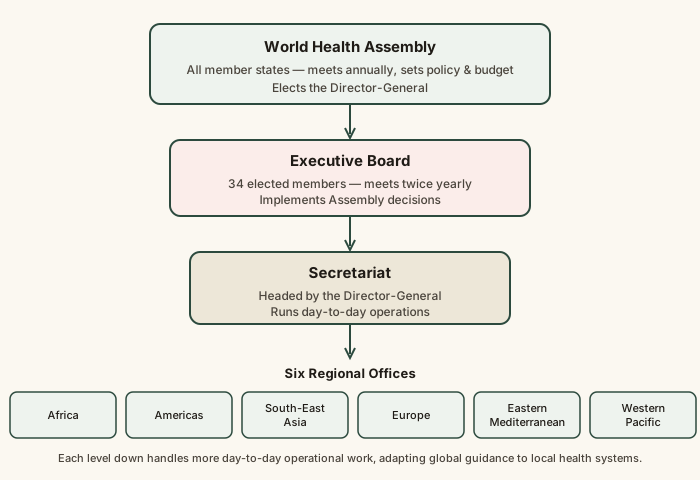
WHO's governance structure, top to bottom
Each level narrows in size but grows in day-to-day operational responsibility — the Assembly sets broad direction once a year with the widest possible input, while the regional offices closest to the bottom handle the actual adaptation of that guidance to real health systems on the ground.
Common mistakes
Common Mistakes
✕
Assuming a WHO PHEIC declaration is a legally binding order that forces specific national policies like lockdowns or border closures.
→ Recognize a PHEIC as a formal international alert and set of recommendations — each country's government decides its own actual response measures.
✕
Treating WHO guidance as equivalent to law, the way a domestic health regulator's rules might function within a country.
→ Remember WHO's influence works through technical credibility and voluntary adoption by national health ministries, not through any independent enforcement mechanism over sovereign countries.
✕
Confusing the International Health Regulations (a specific binding reporting/response framework) with WHO's general guidance and resolutions (non-binding).
→ Keep the two separate — the IHR creates real legal obligations to report and respond to certain events; most other WHO output is influential but non-binding recommendation.
Common misconception
“WHO is a kind of global health police force that can send inspectors into a country or override a national government's health decisions.”
WHO has no independent investigative or enforcement authority inside any sovereign country. Even under the binding International Health Regulations, WHO relies on member states to self-report outbreak data and voluntarily allow technical assistance — it can request information and offer support, but it cannot compel a government to grant access, share data, or change domestic policy.
Quick check
A country experiences a disease outbreak but chooses not to report it to WHO in a timely way, in apparent violation of the International Health Regulations. What can WHO actually do about it?
What to do next
What to do next
Next time a health story mentions a WHO 'declaration' or 'recommendation,' check whether it's describing the binding IHR framework or a non-binding resolution before assuming it changes any country's obligations.
Look up WHO's own governance page (who.int/about/governance) to see the current Executive Board composition and how regional representation is balanced.
If you want a primary-source example of WHO coordination in action, read the short official history of the smallpox eradication program on who.int.
Follow how a PHEIC is actually declared by reading the IHR Emergency Committee process description directly from WHO, rather than secondhand summaries.
FAQ
FAQ
Related terms
Related terms
World Health Assembly
WHO's top decision-making body, made up of delegations from all member states, meeting annually to set policy, approve the budget, and adopt health resolutions and regulations.
International Health Regulations (IHR)
A legally binding agreement among WHO member states (most recently revised in 2005) that sets rules for detecting, reporting, and responding to events that could become international public health emergencies.
Public Health Emergency of International Concern (PHEIC)
WHO's highest level of international alert, declared by the Director-General on the advice of an independent Emergency Committee when an event poses a serious cross-border public health risk.
Executive Board
A 34-member WHO body of technically qualified health officials, elected by the World Health Assembly, that meets twice a year to implement Assembly decisions and prepare the agenda for the next Assembly.
WHO's Director-General declares a Public Health Emergency of International Concern (PHEIC) for a new outbreak. Does this legally require every country to close its borders or take specific containment measures?
This entry was researched from public sources and drafted with AI-assisted tools, then edited — errors are still possible. Spot one, or want a topic covered? Read our disclaimer.
 KnowThis