 KnowThis
Key Takeaways
Key Takeaways
- 1Municipal water treatment is a multi-step process — filtration removes particles, disinfection (commonly chlorination) inactivates pathogens — designed to make tap water safe without needing extra treatment at home under normal conditions.
- 2A boil water advisory means that treatment or distribution process has been disrupted (a water main break, contamination event, or system failure) — it's a signal of a compromised system, not a routine extra-caution recommendation.
- 3Not all waterborne pathogens are equally affected by standard chlorination — some parasites are notably chlorine-resistant, which is why filtration is a separate, necessary treatment barrier, not a redundant one.
The concept
Understanding treatment as a system of layered, specific barriers explains why a disruption to any one layer (not just visible contamination) is enough to trigger a boil water advisory.
A water main breaks near a residential area, and the local water authority issues a boil water advisory even though the tap water still looks clear. Why would an advisory be issued despite no visible change in the water?
Worked examples
Example 1: Normal tap water under a functioning system (baseline case)
Example 2: Responding correctly to an active boil water advisory (edge case / variation)
Example 3: Private well water, which isn't covered by municipal treatment at all (real-world / applied case)
Why can't private well owners rely on a municipal-style boil water advisory system to know if their water needs treatment?
How it works (visual)
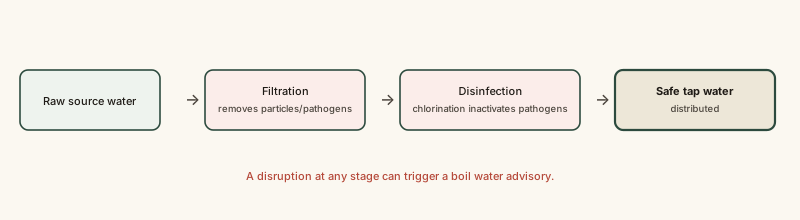
Each stage targets a different category of contaminant, which is exactly why a disruption to any single stage — not just visible contamination — is enough to compromise overall safety.
Common mistakes
Common Mistakes
Assuming clear-looking water is automatically safe during an active boil water advisory.
→ Follow the specific advisory instructions regardless of appearance — most waterborne contamination doesn't visibly change water's clarity.
Treating 'boiling' loosely instead of following the specific advisory instructions (rolling boil, specific duration).
→ Bring water to a full rolling boil for the locally specified duration — a light simmer or brief heating isn't equivalent.
Assuming private well water is automatically safe without independent testing.
→ Arrange regular, independent well water testing, since private wells aren't covered by municipal treatment or monitoring.
Common misconception
“If tap water looks and tastes normal, it's definitely safe, and a boil water advisory is just an overly cautious formality.”
Most waterborne pathogens don't noticeably change water's appearance or taste, so visual/taste inspection isn't a reliable safety check. A boil water advisory is issued in response to a specific identified disruption to the treatment or distribution system — a water main break, contamination event, or system failure — representing a real, specific risk pathway rather than a routine extra-caution measure.
What to do next
What to do next
- During an active boil water advisory, follow your local water authority's specific instructions for which water uses require boiling.
- Bring water to a full rolling boil for the specified duration, not just a light warming, when an advisory requires it.
- If you rely on a private well, arrange regular independent water testing rather than assuming safety without checking.
- Sign up for local water utility alerts if available, so you're notified promptly of any advisory in your area.