 KnowThis
Key Takeaways
Key Takeaways
- 1Soap works by physical disruption, not just dilution — its molecules are amphiphilic, meaning one end binds fat and the other binds water, letting soap tear apart the fatty outer envelope many viruses and bacteria depend on.
- 2Water alone mostly just loosens and dilutes germs on the skin; soap actively breaks down a class of pathogens and lifts oily residue (where germs cling) away from skin so it rinses off.
- 3The CDC and WHO both specify roughly 20 seconds of scrubbing (not just a rinse) because that's the time needed for soap molecules to fully surround and disrupt the microbes and residue on hands, not an arbitrary number.
The concept
Knowing the mechanism explains why certain handwashing habits actually make a measurable difference and others don't — it's not just a ritual, it's a specific physical and chemical process that needs enough time and the right technique to complete. That soap-and-water advantage over sanitizer is exactly why it matters so much in settings like cruise ships, where norovirus outbreaks spread so quickly through shared surfaces and buffets.
Why does the CDC recommend soap and water over alcohol-based hand sanitizer when hands are visibly greasy or dirty?
Worked examples
Example 1: A standard 20-second wash (baseline case)
Example 2: A quick 3-second rinse with no soap (edge case / variation)
Example 3: Handwashing compliance in food service settings (real-world / applied case)
A food handler rinses their hands with water only for 3 seconds after handling raw chicken. What's the main problem with this, mechanistically?
How it works (visual)
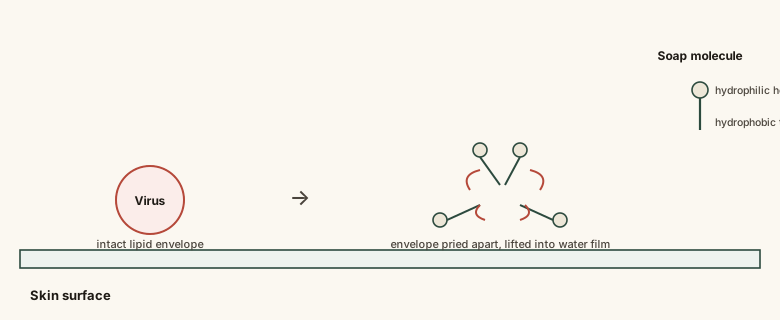
The soap molecules' fat-liking tails burrow into the virus's fatty envelope, and as more molecules cluster in, the envelope is physically pulled apart — a mechanical/chemical disruption, not the same process as sanitizer's alcohol denaturing proteins.
Common mistakes
Common Mistakes
Rinsing with water only and skipping soap entirely.
→ Use soap whenever available — it's the amphiphilic chemistry, not just the water, that disrupts lipid-enveloped pathogens and traps residue.
Washing for only a few seconds instead of the full ~20 seconds.
→ Time it — sing 'Happy Birthday' twice, or count to 20, while scrubbing all hand surfaces, not just the palms.
Missing the backs of hands, between fingers, and under nails.
→ Deliberately scrub every surface, not just palm-to-palm — germs and residue collect in the same overlooked spots repeatedly.
Common misconception
“Hand sanitizer is basically the same as washing with soap and water, just more convenient.”
Sanitizer and soap work through different mechanisms. Alcohol-based sanitizer denatures proteins in many germs but has no mechanical removal action — it doesn't physically lift away dirt, grease, or the germs embedded in it. Soap's amphiphilic molecules trap and physically remove residue through scrubbing and rinsing, and can additionally disrupt the lipid envelope of many viruses directly. The CDC specifically recommends soap and water over sanitizer whenever hands are visibly dirty or greasy for exactly this reason.
What to do next
What to do next
- Wash with soap and water for a full ~20 seconds, covering palms, backs of hands, between fingers, and under nails.
- Reach for soap and water over sanitizer whenever hands are visibly dirty or greasy.
- Wash at key moments: before eating, after using the restroom, after handling raw food, and after coughing/sneezing.
- Keep hand sanitizer (at least 60% alcohol) as a backup for when soap and water genuinely aren't available, not as a routine substitute.