 KnowThis
Key Takeaways
Key Takeaways
- 1Most cruise ship outbreaks are norovirus, which needs as few as 18 viral particles to infect someone and can survive on hard surfaces for weeks.
- 2Alcohol-based hand sanitizer barely affects norovirus — soap and water, which physically wash the virus away, matter far more here than for most illnesses.
- 3Cruise ships aren't necessarily dirtier than similarly sized hotels or resorts — they're one of the most closely monitored settings for illness, which is why their outbreaks get publicly reported while comparable land-based outbreaks often don't.
The concept
That reporting requirement is a big part of why cruise ship outbreaks feel more common than they might actually be relative to other crowded settings — the next examples show why.
Why does alcohol-based hand sanitizer do a relatively poor job protecting against norovirus, compared to soap and water?
Worked examples
Example 1: One infected passenger at the buffet (baseline case)
Example 2: Why sanitizer alone falls short (edge case / variation)
Example 3: Why cruise outbreaks make headlines more than hotel ones (real-world / applied case)
Why do cruise ship illness outbreaks seem to get reported so much more often than similar outbreaks at hotels or resorts?
How it works (visual)
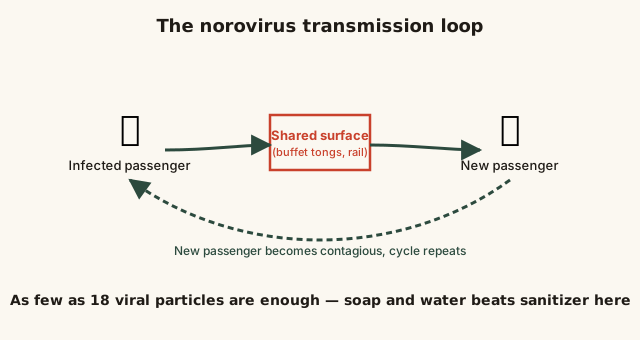
Notice that the loop in the diagram doesn't require the sick person and the newly infected person to ever be in the same place at the same time — the shared surface in the middle is doing all the work of connecting them.
Common mistakes
Common Mistakes
Relying only on hand sanitizer during a cruise, especially during a known outbreak.
→ Wash hands with soap and water at designated stations, especially before eating — sanitizer alone is a weak defense against norovirus specifically.
Assuming a cruise ship outbreak means the ship failed a cleanliness standard.
→ Cruise ships operate under some of the most standardized, regularly inspected sanitation protocols of any travel setting — outbreaks are more often about the virus's contagiousness meeting shared spaces than a cleanliness failure.
Continuing normal activities while symptomatic to avoid missing part of the trip.
→ Report symptoms to the ship's medical staff promptly — cruise lines isolate sick passengers specifically because early isolation is one of the most effective ways to stop an outbreak from spreading further.
Common misconception
“Cruise ships have frequent illness outbreaks because they're dirtier than other travel options.”
Cruise ships are actually subject to more standardized, publicly tracked sanitation inspection than most hotels or resorts, through the CDC's Vessel Sanitation Program. Outbreaks spread quickly not because of poor cleanliness, but because of a specific combination: an unusually contagious virus (norovirus, which needs only a tiny dose to infect someone and resists alcohol-based sanitizer), thousands of people sharing enclosed spaces and self-serve food for days, and a mandatory public reporting threshold that makes cruise outbreaks visible in a way comparable land-based outbreaks usually aren't.
What to do next
What to do next
- Wash hands with soap and water before eating and after using shared surfaces, rather than relying solely on hand sanitizer, especially on a cruise.
- Report symptoms like sudden vomiting or diarrhea to ship medical staff promptly rather than waiting them out — early isolation helps stop outbreaks from spreading.
- Check a cruise line's public Vessel Sanitation Program inspection scores before booking if sanitation history is a concern to you.