 KnowThis
Key Takeaways
Key Takeaways
- 1Air pollution comes overwhelmingly from a small number of source categories: vehicle exhaust, power generation, industrial combustion, agricultural burning, and (increasingly) wildfire smoke.
- 2The Air Quality Index (AQI) is not a direct pollutant concentration — it's a converted 0-500 health-risk scale, calculated from whichever regulated pollutant is performing worst at that moment.
- 3PM2.5, fine particulate matter small enough to reach deep into the lungs and bloodstream, is the pollutant most likely to be driving a high AQI reading in most cities most of the time.
The concept
Because the AQI is a converted risk scale rather than a raw measurement, the same numeric AQI value always represents roughly the same health risk, whether it was driven by wildfire smoke in California or vehicle exhaust in a dense city — that comparability is the entire point of the system.
A city reports an AQI of 165, driven by ozone, on a hot summer afternoon. Does this mean the raw ozone concentration in the air is literally 165 micrograms per cubic meter?
Worked examples
Example 1: Reading a daily AQI report (baseline case)
Example 2: A wildfire smoke event (edge case / variation)
Example 3: Comparing two cities with different pollution profiles (real-world / applied case)
How it works (visual)
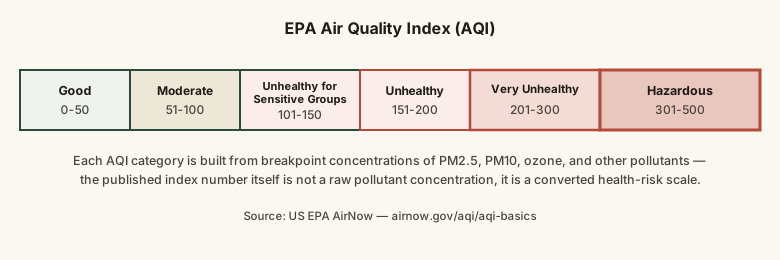
Each band corresponds to a specific public-health guidance level — at "Unhealthy for Sensitive Groups," people with asthma, children, and older adults are advised to reduce prolonged outdoor exertion, while the general public isn't yet advised to change behavior until the "Unhealthy" band begins.
Common mistakes
Common Mistakes
Assuming a 'Good' AQI day means zero pollution.
→ AQI 'Good' (0-50) means pollutant levels pose minimal risk, not zero pollutant presence — there is essentially no outdoor environment with literally zero measurable pollutants.
Treating AQI as an average of all pollutants rather than the worst one.
→ Remember AQI reports the maximum sub-index across the six criteria pollutants, specifically so a spike in one dangerous pollutant (like wildfire PM2.5) isn't diluted by other, unaffected pollutants.
Assuming indoor air is automatically safer during a high-AQI outdoor event.
→ PM2.5 from wildfire smoke and vehicle exhaust can infiltrate indoor spaces through gaps and ventilation systems — indoor air quality during a high-AQI event depends heavily on filtration, not just closed doors and windows.
Common misconception
“Air pollution is mostly a problem for heavily industrialized cities with visible smog — if you can't see haze, the air is fine.”
PM2.5, the pollutant most often driving elevated AQI readings, is frequently invisible to the naked eye at concentrations that still pose real health risk — visible haze typically only appears at much higher concentrations than the level where health guidance already recommends caution. Clear-looking air is not the same as clean air on the AQI scale.
Why can air look perfectly clear on a day when the AQI is elevated into the 'Unhealthy for Sensitive Groups' range?
What to do next
What to do next
- Check your local AQI (via AirNow.gov in the US, or your national equivalent) before planning extended outdoor exercise, especially if you have asthma or another respiratory condition.
- Treat 'clear-looking air' as no guarantee of a low AQI — check the actual number rather than judging by visibility alone.
- During a wildfire smoke event, understand that the AQI can be driven almost entirely by PM2.5 — check which pollutant is dominant, since that shapes the specific guidance (e.g. N95 masks specifically target particulates).
- If you're in a sensitive group (asthma, heart disease, pregnancy, young children, older adults), pay attention starting at the 'Unhealthy for Sensitive Groups' band, not just the 'Unhealthy' band meant for the general public.