Water pollution splits into point-source pollution (a single identifiable discharge, like a factory outfall pipe) and nonpoint-source pollution (diffuse runoff from farms, lawns, and streets across a whole watershed) — the latter is now the larger driver of major consequences like eutrophication and dead zones.
Reading time
— 4 min
Updated
— Aug 22, 2026
Fact-reviewed
— Aug 22, 2026
Key Takeaways
Key Takeaways
1Water pollution splits into two structurally different categories: point-source (one identifiable pipe or outfall) and nonpoint-source (diffuse runoff across a whole watershed) — and regulation targets them very differently.
2Nonpoint-source runoff carrying excess nitrogen and phosphorus is now the dominant cause of the largest-scale water pollution consequence: eutrophication, which can produce oxygen-starved 'dead zones' far from the original source.
3A body of water can look clean and still be biologically collapsing — dead zones are defined by dissolved oxygen levels, not visible clarity or color.
The concept
Water pollution comes from two different kinds of sources. Point-source pollution comes from one identifiable place, like a factory pipe dumping directly into a river. Nonpoint-source pollution is diffuse — fertilizer washing off thousands of farms and lawns during a rainstorm, all draining into the same river a little at a time. Today, nonpoint-source runoff is the bigger overall problem, mainly because it triggers eutrophication — an explosion of algae growth that eventually starves the water of oxygen.
Because nonpoint-source pollution has no single owner, fixing it usually requires coordinated changes across an entire watershed — better farm nutrient management, buffer strips along waterways, and stormwater capture in cities — rather than the permit-and-penalty approach that works for point sources.
Quick check
A lake shows a large algal bloom every summer, fed by fertilizer runoff from farms spread across a 50-mile radius. Is this best classified as point-source or nonpoint-source pollution?
Worked examples
Example 1: A factory discharge permit violation (baseline case)
A factory's wastewater outfall pipe is found discharging a pollutant above its permitted concentration limit. Because the pollution is traceable to one identifiable point, regulators can measure the exact discharge, cite the specific permit violated, and require a specific fix at that one location — the classic point-source enforcement pattern.
Example 2: A watershed-wide nutrient problem (edge case / variation)
A river shows rising nitrogen levels traced not to any single discharger but to thousands of farms across its drainage basin, each contributing a small, individually legal amount of fertilizer runoff. No single farm is a permit violator, yet the combined effect downstream is a major eutrophication event — illustrating why nonpoint-source pollution requires basin-wide coordination (incentive programs, buffer zones) rather than enforcement against one party.
Example 3: The Gulf of Mexico dead zone (real-world / applied case)
Nitrogen and phosphorus runoff from farms across the Mississippi River basin — spanning dozens of US states — flows downstream and triggers a large annual algal bloom in the Gulf of Mexico. When the bloom dies and decomposes, the resulting oxygen depletion creates a hypoxic dead zone that regularly measures thousands of square miles, forcing fish and shrimp to leave the area or die. The pollution source (fertilizer applied a thousand miles upstream) and the consequence (a marine dead zone at the river's mouth) are geographically disconnected by an entire watershed — a scale of cause-and-effect separation that point-source pollution rarely produces.
How it works (visual)
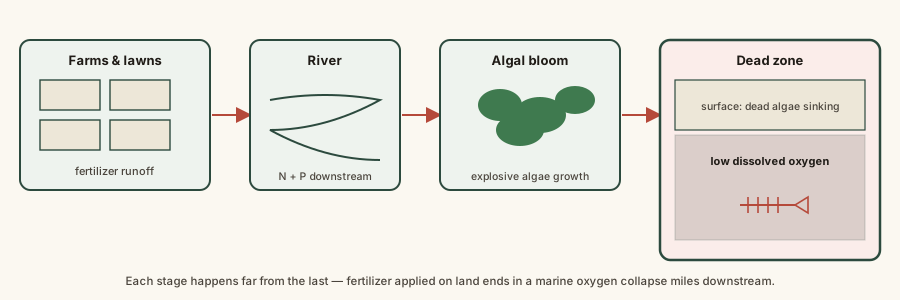
From nutrient runoff to a dead zone: the eutrophication chain
Each stage of this chain happens far from the last — the fertilizer is applied on land, the bloom forms on the water's surface, and the oxygen collapse happens in the water column below, often at the river's mouth or in a coastal zone many miles from any single farm.
Common mistakes
Common Mistakes
✕
Assuming water pollution is always traceable to one polluter.
→ Recognize that the largest-scale water pollution problems today (eutrophication, agricultural runoff) are typically nonpoint-source — diffused across many small contributors, not one identifiable party.
✕
Judging water quality by visible clarity alone.
→ Dissolved oxygen level, not clarity or color, is what actually determines whether a body of water can support fish and other aquatic life — clear water can still be a dead zone.
✕
Treating fertilizer runoff as a minor or purely local issue.
→ Nutrient runoff effects compound downstream across an entire watershed and can produce dead zones hundreds of miles from the original farms, as the Gulf of Mexico case shows.
Common misconception
“Water pollution mainly comes from factories illegally dumping waste into rivers.”
Illegal point-source dumping does happen and is seriously regulated, but the larger-scale, harder-to-fix water pollution problem today is legal, diffuse nonpoint-source runoff — fertilizer, pet waste, and road runoff from ordinary daily activity across an entire watershed, not a single dramatic dumping event.
Quick check
Why is nonpoint-source pollution generally harder to regulate than point-source pollution?
What to do next
What to do next
If you use lawn or garden fertilizer, follow the recommended application rate and avoid applying before heavy rain — excess fertilizer is exactly the kind of nonpoint-source contribution that adds up across a watershed.
Learn whether your local waterway has a nutrient-management or watershed-protection program, since nonpoint-source problems are addressed at that scale, not household by household.
When evaluating a body of water's health, look for dissolved oxygen and algal bloom reports rather than judging purely by visual clarity.
Support or participate in buffer-strip and stormwater-capture initiatives in your area — these are the standard tools for reducing nonpoint-source runoff before it reaches a waterway.
FAQ
FAQ
Related terms
Related terms
Point-source pollution
Water pollution traceable to a single identifiable discharge point, like a factory outfall pipe or a wastewater treatment plant, and directly regulated under permits in most countries.
Nonpoint-source pollution
Water pollution that enters waterways diffusely, carried by rain and snowmelt runoff across farms, lawns, streets, and construction sites rather than from one identifiable pipe.
Eutrophication
The process by which excess nutrients (mainly nitrogen and phosphorus) entering a body of water trigger explosive algae growth, which later dies, decomposes, and consumes the water's dissolved oxygen.
Hypoxic zone (dead zone)
An area of water with dissolved oxygen levels too low to support most marine life, typically caused downstream of major nutrient runoff after an algal bloom decomposes.
This entry was researched from public sources and drafted with AI-assisted tools, then edited — errors are still possible. Spot one, or want a topic covered? Read our disclaimer.
 KnowThis