 KnowThis
Key Takeaways
Key Takeaways
- 1Plastic in the ocean doesn't decompose biologically the way food waste does — sunlight causes photodegradation, breaking it into progressively smaller fragments that persist for decades to centuries rather than disappearing.
- 2The Great Pacific Garbage Patch is not a solid floating island of trash — it's a diffuse concentration of microplastic fragments and larger debris spread across a vast area, concentrated by a rotating ocean current system called a gyre.
- 3A large share of ocean plastic enters not from ocean-based sources but from land, carried down rivers and coastlines, meaning inland waste management directly affects ocean plastic levels.
The concept
Because photodegradation only fragments plastic rather than eliminating it, the total mass of plastic in a gyre doesn't meaningfully decrease on its own — it just gets distributed into smaller and smaller, harder-to-remove pieces over time.
If you flew over the Great Pacific Garbage Patch in an airplane, would you expect to see a visible island of floating trash?
Worked examples
Example 1: A plastic bottle's fate at sea (baseline case)
Example 2: A microbead entering the water pre-fragmented (edge case / variation)
Example 3: The North Pacific Subtropical Gyre (real-world / applied case)
How it works (visual)
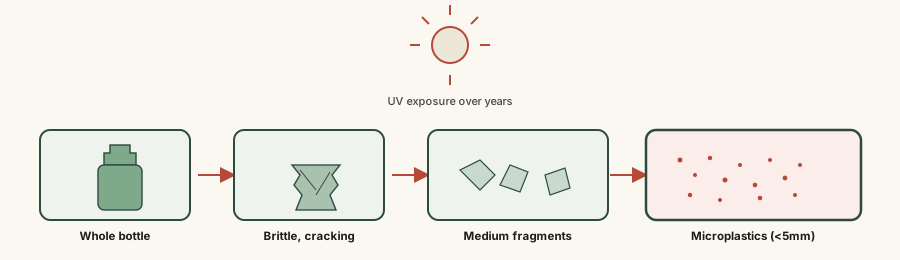
At every stage of this timeline the plastic is still present — it just becomes smaller and less visible, which is precisely why photodegradation is described as fragmentation rather than decomposition.
Common mistakes
Common Mistakes
Assuming plastic in the ocean eventually biodegrades away like organic waste.
→ Recognize that photodegradation fragments plastic into smaller pieces without eliminating the underlying material — the total plastic mass persists for decades to centuries.
Picturing the Great Pacific Garbage Patch as a visible floating trash island.
→ Understand it's mostly a diffuse concentration of microplastics and suspended fragments, detected by trawling the water column, not visible from a boat or satellite.
Assuming ocean plastic pollution is caused mainly by ships and ocean-based activity.
→ Most ocean plastic by mass is estimated to originate from land-based sources carried down rivers, making inland waste management directly relevant to ocean plastic levels.
Common misconception
“Once plastic reaches the ocean, sunlight and waves eventually break it down into harmless natural material, similar to how wood or food waste decomposes.”
Sunlight-driven photodegradation fragments plastic's polymer structure into smaller pieces, but it doesn't convert the material back into naturally occurring, harmless compounds the way biological decomposition does for organic matter. The plastic mass persists as microplastics for decades to centuries, simply becoming smaller and more pervasive rather than disappearing.
Why do manufactured plastic microbeads matter separately from photodegradation, even though both end up as small plastic particles?
What to do next
What to do next
- Reduce single-use plastic where practical, since a large share of ocean plastic traces back to land-based litter and waste management gaps, not ocean-based sources.
- Check personal care product labels for 'polyethylene' or 'polypropylene' microbeads if concerned about pre-fragmented microplastic sources, though many jurisdictions have already banned them.
- Support or participate in river and coastal cleanup efforts — since most ocean plastic arrives via rivers, upstream cleanup has an outsized effect compared to open-ocean collection.
- When encountering claims about ocean plastic 'biodegrading,' check whether the source means full biological decomposition or just physical fragmentation — they are not the same outcome.