Soil contamination happens when pollutants like heavy metals, petroleum byproducts, or pesticide residue accumulate in soil, and because soil doesn't disperse the way air or flowing water does, contamination tends to stay concentrated at its original location for decades unless actively removed or treated.
Reading time
— 4 min
Updated
— Aug 22, 2026
Fact-reviewed
— Aug 22, 2026
Key Takeaways
Key Takeaways
1Soil contamination behaves fundamentally differently from air or water pollution — soil doesn't disperse pollutants the way moving air or flowing water does, so contaminants tend to stay concentrated at their original location.
2Heavy metals (lead, arsenic, cadmium, mercury) are the most persistent soil contaminant category because they don't chemically break down over time — they only decrease in concentration through active removal or extremely slow natural leaching.
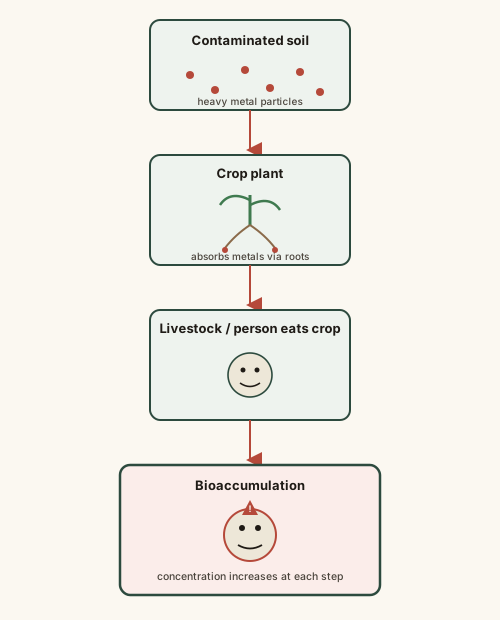
3Contaminated soil can enter the food chain even without visible signs, since plants grown in it absorb metals into their tissue, which is the main pathway for bioaccumulation up to humans.
The concept
Soil contamination happens when harmful substances — often heavy metal contamination like lead or arsenic, but also petroleum products and pesticide residue — build up in the ground, usually from past industrial activity, mining, or improper waste disposal. Unlike air pollution that disperses with wind, or water pollution that flows downstream, contaminated soil mostly stays exactly where it was contaminated, sometimes for decades, until someone actively cleans it up.
Because soil contamination stays localized rather than dispersing, its risk is highly site-specific — a contaminated lot next to a former factory can sit right beside completely clean soil a short distance away, unlike air pollution which tends to affect a whole region more uniformly.
Quick check
A factory that used lead-based processes closed 40 years ago. Is the soil beneath it likely to still be contaminated today, all else being equal?
Worked examples
Example 1: A former gas station site (baseline case)
A gas station closes after decades of operation. Underground fuel tanks had small, undetected leaks over the years, leaving petroleum hydrocarbons in the surrounding soil. Before the site can be redeveloped for another use, an environmental assessment and remediation (often removing and replacing the contaminated soil, or treating it in place) is required — a routine process for former fueling sites specifically because petroleum contamination doesn't disperse away on its own.
Example 2: Lead contamination near a former smelter (edge case / variation)
A residential neighborhood built near a former lead smelter shows elevated lead levels in garden soil decades after the smelter closed, even though there's no petroleum or organic contamination involved at all. Because lead is a heavy metal rather than an organic compound, this case requires a different remediation approach (often soil removal and replacement, or capping with clean soil) than the gas-station example — illustrating that "soil contamination" isn't one uniform problem with one uniform fix.
Example 3: A Superfund mining site (real-world / applied case)
A former mining operation left behind soil and waste piles with high concentrations of arsenic and cadmium, listed on the EPA's Superfund National Priorities List for cleanup. Decades after mining stopped, remediation crews still work through phases of soil removal, containment, and monitoring, because the metals present don't naturally decay — the site's timeline for cleanup is measured in years to decades of active work, not natural recovery over time.
How it works (visual)
Bioaccumulation pathway: contaminated soil to the human food chain
The concentration doesn't stay constant as it moves up this chain — it tends to increase at each step, which is the defining feature of bioaccumulation and why even soil concentrations that seem individually modest can pose a real risk further up the chain.
Common mistakes
Common Mistakes
✕
Assuming contaminated soil will clean itself up naturally given enough time.
→ Recognize that heavy metals in particular don't chemically degrade — active remediation, not time alone, is what reduces contamination levels.
✕
Assuming soil contamination only matters if the site 'looks' polluted.
→ Heavy metal and pesticide contamination is frequently invisible to the eye — it's identified through soil testing, not visual inspection.
✕
Treating all soil contamination as the same problem with the same fix.
→ Petroleum, heavy metals, and pesticide residue require different remediation approaches — there's no single universal soil cleanup method.
Common misconception
“If an old industrial site has been abandoned and undisturbed for decades, any contamination has likely faded away on its own by now.”
Heavy metal contamination specifically does not fade with time the way some organic pollutants can slowly break down — lead, arsenic, cadmium, and mercury persist in soil indefinitely without active remediation. Decades of abandonment alone provide no meaningful natural cleanup for a metals-contaminated site.
Quick check
Why is soil contamination often described as more 'localized' than air or water pollution?
What to do next
What to do next
If you're growing food in soil near an older building, industrial area, or busy roadway, consider a soil test for lead before planting edible crops directly in the ground.
When buying or redeveloping a property with a prior industrial or commercial history, check whether it's listed on an environmental contamination database before assuming the soil is clean.
Understand that 'the site looks fine now' is not evidence of clean soil — heavy metal and pesticide contamination require testing to detect, not visual inspection.
Support brownfield redevelopment programs in your area, since they specifically fund the remediation needed to safely reuse contaminated former industrial sites.
FAQ
FAQ
Related terms
Related terms
Heavy metal contamination
Soil pollution from metals like lead, arsenic, cadmium, or mercury, which don't break down over time and can persist in soil indefinitely unless physically removed or chemically treated.
Bioaccumulation
The buildup of a substance (often a heavy metal or persistent chemical) in a living organism faster than it can be excreted, increasing in concentration as it moves up the food chain.
Brownfield
A property where redevelopment or reuse is complicated by the presence, or potential presence, of a hazardous substance, pollutant, or contaminant from prior industrial or commercial use.
Remediation
The active process of removing, containing, or chemically treating contaminated soil or groundwater, as opposed to waiting for natural processes to disperse the pollutant.
A city street measures 70 dB, and a construction site nearby measures 90 dB. How much more sound energy does the construction site actually have, compared to the street?
This entry was researched from public sources and drafted with AI-assisted tools, then edited — errors are still possible. Spot one, or want a topic covered? Read our disclaimer.
 KnowThis