Modern industrial pollution regulation works primarily through permitting systems that set enforceable, facility-specific limits on emissions and discharges, backed by required monitoring, reporting, and legal penalties for exceeding those limits — a fundamentally different mechanism than an outright ban.
Reading time
— 4 min
Updated
— Aug 22, 2026
Fact-reviewed
— Aug 22, 2026
Key Takeaways
Key Takeaways
1Industrial pollution regulation works mainly through permitting, not outright bans — a facility gets a legally enforceable limit on what it may release, verified through required monitoring and reporting.
2Permit limits for new or modified facilities are often set using 'best available control technology' standards, which require the most effective feasible pollution control, not just any minimum threshold.
3US EPA data shows major reductions in key air pollutants since the Clean Air Act's passage in 1970, even as the economy and vehicle miles traveled grew substantially over the same period — direct evidence the permitting system has functioned as intended.
The concept
Industrial pollution regulation doesn't work by banning emissions entirely — it works through a discharge permit system. A specific factory or power plant gets a legal permit that sets exactly how much of a given pollutant it's allowed to release, and it has to measure and report its actual emissions to prove it's staying within that limit. Exceeding the limit triggers real legal consequences, from fines to required fixes.
Because the system is built around individual, monitored, enforceable permits rather than a blanket rule, regulators can tailor limits to what's actually achievable for a specific industry and facility type, while still being able to point to a specific violated number when enforcement is needed.
Quick check
A new factory wants to open near a residential area. Under a permit-based regulatory system, what determines whether and how it can legally operate?
Worked examples
Example 1: A power plant's air emissions permit (baseline case)
A coal-fired power plant holds a Clean Air Act permit setting specific limits on sulfur dioxide and nitrogen oxide emissions, based on the pollution-control equipment (like scrubbers) it's required to install. The plant must continuously monitor its stack emissions and report them to regulators — a direct, auditable link between the permit's numeric limit and the facility's actual measured output.
Example 2: A facility exceeding its permit limit (edge case / variation)
A factory's monitoring data shows it exceeded its permitted wastewater discharge limit for several months due to an equipment malfunction. Because the permit system requires ongoing self-reported monitoring data, the violation is identifiable and traceable to a specific facility and time period, triggering an enforcement action requiring corrective repairs and a fine — a very different outcome than would occur under a system without required monitoring and reporting.
Example 3: Nationwide air quality trends since 1970 (real-world / applied case)
Since the Clean Air Act's passage in 1970, US EPA data shows aggregate emissions of key criteria pollutants have fallen substantially nationwide, even as the US economy, population, and vehicle miles traveled all grew significantly over the same decades. This national-scale trend is the aggregate result of millions of individual facility permits and vehicle emission standards being enforced over time — a real-world demonstration that permit-based regulation can reduce pollution while the regulated economic activity continues to grow.
How it works (visual)
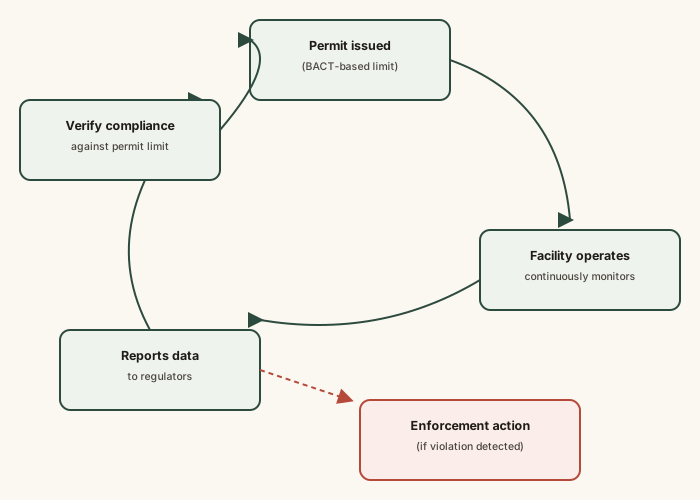
The industrial permit-and-enforcement cycle
The loop repeats continuously rather than being a one-time approval — a facility's permit compliance is an ongoing, monitored relationship, not a single certificate granted once and never revisited.
Common mistakes
Common Mistakes
✕
Assuming industrial pollution regulation means pollutants are banned outright.
→ Recognize the system is built on enforceable permit limits and monitoring, not blanket bans — facilities can legally emit specific, limited amounts under a valid permit.
✕
Assuming environmental regulation and economic growth are inherently opposed.
→ US EPA data shows key pollutant emissions have fallen substantially since 1970 even as GDP and vehicle miles traveled grew significantly — the two trends have coexisted, not traded off one-for-one.
✕
Assuming a permit limit is a fixed, one-time approval that never gets revisited.
→ Permits require ongoing monitoring and reporting, and can be revised, especially when a facility is modified or when technology standards (like BACT) advance.
Common misconception
“Environmental regulations like the Clean Air Act necessarily slow down or shrink industrial and economic activity.”
US EPA's own long-term air quality trend data shows aggregate emissions of key regulated pollutants falling substantially since 1970 while US GDP, population, and vehicle miles traveled all grew considerably over the same period — a documented case where pollution control and continued economic growth occurred together, not a strict trade-off between the two.
Quick check
What role does 'best available control technology' (BACT) play in setting a new facility's permit limits?
What to do next
What to do next
If curious about a specific facility's environmental record, check whether your country's environmental agency publishes permit and compliance data (in the US, EPA's ECHO database covers this).
When evaluating claims about industrial pollution trends, look for actual emissions data over time rather than assuming regulation automatically means either total prevention or no real effect.
Understand that 'best available control technology' standards can change as pollution-control technology improves, meaning permit requirements for new facilities can become stricter over time.
Recognize the difference between a permit violation (an enforceable, documented event) and general public concern about a facility, since regulatory action specifically requires the former.
FAQ
FAQ
Related terms
Related terms
Discharge permit
A legal authorization issued to a specific facility that sets enforceable limits on how much of a given pollutant it may release, and requires monitoring and reporting to verify compliance.
Best available control technology (BACT)
A regulatory standard requiring a facility to use the most effective pollution-control technology that is technically and economically feasible, used to set permit limits for new or modified industrial sources.
National Ambient Air Quality Standards (NAAQS)
US EPA-set limits on concentrations of key pollutants in outdoor air, used as the overall target that permitting and regulation for individual facilities is designed to collectively achieve.
Enforcement action
A legal or administrative response (fines, corrective orders, or in serious cases criminal charges) taken against a facility found to be violating its permit limits.
A city reports an AQI of 165, driven by ozone, on a hot summer afternoon. Does this mean the raw ozone concentration in the air is literally 165 micrograms per cubic meter?
This entry was researched from public sources and drafted with AI-assisted tools, then edited — errors are still possible. Spot one, or want a topic covered? Read our disclaimer.
 KnowThis