 KnowThis
Key Takeaways
Key Takeaways
- 1A protected area is a legal boundary with enforceable restrictions on specific activities — it's a regulatory designation, not just a scenic label.
- 2The IUCN ranks protected areas into seven management categories, from Ia (strict nature reserve, almost no human access) to VI (managed resource area, where regulated extraction like sustainable logging or fishing is still allowed).
- 3A designation on a map means nothing without enforcement — a "paper park" is legally protected but not actually defended against poaching, logging, or encroachment on the ground.
The concept
The practical question for any given protected area isn't just "is it protected" but "protected from what, and how strictly" — a category VI managed resource area and a category Ia strict reserve can sit right next to each other on a map and mean almost entirely different things on the ground.
A country announces a new national park covering 10,000 km² but provides no funding for rangers or enforcement. What's the most accurate description of this situation?
Worked examples
Example 1: Reading a protected area's category to understand what it actually restricts (baseline case)
Example 2: The same boundary, two different real restrictions depending on category (edge case / variation)
Example 3: A real-world paper park problem (real-world / applied case)
Why does the IUCN use seven different management categories instead of a single 'protected' vs. 'not protected' label?
How it works (visual)
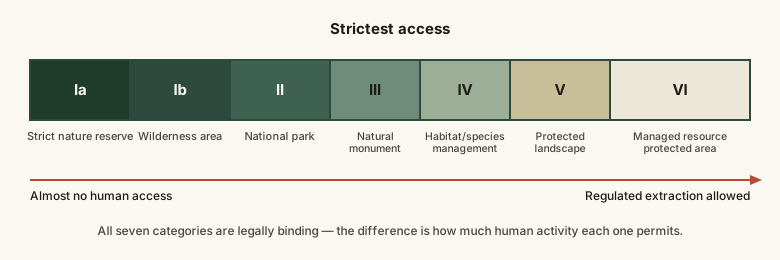
The spectrum runs from near-total exclusion of human activity on the left to regulated, sustainable resource use on the right — "protected" is a spectrum of permitted activity, not a single fixed rule.
Common mistakes
Common Mistakes
Assuming every protected area or national park bans all human presence and activity.
→ Check the specific IUCN category — categories IV, V, and especially VI explicitly permit regulated human activity like sustainable resource extraction or traditional land use.
Treating a legal designation as proof the area is actually being defended on the ground.
→ Look for evidence of enforcement capacity (ranger staffing, monitoring programs, funding) — a designation without enforcement is a "paper park" in practice.
Assuming a higher category number means "more protected" in a simple linear sense.
→ The categories describe different permitted uses, not a strict better-to-worse ranking — a well-enforced category VI area can protect biodiversity more effectively than a poorly enforced category Ia reserve.
Common misconception
“A national park is a single, universal type of protection that means the same thing everywhere in the world.”
National parks and other protected areas vary enormously in what they actually restrict, based on national law and IUCN category. Some ban virtually all human activity; others explicitly permit regulated logging, fishing, or traditional community use. The common thread is a legal boundary with some enforceable restriction — not a single universal rule about what's allowed inside it.
If a protected area's category permits regulated resource extraction (like category VI), does that make it a weaker or less legitimate form of conservation?
What to do next
What to do next
- Next time you visit or read about a national park, look up its IUCN management category to understand what's actually restricted there.
- When following conservation news, check for mentions of enforcement funding and ranger staffing, not just new designation announcements — that's the real signal of effective protection.
- Look up the Protected Planet database (protectedplanet.net) to see the real protected-area coverage of a country or region you're curious about.
- Remember that "protected" describes a spectrum of restriction, not a single fixed rule, when evaluating conservation claims.