 KnowThis
Key Takeaways
Key Takeaways
- 1Habitat loss — not hunting or pollution — is the leading driver of species decline worldwide, according to IUCN Red List threat assessments covering the majority of listed threatened species.
- 2Habitat fragmentation can be as damaging as outright habitat destruction, since it strands populations in patches too small or too isolated to remain viable even when some original habitat still exists.
- 3The dominant real-world cause of habitat loss is land conversion for agriculture, not urban sprawl — farming and grazing land use dwarfs the footprint of cities worldwide.
The concept
Understanding which specific pressure is driving habitat loss in a given place — agriculture, logging, urban sprawl, or infrastructure — matters because each has a different realistic solution.
Which of the following removes the most habitat by land area worldwide?
Worked examples
Example 1: A single species losing contiguous range (baseline case)
Example 2: Fragmentation without total loss (edge case / variation)
Example 3: A real-world reversal through habitat solution (real-world / applied case)
A grassland's total protected area stays the same over ten years, but new roads split it into four disconnected patches. Should conservationists consider this a win, a loss, or unchanged?
How it works (visual)
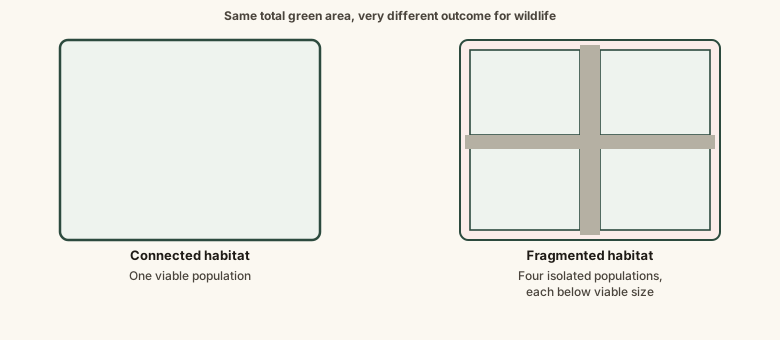
Both diagrams contain the same total area of habitat — the only difference is connectivity. This is the core reason habitat-loss statistics reported purely as "percent of area remaining" can understate real ecological damage.
Common mistakes
Common Mistakes
Assuming habitat loss is mainly caused by cities and suburban sprawl.
→ Recognize agriculture as the dominant global driver by land area — urban land use, while locally intense, is a much smaller share of total converted land worldwide.
Judging habitat health purely by total remaining area.
→ Check connectivity too — a fragmented landscape can fail wide-ranging species even when its total area looks adequate on a map.
Treating habitat loss as permanent and irreversible by default.
→ Recognize that reforestation, land-use policy change, and protected-area expansion have measurably reversed habitat loss in real cases, though recovery is slower than loss and doesn't restore identical original ecosystems.
Common misconception
“Species decline mostly happens because of hunting or poaching.”
For the majority of species assessed as threatened on the IUCN Red List, habitat loss and degradation is the most commonly cited threat, ahead of direct exploitation like hunting or fishing. Hunting and poaching are real, serious pressures for specific high-profile species, but habitat loss is the broader, more pervasive driver across the full range of threatened species worldwide.
What to do next
What to do next
- When reading about a species' conservation status, check whether habitat loss or fragmentation (not just hunting) is listed as its primary threat — it usually is.
- Look for whether protected-area or reforestation efforts in a region address connectivity between patches, not just total protected acreage.
- Support certified sustainable agriculture and forestry when purchasing food and wood products — agricultural land-use pressure is the largest single driver of habitat conversion.
- Read the wildlife-corridors and rewilding-projects entries in this cluster to see how fragmented habitat is actively being reconnected.