 KnowThis
Key Takeaways
Key Takeaways
- 1Deforestation is driven overwhelmingly by agricultural land conversion, not logging for wood products alone, according to global forest-monitoring data.
- 2Reforestation (replanting previously forested land) and afforestation (planting new forest where none recently existed) are distinct terms often used loosely as synonyms.
- 3A newly reforested area takes decades to approach the biodiversity, soil structure, and carbon storage of the old-growth forest it may have replaced — tree cover and forest ecosystem function are not the same thing.
The concept
Understanding this distinction between tree cover and full ecosystem function is essential for evaluating whether a reported reforestation success is restoring a real forest or simply a fast-growing plantation.
A company reports it has 'reforested' 10,000 hectares by planting a single fast-growing tree species as a monoculture plantation. Has it restored the original forest ecosystem?
Worked examples
Example 1: Tropical deforestation for agriculture (baseline case)
Example 2: A monoculture reforestation plantation (edge case / variation)
Example 3: A large-scale multi-decade restoration success (real-world / applied case)
Why did Costa Rica's reforestation success take decades rather than happening quickly?
How it works (visual)
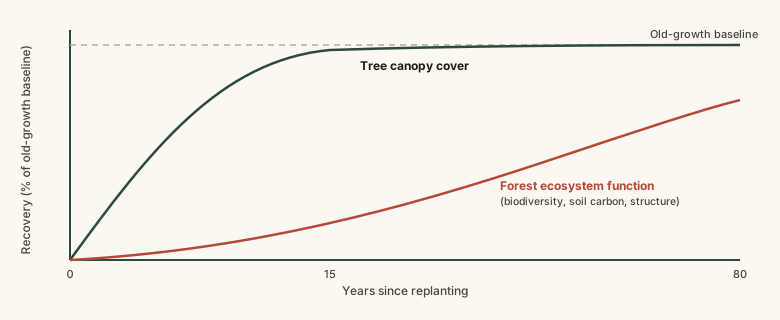
This gap between the two curves is why forest restoration timelines quoted in canopy-cover percentages alone can overstate how ecologically recovered a reforested area actually is.
Common mistakes
Common Mistakes
Treating 'reforestation' and 'afforestation' as interchangeable terms.
→ Remember reforestation replants previously forested land, while afforestation plants forest where none recently existed — the latter can sometimes disrupt a different native ecosystem like grassland if planned carelessly.
Assuming restored tree cover means the original forest ecosystem has been restored.
→ Check whether biodiversity and ecosystem-function data (not just canopy-cover percentage) is reported — a monoculture plantation can restore visible tree cover far faster than genuine forest ecosystem complexity.
Assuming deforestation is driven mainly by logging for timber and paper.
→ Recognize that agricultural expansion (cattle grazing, palm oil, soy) is the dominant documented driver of tropical deforestation globally, according to FAO and Global Forest Watch data.
Common misconception
“Planting a large number of trees is functionally equivalent to restoring a forest.”
Tree-planting restores visible canopy cover relatively quickly, but forest ecosystem function — biodiversity, soil carbon accumulation, structural complexity built over decades of undisturbed growth — recovers far more slowly, and a monoculture plantation may never fully replicate it. Reforestation is a genuine and valuable conservation tool, but "trees planted" and "forest restored" are meaningfully different claims.
What to do next
What to do next
- When evaluating a reforestation claim or program, look for whether it reports species diversity, not just number of trees planted or canopy-cover percentage.
- Support forest restoration efforts that use mixed native species rather than single fast-growing monocultures where the goal is genuine ecosystem recovery.
- Check the sourcing of agricultural products (beef, palm oil, soy) linked to deforestation-risk supply chains if you want to reduce demand-side pressure.
- Read the habitat-loss-and-solutions entry in this cluster for how deforestation fits into the broader habitat-loss picture.