 KnowThis
Key Takeaways
Key Takeaways
- 1Marine protected areas exist on a spectrum from lightly regulated multi-use zones to strict no-take reserves — the protection level, not the MPA label itself, determines conservation outcomes.
- 2Well-enforced no-take zones have documented, measurable increases in fish biomass and size compared to unprotected or lightly protected waters nearby.
- 3The 'spillover effect' — fish migrating out of a well-protected reserve into surrounding waters — means strict no-take zones can benefit nearby fisheries, not just the protected area itself.
The concept
Because protection levels vary so widely, evaluating any specific MPA requires looking past the label to the actual restrictions and enforcement in place.
A country announces that 30% of its ocean territory is now a 'marine protected area.' What's the most important follow-up question to ask?
Worked examples
Example 1: A well-enforced no-take reserve (baseline case)
Example 2: A "paper park" with weak enforcement (edge case / variation)
Example 3: Spillover benefiting a local fishery (real-world / applied case)
How can a strict no-take marine reserve actually help nearby fishing communities, rather than just taking away fishing grounds?
How it works (visual)
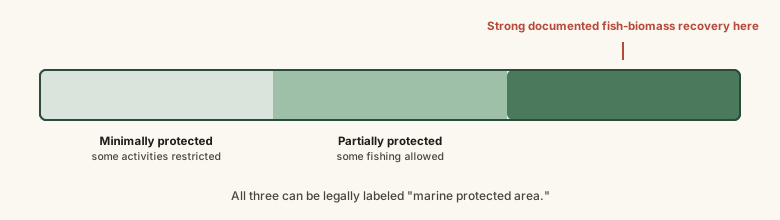
Two MPAs can occupy the same map area and carry the same legal label while sitting at opposite ends of this spectrum — which is why the specific restrictions matter more than the MPA designation itself.
Common mistakes
Common Mistakes
Assuming all areas labeled 'marine protected area' have the same level of protection.
→ Check the specific restriction level — MPA covers everything from lightly restricted multi-use zones to strict no-take reserves, and outcomes differ enormously between them.
Judging MPA success purely by legal designation rather than enforcement.
→ Look for evidence of active patrol and enforcement, since a 'paper park' without enforcement often shows little real ecological difference from unprotected waters.
Assuming no-take zones only take away value from local fishing communities.
→ Consider the spillover effect — well-enforced no-take zones have documented cases of improving catch in adjacent fished waters as populations recover and migrate outward.
Common misconception
“A high percentage of a country's waters being 'marine protected' means its oceans are well conserved.”
Because MPA is a broad category spanning weak to strict protection, a high percentage figure can include large areas with minimal real restrictions or enforcement. Conservation scientists increasingly emphasize the percentage of waters under strict, well-enforced no-take protection specifically, since that is the category most reliably linked to measurable ecological recovery.
What to do next
What to do next
- When you read that a percentage of ocean is 'protected,' look for the breakdown by protection level, not just the total figure.
- Look up whether MPAs near you or a place you're visiting have active enforcement/patrol programs, not just legal designation.
- Support organizations that fund MPA enforcement and monitoring, not just designation campaigns.
- Read the protected-area entry in this cluster for how the same 'protection level matters more than the label' principle applies to land-based reserves too.