 KnowThis
Key Takeaways
Key Takeaways
- 1A wildlife corridor is a connective strip of habitat linking two or more larger patches, letting animals move between them rather than being stranded in an isolated fragment.
- 2Corridors primarily solve two problems caused by habitat fragmentation: genetic isolation (small isolated populations losing genetic diversity through inbreeding) and blocked seasonal migration routes.
- 3Corridors range enormously in scale, from a small underpass letting animals safely cross a highway to continent-spanning conservation initiatives connecting protected areas across national borders.
The concept
Corridor design isn't one-size-fits-all — the right width, vegetation, and crossing structure depend heavily on which species the corridor is meant to serve.
Why does connecting two small, isolated wildlife populations with a corridor help more than just protecting each patch separately?
Worked examples
Example 1: A highway wildlife overpass (baseline case)
Example 2: A corridor too narrow or exposed for its target species (edge case / variation)
Example 3: A continental-scale corridor initiative (real-world / applied case)
A conservation group builds a very narrow, open (uncovered) strip of land to connect two forest patches for a large predator-wary mammal species. What is the most likely outcome?
How it works (visual)
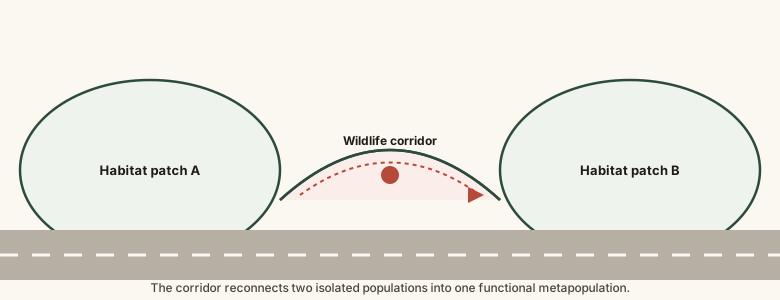
The corridor doesn't need to match the size of either patch — its job is simply to make safe crossing possible, restoring the functional connection between two otherwise isolated populations.
Common mistakes
Common Mistakes
Assuming any strip of green space between two habitat patches functions as an effective corridor.
→ Recognize corridor effectiveness depends on width, vegetation cover, and design matched to the specific target species' behavior — a corridor unsuitable for the species it's meant to serve won't be used.
Thinking corridors only matter for large, charismatic mammals.
→ Understand connectivity benefits a wide range of taxa, including amphibians, insects, and even some plant species whose seeds rely on animal movement for dispersal.
Believing protecting isolated patches is just as good as connecting them.
→ Recognize that isolated small populations face genetic and demographic risks that connectivity specifically mitigates, which is why modern conservation planning increasingly prioritizes connectivity alongside raw protected area.
Common misconception
“Wildlife corridors are mainly a 'nice to have' feature, not essential conservation infrastructure.”
Connectivity between habitat patches directly affects a population's genetic health and its resilience to local disasters — a fragmented, isolated population faces measurably higher extinction risk than an equivalent-sized but connected metapopulation. Conservation science increasingly treats corridors as core infrastructure, not an optional add-on to protected areas.
What to do next
What to do next
- Look into whether your region has wildlife crossing infrastructure planned or built along major highways — many transportation agencies publish this data.
- When evaluating a conservation project, ask whether it addresses habitat connectivity, not just total protected area.
- Support organizations working on cross-border or cross-jurisdiction corridor initiatives, since wide-ranging species often need connectivity spanning multiple land-management authorities.
- Read the habitat-loss-and-solutions and rewilding-projects entries in this cluster to see how fragmentation and corridors interact.