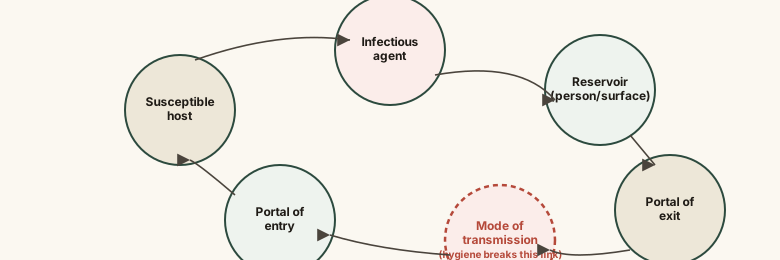
Infection prevention isn't a vague notion of 'cleanliness' — epidemiologists describe it as breaking the chain of infection, a six-link sequence (infectious agent, reservoir, portal of exit, mode of transmission, portal of entry, susceptible host) that must all be intact for disease to spread, and most everyday hygiene habits work by disrupting the transmission link specifically.
Reading time
— 4 min
Updated
— Aug 21, 2026
Fact-reviewed
— Aug 21, 2026
This entry is general health information, not medical advice. It explains the public-health framework behind hygiene habits. For symptoms of an active infection, consult a doctor.
Key Takeaways
Key Takeaways
1Public health describes infection spread as a six-link chain — infectious agent, reservoir, portal of exit, mode of transmission, portal of entry, susceptible host — and every link must be intact for an infection to spread.
2Breaking any single link stops transmission — you don't need to eliminate the germ itself to prevent infection, which is why hygiene habits focus on disrupting transmission and entry points rather than trying to sterilize the environment.
3Most everyday personal hygiene habits (handwashing, covering coughs, not touching your face) specifically target the 'mode of transmission' and 'portal of entry' links, which is why they're effective even against germs we can't see or identify.
The concept
For any infection to spread from one person to another, six things have to happen in sequence: a germ has to exist, it needs a place to live and multiply (like a person's respiratory tract), it needs a way to leave that place (like a cough), a way to travel to a new person (like airborne droplets), a way to enter that new person's body (like their nose or mouth), and that person has to actually be able to get sick from it. This is called the chain of infection. Break any one link, and the infection can't spread — which is exactly what hygiene habits are designed to do.
This framework is useful precisely because you don't need to know exactly what germ you're dealing with to protect yourself — breaking a link in the chain works regardless of which specific pathogen is involved.
Quick check
Someone argues that handwashing is 'useless' against a specific virus because it doesn't kill the virus directly on contact. What's the flaw in this reasoning?
Worked examples
Example 1: Tracing the full chain for a common cold (baseline case)
Infectious agent: rhinovirus. Reservoir: an infected person's respiratory tract. Portal of exit: their nose/mouth during a sneeze. Mode of transmission: airborne droplets or a contaminated surface. Portal of entry: a new person's nose, eyes, or mouth. Susceptible host: anyone without existing immunity to that specific virus strain. All six links being intact is what allows the cold to spread from one person to the next.
Example 2: The same chain, with one link deliberately broken (edge case / variation)
Same scenario, but the exposed person washes their hands thoroughly before touching their face after contact with a contaminated surface. The infectious agent, reservoir, portal of exit, and mode of transmission all still occurred exactly as before — but the germ is physically removed from the hand before it reaches the portal of entry (eyes, nose, mouth), breaking the chain at that specific point. The infection doesn't spread, not because the virus was destroyed everywhere, but because one link failed to connect.
Example 3: Hospital infection control protocols (real-world / applied case)
Hospitals formalize chain-of-infection thinking into layered protocols: hand hygiene stations at every room entry (transmission link), isolation rooms for contagious patients (reservoir/portal-of-exit link), personal protective equipment like masks and gloves for staff (portal-of-entry link for staff, transmission-link for patients), and vaccination requirements for healthcare workers (susceptible-host link). No single measure is assumed to be sufficient — CDC infection control guidance for healthcare settings explicitly layers interventions across multiple links simultaneously, since a real environment has too many possible transmission routes to rely on breaking just one.
Quick check
Why do hospitals use multiple infection-control measures at once (hand hygiene, isolation, PPE, vaccination) rather than relying on just one?
How it works (visual)
The six-link chain of infection
Public health interventions are essentially a menu of options for which link to break — hygiene targets transmission and entry, isolation targets the reservoir and exit, and vaccination targets host susceptibility, all valid ways to stop the same circular chain.
Common mistakes
Common Mistakes
✕
Assuming a hygiene measure is useless because it doesn't 'kill' the germ.
→ Remember that physically removing or blocking a pathogen breaks the chain just as effectively as destroying it — the goal is interrupting any one link.
✕
Relying on a single hygiene habit and assuming it covers all transmission routes.
→ Layer measures that target different links (handwashing for contact transmission, covering coughs for airborne transmission) rather than relying on one alone.
✕
Thinking infection prevention requires eliminating all germs from an environment.
→ Focus on breaking specific links in the chain for the transmission routes that actually matter in a given situation, rather than pursuing impossible total sterilization.
Common misconception
“Hygiene habits only matter if they physically destroy germs on contact.”
The chain-of-infection model shows that breaking any one of six links stops transmission — destroying the pathogen is only one way to do that. Physically removing a pathogen (handwashing), blocking its exit (covering a cough), blocking its entry (a barrier like a bandage over a cut), or making the host non-susceptible (vaccination) are all equally valid ways to interrupt the chain, which is why such a wide range of hygiene habits are all genuinely effective.
What to do next
What to do next
Wash hands regularly to break the transmission link for contact-spread germs.
Cover coughs and sneezes to break the portal-of-exit link for airborne-spread germs.
Keep cuts and wounds covered to block a portal of entry for germs on skin.
Stay current on recommended vaccinations, which work by reducing host susceptibility rather than blocking transmission.
FAQ
FAQ
Related terms
Related terms
Chain of infection
The six-link sequence — infectious agent, reservoir, portal of exit, mode of transmission, portal of entry, susceptible host — that must all be present and intact for an infection to spread from one host to another.
Reservoir
The place where an infectious agent normally lives and multiplies, such as a person, animal, or contaminated surface, before it exits and spreads.
Two people sleep the same total number of hours, but one wakes up in the middle of a deep-sleep stage due to an alarm, while the other wakes up naturally near a cycle boundary. What does sleep-cycle science suggest about how each might feel?
This entry was researched from public sources and drafted with AI-assisted tools, then edited — errors are still possible. Spot one, or want a topic covered? Read our disclaimer.
 KnowThis