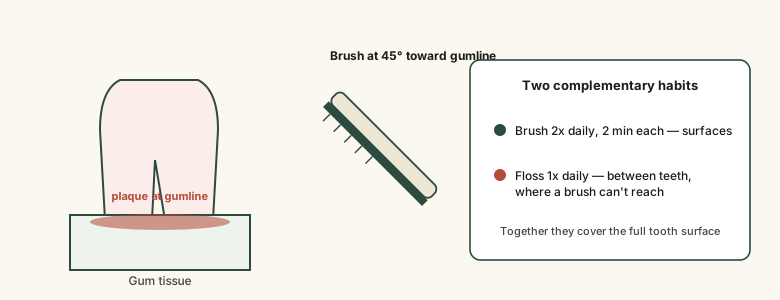
Oral hygiene works by mechanically disrupting plaque — a sticky biofilm of bacteria that forms continuously on teeth — before it hardens into tartar or produces the acid that causes cavities and gum disease; brushing and flossing are complementary because a brush reaches tooth surfaces while only floss reaches between teeth.
Reading time
— 4 min
Updated
— Aug 21, 2026
Fact-reviewed
— Aug 21, 2026
This entry is general health information, not medical or dental advice. For tooth pain, bleeding gums, or any specific dental concern, see a dentist or dental hygienist.
Key Takeaways
Key Takeaways
1Plaque forms continuously on teeth — it's a living biofilm of bacteria, not just leftover food, and it needs to be mechanically disrupted regularly before it mineralizes into tartar.
2Brushing and flossing are complementary, not redundant — a toothbrush cleans the flat and outer/inner tooth surfaces, but only floss reaches the tight contact points between teeth where a brush's bristles can't fit.
3The American Dental Association recommends brushing twice daily for two minutes with fluoride toothpaste and flossing once daily — the two-minute duration matters because it's roughly the time needed to cover all tooth surfaces at a proper angle.
The concept
Bacteria in your mouth constantly form a sticky film called plaque on your teeth, feeding on sugars and starches from food and producing acid as a byproduct. That acid is what wears down tooth enamel and causes cavities. Brushing physically scrubs plaque off the flat surfaces of your teeth, while flossing reaches the narrow gaps between teeth that a brush's bristles simply can't fit into — which is why dentists recommend both, not either one alone.
The core idea is timing: plaque is soft and easily removed for roughly the first day, then progressively harder to remove as it mineralizes — so the value of daily brushing and flossing is about staying ahead of that clock, not just general cleanliness.
Quick check
Someone brushes thoroughly twice a day but never flosses. What's the main gap in their oral hygiene routine?
Worked examples
Example 1: A standard daily routine (baseline case)
Brushing for two minutes, twice a day, at a 45-degree angle toward the gumline, followed by flossing once a day, mechanically disrupts plaque across essentially all tooth surfaces before it has time to mineralize into tartar — the routine recommended by the ADA and echoed by CDC oral health guidance.
Example 2: Brushing without flossing over several weeks (edge case / variation)
Even with perfect twice-daily brushing, the contact points between teeth accumulate undisturbed plaque week after week. Over time, this localized, untouched plaque is disproportionately linked to cavities between teeth and to gum inflammation right at those contact points — a pattern dentists specifically look for as a sign of a flossing gap, distinct from the more evenly distributed wear seen with inconsistent brushing.
Example 3: Skipping oral hygiene during an illness or travel (real-world / applied case)
A few days of skipped or rushed brushing (common during illness, travel, or a disrupted routine) gives plaque enough of a head start to begin mineralizing in spots, particularly along the gumline. This is exactly why dentists note that a short lapse is recoverable with a return to a normal routine, but a habitually short or skipped routine compounds into visible tartar buildup that requires a professional cleaning to remove, since tartar itself can no longer be brushed away.
Quick check
Why does a dentist emphasize consistency (daily habit) over occasional thorough cleaning for oral hygiene?
How it works (visual)
Brushing angle and the brushing + flossing division of labor
The 45-degree angle isn't arbitrary — it's the angle that lets bristles slip slightly under the gumline, the specific spot where plaque accumulation is most strongly linked to gum disease, rather than just brushing the flat, easy-to-reach tooth surfaces.
Common mistakes
Common Mistakes
✕
Brushing without flossing, assuming brushing alone covers all tooth surfaces.
→ Floss once daily — it's the only routine tool that reaches the tight contact points between teeth.
✕
Brushing too briefly to cover all surfaces at the recommended angle.
→ Brush for the full two minutes, angling bristles toward the gumline, not just scrubbing the flat chewing surfaces.
✕
Assuming a missed day or two of brushing has no lasting effect.
→ Return to routine as soon as possible — plaque left undisturbed for 24-72 hours can begin mineralizing into tartar, which home brushing can no longer remove.
Common misconception
“Flossing is optional if you already brush thoroughly twice a day.”
Brushing and flossing clean different, non-overlapping tooth surfaces. A toothbrush's bristles physically cannot fit into the tight contact points between teeth — no amount of brushing thoroughness changes that geometric limitation. Only floss (or similar interdental tools) reaches those spots, which is why dental associations recommend both as complementary, not redundant, habits.
What to do next
What to do next
Brush twice daily for two minutes with fluoride toothpaste, angling bristles toward the gumline.
Floss once daily to clean the contact points between teeth that a toothbrush can't reach.
Don't let a missed day become a habit — plaque begins mineralizing into un-brushable tartar within 24-72 hours.
See a dentist for regular checkups and professional cleaning, which is the only way to remove tartar once it's formed.
FAQ
FAQ
Related terms
Related terms
Plaque
A sticky, continuously-forming biofilm of bacteria on tooth surfaces that produces acid from sugars and starches, the primary driver of cavities and gum disease if not regularly disrupted.
Tartar (dental calculus)
Plaque that has hardened onto teeth through mineralization, which can no longer be removed by brushing or flossing and requires professional dental cleaning.
Someone argues that handwashing is 'useless' against a specific virus because it doesn't kill the virus directly on contact. What's the flaw in this reasoning?
This entry was researched from public sources and drafted with AI-assisted tools, then edited — errors are still possible. Spot one, or want a topic covered? Read our disclaimer.
 KnowThis