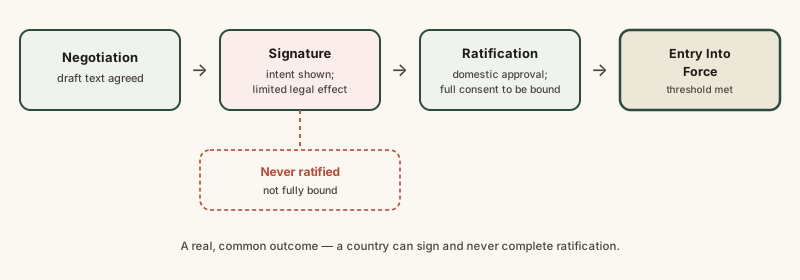
An international treaty typically moves through negotiation, signature, and ratification — with signature signaling a country's intent to be bound but ratification, usually requiring separate domestic legislative approval, being the step that actually creates a binding legal obligation under international law.
Reading time
— 4 min
Updated
— Aug 21, 2026
Fact-reviewed
— Aug 21, 2026
Key Takeaways
Key Takeaways
1A treaty typically moves through three distinct stages — negotiation, signature, and ratification — and only the last one actually creates a binding legal obligation under international law.
2Signing a treaty signals intent and commits a country not to actively undermine its purpose, but a country can sign a treaty and never ratify it, in which case it's never fully bound.
3Most treaties require a minimum number of ratifying countries before they legally 'enter into force,' meaning even a fully ratified treaty may sit dormant until enough other countries catch up.
The concept
Making a treaty isn't a single event — it's a process. Diplomats first negotiate the actual text, then their representatives sign it to show they agree with what was negotiated. But signing alone usually doesn't make a country legally bound. Each country then has to separately go through ratification — typically its own legislature formally approving the treaty — before that country is actually obligated to follow it.
The gap between signature and ratification is exactly where a lot of public confusion about treaties comes from — a country "signing" a major agreement is genuine news, but it isn't the same as that country being legally bound yet.
Quick check
If a country's diplomat signs a treaty, is that country immediately legally bound by all of its terms?
Worked examples
Example 1: The standard treaty lifecycle (baseline case)
Countries negotiate a treaty text over one or more formal conference sessions, reach agreement on final wording, and their representatives sign it. Each signing country then submits the treaty through its own domestic approval process — a legislative vote, in many systems — and upon approval, formally deposits an instrument of ratification with the treaty's designated depositary (often a specific country or the UN). Once the treaty's stated minimum-ratification threshold is met, it enters into force for those countries that have ratified by that point.
Example 2: A country that signs but never ratifies (edge case / variation)
It's a real and fairly common occurrence for a country to sign a treaty — showing political support for its goals — and then never complete ratification, whether due to a change in government, insufficient legislative support, or shifting priorities. That country is not bound by the treaty's substantive obligations, only by the narrower Vienna Convention duty not to actively defeat its purpose. This is why treaty signature counts and ratification counts are reported as separate figures in official treaty status tables.
Example 3: A treaty that takes years to enter into force (real-world / applied case)
Some treaties set a high ratification threshold relative to how quickly countries actually ratify, meaning years can pass between a treaty being finalized and it legally entering into force for anyone. During that gap, the treaty text exists and countries may have signed it, but no one is yet legally bound by its substantive terms — illustrating why "a treaty was agreed" and "a treaty is in force" can be separated by a significant amount of real time.
Quick check
Why do many treaties require a minimum number of ratifying countries before entering into force, rather than binding each country as soon as it individually ratifies?
How it works (visual)
From negotiation to entry into force
The dotted branch matters as much as the main path — a real share of signed treaties never complete ratification for at least some signatories, which is why treaty status tables always report signatures and ratifications as separate counts.
Common mistakes
Common Mistakes
✕
Treating a country 'signing' a treaty as equivalent to that country being fully legally bound.
→ Check whether the country has also ratified — signature alone typically creates only a narrow duty, not full binding obligation.
✕
Assuming a treaty is in force worldwide the moment it's finalized.
→ Check the treaty's stated entry-into-force threshold and how many countries have ratified — a treaty can be finalized for years before it legally takes effect.
✕
Assuming ratification always requires the same process across every country.
→ Domestic ratification procedures vary by country's own constitutional system — some require legislative supermajorities, others simpler executive approval.
Common misconception
“Once a country signs an international treaty, it's automatically and immediately bound by everything in it.”
Signature and ratification are legally distinct steps for most modern treaties. Signature shows intent and creates a narrower duty not to undermine the treaty's purpose, but the country isn't fully bound by the treaty's substantive obligations until it separately completes ratification — a process that can be delayed indefinitely or never completed at all.
Quick check
Can a country attach a reservation when ratifying a treaty to modify how one specific clause applies to it?
What to do next
What to do next
Next time a country is reported to have 'signed' a major treaty, check separately whether it has also ratified before assuming it's bound.
Look up a treaty's entry-into-force clause (the UN Treaty Collection publishes these) to see its specific ratification threshold.
Check whether a treaty your own country has joined carries any reservations — these are usually published alongside the ratification record.
Read the short, readable Vienna Convention on the Law of Treaties for the actual rules behind this whole process, straight from the primary source.
FAQ
FAQ
Related terms
Related terms
Signature
A negotiator's initial act of signing a treaty text, signaling a country's intent to be bound and committing it not to undermine the treaty's purpose — but generally not yet creating a full binding obligation.
Ratification
The formal domestic act, usually requiring legislative approval, by which a country confirms its consent to be legally bound by a treaty it has already signed.
Entry into force
The point at which a treaty becomes legally binding on its parties, often requiring a minimum number of countries to have ratified it first, as specified in the treaty's own text.
Reservation
A formal declaration by which a country ratifying a treaty excludes or modifies how a specific provision applies to it, allowed unless the treaty itself prohibits reservations.
Why do many treaties require a minimum number of ratifying countries before entering into force, rather than binding each country as soon as it individually ratifies?
This entry was researched from public sources and drafted with AI-assisted tools, then edited — errors are still possible. Spot one, or want a topic covered? Read our disclaimer.
 KnowThis