The Nobel Prizes are six separate annual awards — Physics, Chemistry, Physiology or Medicine, Literature, Peace, and the related Economic Sciences prize — each administered by a different Swedish or Norwegian institution, selected through a confidential nomination process that runs roughly a year before the prize is announced.
Reading time
— 4 min
Updated
— Sep 25, 2026
Fact-reviewed
— Aug 21, 2026
Key Takeaways
Key Takeaways
1There are six Nobel Prize categories — Physics, Chemistry, Physiology or Medicine, Literature, Peace, and Economic Sciences — each run by a separate institution, not one single unified body.
2Nominations are never open to the public — only specifically invited nominators, such as previous laureates and qualified academics, can submit a candidate.
3The Economic Sciences prize, formally the Sveriges Riksbank Prize, was created in 1968 and isn't one of the five original prizes named in Alfred Nobel's 1895 will, though it's awarded alongside them using a similar process.
The concept
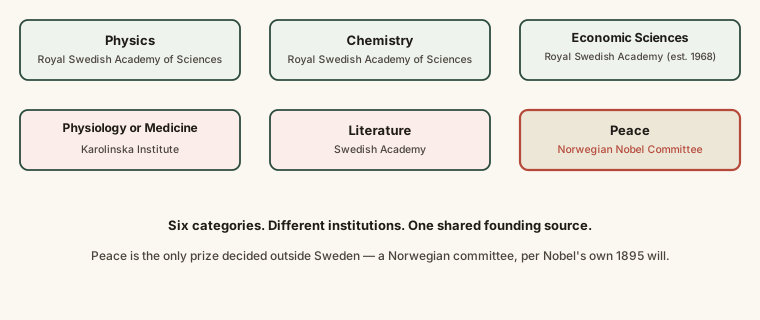
The Nobel Prize is actually six separate prizes, each judged by its own group of experts. Physics, Chemistry, and Economic Sciences are decided by the Royal Swedish Academy of Sciences; Physiology or Medicine by the Karolinska Institute; Literature by the Swedish Academy; and Peace, uniquely, by a Norwegian committee rather than a Swedish one. Every year, a Nobel Committee for each category reviews confidential nominations and recommends a winner to that category's awarding institution.
The part of the process most people never see is exactly how selective and confidential the nomination stage is — winning a Nobel Prize starts with being nominated by someone specifically invited to do so, not by applying.
Quick check
Can a member of the public nominate someone for a Nobel Prize by submitting a name to the Nobel Committee?
Worked examples
Example 1: The Physics Prize selection process (baseline case)
Each September, the Nobel Committee for Physics sends confidential nomination invitations to thousands of physicists and past laureates worldwide. Nominations close the following January. Through the spring and summer, the committee consults outside experts and narrows the field, and by early October it recommends a laureate (or up to three sharing the prize) to the Royal Swedish Academy of Sciences, which formally approves and announces the winner — completing a process that spans roughly a full year from initial invitation to final announcement.
Example 2: Why the Peace Prize is decided differently (edge case / variation)
Unlike the other five prizes, the Peace Prize is selected entirely by the Norwegian Nobel Committee, appointed by Norway's parliament, rather than by a Swedish scientific or literary academy. This is a structural exception written into Nobel's original 1895 will itself, not a later change — meaning the Peace Prize has always followed a genuinely separate institutional path from the Physics, Chemistry, Medicine, and Literature prizes, even though all six are announced during the same annual Nobel season.
Example 3: A prize shared by multiple laureates (real-world / applied case)
Nobel Prize rules allow a single prize to be shared by up to three people, reflecting cases where a discovery or body of work involved multiple key contributors. When this happens, the prize's monetary award is split among the laureates (evenly, or as the awarding institution decides), while each laureate still receives full recognition as a Nobel laureate — showing that "winning a Nobel Prize" doesn't require having been the single, sole contributor to the honored work.
Quick check
Is the Nobel Prize in Economic Sciences one of the original prizes named in Alfred Nobel's 1895 will?
How it works (visual)
The six Nobel Prizes and their awarding institutions
Laid out this way, the "one Nobel Prize" mental model breaks down visibly — it's six separate award processes that happen to share a name, a founding source of funds, and an annual announcement season.
Common mistakes
Common Mistakes
✕
Assuming a single Nobel Committee decides all six prize categories.
→ Remember each category has its own committee and awarding institution — Physics, Chemistry, Medicine, Literature, Peace, and Economics are all decided separately.
✕
Believing the public can nominate candidates directly.
→ Only specifically invited nominators (past laureates, qualified academics, and similar invited groups) can submit nominations — there's no public nomination route.
✕
Treating the Economic Sciences prize as identical in origin to the original five prizes.
→ It's a later 1968 addition by Sweden's central bank, not one of Nobel's original 1895 will categories, even though it follows a similar selection process.
Common misconception
“Nobel Prize winners are chosen through an open, public voting or application process.”
The process is deliberately confidential at every stage — nominations come only from specifically invited nominators, committee deliberations aren't published in real time, and even historical nomination records stay sealed for 50 years under the Nobel institutions' own confidentiality rule. There is no public voting or open application involved at any point.
Quick check
How long does the Nobel institutions' confidentiality rule keep nomination records sealed before any public disclosure?
What to do next
What to do next
Next time a Nobel Prize is announced, check which institution awarded it — the answer tells you a lot about how that specific prize's process works.
Look up which of the six categories a country's past laureates have won in, on the Nobel Prize's own official site, to see real category-by-category patterns.
Remember that 'shared' Nobel Prizes (up to three laureates) are common, not an exception — check whether a prize you're reading about was shared.
If you're curious about historical selection debates, the Nobel institutions publish nomination archives for years more than 50 years in the past.
FAQ
FAQ
Related terms
Related terms
Nobel Committee
One of several bodies (a different one for each prize category) responsible for evaluating nominations and recommending that category's laureate to the awarding institution.
Nomination
A formal proposal of a candidate for a Nobel Prize, submitted only by individuals specifically invited to nominate (such as previous laureates or qualified academics), never through open public submission.
Sveriges Riksbank Prize
The formal name of the Economic Sciences prize, established in 1968 by Sweden's central bank in memory of Alfred Nobel — not one of the five original prizes named in Nobel's 1895 will, though administered alongside them.
50-year confidentiality rule
The Nobel institutions' practice of keeping nomination and evaluation records sealed for 50 years before any public disclosure, protecting the confidentiality of the selection process.
This entry was researched from public sources and drafted with AI-assisted tools, then edited — errors are still possible. Spot one, or want a topic covered? Read our disclaimer.
 KnowThis