 KnowThis
Key Takeaways
Key Takeaways
- 1The Human Development Index (HDI) combines three separate dimensions — life expectancy, education, and gross national income per capita — into a single number between 0 and 1.
- 2Each dimension is first normalized against a fixed minimum and maximum before combining, so a country's raw life-expectancy figure and raw income figure can be fairly compared on the same 0-to-1 scale.
- 3The UNDP has used a geometric mean (not a simple average) to combine HDI's dimensions since 2010, specifically because it penalizes a country that's very weak in one dimension more than an arithmetic average would.
The concept
Because HDI is a genuine formula and not a subjective vote, it's possible to reconstruct roughly how a country's score was built from its three underlying dimension scores, which is exactly what the worked examples below do.
A news article says 'Country X ranks 45th on a global happiness index.' What does knowing the index is a composite index tell you about that ranking?
Worked examples
Example 1: Averaging three normalized dimension scores (baseline case)
Example 2: Why the geometric mean matters more when scores are uneven (edge case / variation)
Example 3: Normalizing a raw life-expectancy figure (real-world / applied case)
Why does the HDI normalize each dimension to a 0-to-1 scale before combining them, instead of just averaging the raw numbers (years of life expectancy, dollars of income, years of schooling) directly?
How it works (visual)
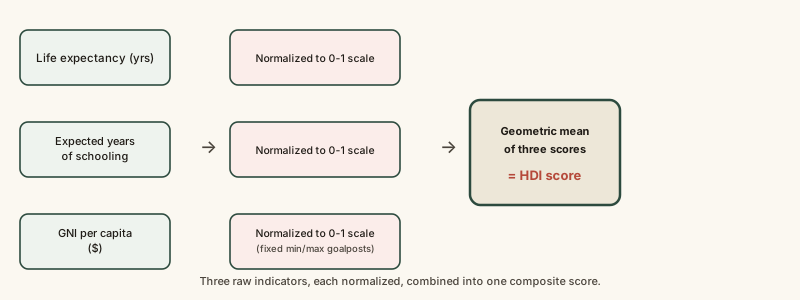
Every stage in this pipeline is a defined, published step — nothing about it is a subjective vote or a survey opinion, which is exactly why HDI comparisons across countries and across years are considered methodologically consistent.
Common mistakes
Common Mistakes
Treating a composite index score as a single, direct physical measurement rather than the output of a multi-step formula.
→ Remember the number is built from several normalized dimensions combined by a defined method — check what's actually inside the index before over-interpreting a small year-over-year change.
Assuming all country-ranking indices use the same combining method (simple average) as each other.
→ Check the specific index's own technical methodology — HDI uses a geometric mean, but many other well-known indices genuinely do use simple weighted averages instead.
Comparing a country's raw life expectancy or raw income directly against another country's HDI-normalized score, as if they were the same kind of number.
→ Only compare like with like — a raw statistic and a normalized 0-to-1 dimension score inside an index are not interchangeable.
Common misconception
“A country's HDI (or any composite ranking) drops mainly because the country actually got 'worse' in some absolute sense.”
A country's HDI can shift even without much changing internally, if the UNDP revises its normalization goalposts, updates its underlying data sources, or if other countries' scores shift the relative ranking. The HDI number itself is a fairly stable reflection of underlying conditions, but ranking position among all countries is relative — a country can hold steady in absolute terms and still fall in rank if others rise faster.
Two different global indices rank the same country very differently — 15th on one, 60th on another. Does this mean one of the indices must be wrong?
Try it yourself
This calculator uses a simplified arithmetic average for illustration — the real HDI uses a geometric mean, which (per Example 2 above) produces a lower score whenever the three inputs are uneven.
What to do next
What to do next
- Next time you see a country ranking in the news, look up which specific dimensions the index actually measures before drawing conclusions from the rank alone.
- Check whether the index combines its dimensions with a simple average or a geometric mean — it changes how much a single weak dimension drags down the overall score.
- Compare a country's score across a few consecutive years, not just its single-year rank, since rank position shifts with every other country's movement too.
- When two indices disagree sharply on a country, look up what each one is actually measuring before assuming either is wrong.