 KnowThis
Key Takeaways
Key Takeaways
- 1A democracy's structural core isn't voting alone — it's splitting government power across three separated branches (legislative, executive, judicial) so no single branch can act unchecked.
- 2Each branch holds specific tools to limit the other two — this is what 'checks and balances' actually refers to, not just a slogan about fairness.
- 3The exact shape of these branches varies by country (a president versus a prime minister, for example), but the separation-of-powers structure underneath is close to universal among functioning democracies.
The concept
Understanding this structure matters less as trivia and more as a diagnostic tool — when a country's democracy is under strain, it's almost always visible first as one branch trying to remove or ignore the checks the other two hold over it.
A country holds regular elections, but the elected leader can dismiss judges at will and rule by decree without legislative approval. Is this a functioning separation-of-powers democracy?
Worked examples
Example 1: A law passes despite a veto (baseline case)
Example 2: A court strikes down a law (edge case / variation)
Example 3: Confirmation power as a slow-acting check (real-world / applied case)
Why does judicial review (a court striking down an already-passed, already-signed law) matter as a check, if the law already went through the legislature and the executive?
How it works (visual)
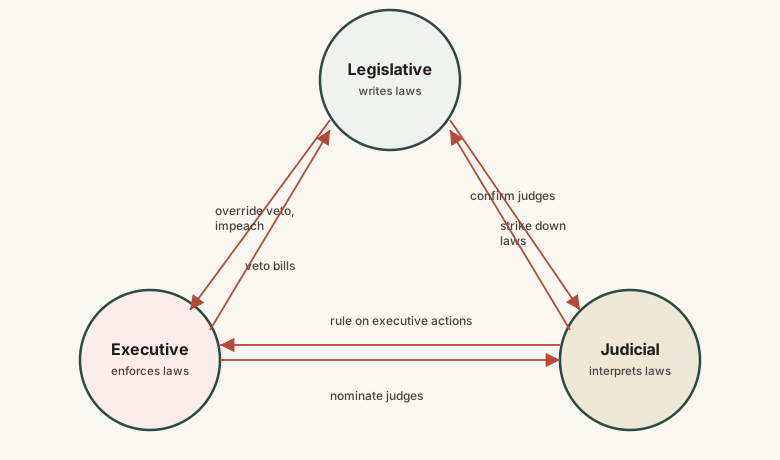
Each side of the triangle represents a real, named power one branch holds over another — not a vague notion of "balance," but specific, exercisable tools like veto override, judicial review, and confirmation votes. Removing any one arrow from this diagram is functionally what a slide toward authoritarianism looks like from the inside.
Common mistakes
Common Mistakes
Assuming holding regular elections alone is sufficient proof a country is a functioning democracy.
→ Check whether the branches remain genuinely independent after the election — can the judiciary rule against the executive, can the legislature block executive action, without the executive being able to simply remove or ignore them?
Treating 'separation of powers' and 'checks and balances' as interchangeable terms for the same idea.
→ Separation of powers is the structural split into three branches; checks and balances are the specific tools (veto, override, judicial review, confirmation) that make that split enforceable rather than just decorative.
Assuming every democracy uses the US presidential model with a directly-elected head of state.
→ Remember parliamentary systems (UK, Germany, India, Japan, and most democracies globally) fuse the executive more closely with the legislature — the head of government is a member of and answerable to parliament, not separately elected.
Common misconception
“A president or prime minister is 'in charge' of the government the way a CEO is in charge of a company.”
In a functioning separation-of-powers democracy, the executive is one of three co-equal branches, not a hierarchical top. The executive can be blocked by the legislature, overruled by the courts, and in many systems removed from office by either. The design goal is explicitly to prevent any single office, including the highest one, from operating like an unchecked chief executive.
A head of government wants to expand their own term limits. In a genuine separation-of-powers democracy, can they simply decide this unilaterally?
What to do next
What to do next
- When evaluating any country's democratic health, look past the existence of elections and check whether the judiciary and legislature can meaningfully act against the executive.
- Learn whether your own country uses a presidential or parliamentary structure — it changes how directly the executive and legislative branches are separated.
- Next time you read about a court striking down a law, notice which branch originally passed it — that's judicial review checking the legislative-executive combination in action.
- Watch for attempts to weaken confirmation processes or remove judges outside normal procedure — these are early warning signs of a branch losing its independence.