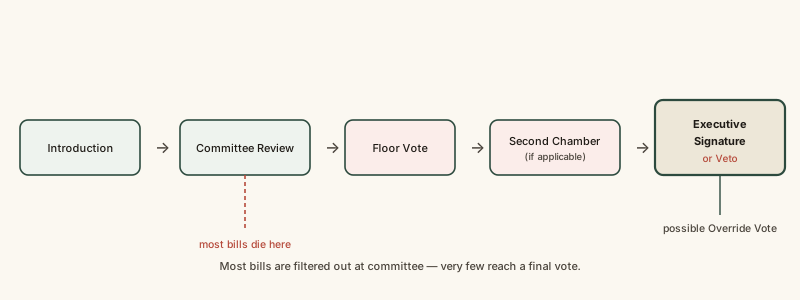
In most legislative systems, a bill moves through introduction, committee review, floor debate and amendment, a vote (often in more than one chamber), and finally executive approval — with committee review acting as the main filter where the overwhelming majority of proposed bills quietly die.
Reading time
— 4 min
Updated
— Aug 21, 2026
Fact-reviewed
— Aug 21, 2026
Key Takeaways
Key Takeaways
1A bill moves through several distinct stages — introduction, committee review, floor debate, a vote, and often executive approval — and can be rejected or simply die at any stage along the way.
2Committee review is the real filter in most systems: the large majority of introduced bills never make it out of committee to a full floor vote at all.
3Even after both a legislature passes a bill and an executive signs it, the process described here is a general model — the specific chambers, committee structures, and veto rules vary meaningfully between countries.
The concept
A bill starts as a written proposal introduced by a lawmaker. It then usually goes to a smaller committee that studies it, holds hearings, and can revise or simply shelve it. If it survives committee, the full legislative chamber debates it, sometimes amends it, and takes a vote. If it passes there — and in a two-chamber system, in the other chamber too — it typically goes to the head of the executive branch, who can sign it into law or reject it.
The single most common misunderstanding about lawmaking is picturing it as a straight line from proposal to law — in practice it's closer to a filter with several narrow points where a bill can quietly stop moving forward.
Quick check
If a lawmaker introduces a bill, does it automatically receive a vote by the full legislative chamber?
Worked examples
Example 1: A bill that clears every stage (baseline case)
A lawmaker introduces a bill, which is referred to the relevant subject-matter committee. The committee holds hearings, makes amendments, and votes to advance it. The full chamber debates and passes it. In a two-chamber system, the other chamber does the same (often after reconciling any differences between the two chambers' versions). The executive then signs the reconciled bill, and it becomes law — a process that, even when everything proceeds smoothly, commonly takes months.
Example 2: A bill that dies in committee (edge case / variation)
A bill is introduced and referred to committee, but the committee chair never schedules it for a hearing or a vote — often because it lacks sufficient support, conflicts with other priorities, or the chair simply doesn't advance it. The bill effectively dies without any recorded vote at all, and typically must be reintroduced from scratch in a future legislative session if a lawmaker still wants to pursue it — illustrating that "no vote" is itself one of the most common outcomes for an introduced bill.
Example 3: A vetoed bill and an override attempt (real-world / applied case)
A bill passes both legislative chambers and reaches the executive, who vetoes it. The legislature can attempt an override vote, which in many systems requires a supermajority (commonly two-thirds) in both chambers — a much higher bar than the simple majority that originally passed the bill. Override attempts frequently fail even when the original passage was comfortable, since gathering a supermajority is a materially harder threshold than a simple majority.
Quick check
If an executive vetoes a bill, can the legislature ever still make it law without the executive's signature?
How it works (visual)
From introduction to law: where bills actually stop
The width of the "dies here" branch after committee review isn't decorative — it reflects that committee review, not the floor vote or executive veto, is where most bills actually stop moving forward.
Common mistakes
Common Mistakes
✕
Assuming every introduced bill gets a floor vote or public debate.
→ Remember committee review filters out most bills before they ever reach the full chamber — no vote at all is a common, unremarkable outcome.
✕
Treating a legislative veto override as just as easy as the original vote.
→ Check the override threshold — it's typically a supermajority, a meaningfully higher bar than the simple majority that passed the bill originally.
✕
Assuming this exact process is identical in every country.
→ Treat this as a general model — the number of chambers, committee structures, and veto/override rules vary by country's own constitutional system.
Common misconception
“Any bill that a majority of the public supports will eventually become law if enough people want it.”
Public support alone doesn't move a bill through the legislative process — a bill still has to be introduced by a lawmaker, survive committee review, pass floor votes (in one or both chambers, depending on the system), and often clear an executive signature or veto override. A bill can have broad public support and still die in committee if it never receives a hearing or vote there.
Quick check
Is committee review mainly a formality that nearly all bills pass through quickly on their way to a floor vote?
What to do next
What to do next
Next time you hear about a bill 'introduced' in the news, remember that's the very first of several stages, not a sign it will become law.
Check whether a bill you're following has cleared committee — that single fact tells you more about its real chances than the initial introduction did.
Look up your own country's legislature's official site, which typically tracks each bill's exact current stage in real time.
If a bill is vetoed, check the override threshold required in your country's system before assuming the veto is either final or easily reversed.
FAQ
FAQ
Related terms
Related terms
Bill
A formal, written proposal for a new law or a change to an existing law, introduced into a legislature for consideration.
Committee review
The stage where a smaller group of legislators examines, debates, and often revises a bill in detail before it can reach the full chamber — the point at which most bills are never advanced further.
Floor vote
A vote by the full membership of a legislative chamber on whether to pass a bill, typically following committee review and any floor debate or amendments.
Veto
The power of an executive (such as a president or governor) to reject a bill passed by the legislature, which in many systems the legislature can override with a sufficiently large vote.
This entry was researched from public sources and drafted with AI-assisted tools, then edited — errors are still possible. Spot one, or want a topic covered? Read our disclaimer.
 KnowThis