 KnowThis
Key Takeaways
Key Takeaways
- 1"Sanctions" is an umbrella term covering several structurally different tools — trade restrictions, financial/asset freezes, travel bans, and arms embargoes — not one single mechanism.
- 2Sanctions can be imposed unilaterally by a single country or multilaterally through a body like the UN Security Council, and the two have very different legal weight and global reach.
- 3Sanctions are a policy tool positioned deliberately between diplomacy and military force — designed to impose real cost without direct armed conflict.
The concept
Because sanctions operate through the ordinary machinery of banking, trade, and travel systems rather than direct confrontation, their actual effect depends heavily on how many other countries participate — a sanction observed only by the country that imposed it has a very different real-world impact than one observed by most of the global financial system.
A single country imposes sanctions on another country entirely on its own, without UN Security Council involvement. Are these sanctions legally binding on every other country in the world?
Worked examples
Example 1: A targeted asset freeze (baseline case)
Example 2: Multilateral vs. unilateral reach (edge case / variation)
Example 3: Targeted vs. comprehensive sanctions design (real-world / applied case)
Why did sanctions policy shift toward more narrowly 'targeted' sanctions after the 1990s?
How it works (visual)
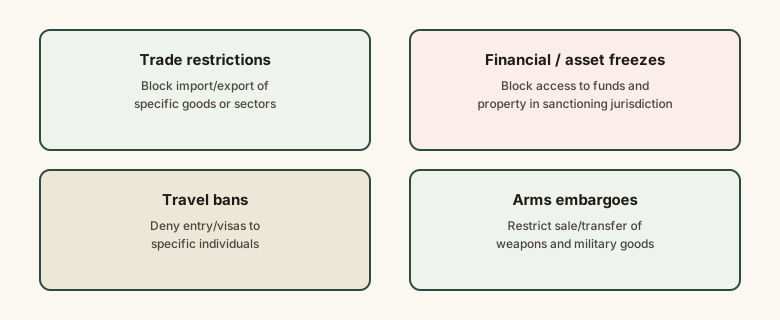
A real sanctions package often combines several of these tools at once — for example, pairing an asset freeze with a travel ban on the same targeted individuals, or layering a trade restriction on top of a broader arms embargo — rather than relying on a single mechanism.
Common mistakes
Common Mistakes
Treating 'sanctions' as one single, uniform action rather than an umbrella term for several distinct tools.
→ Check specifically which type of sanction is being discussed — trade, financial, travel, or arms — since each operates through a different mechanism with different real-world effects.
Assuming any country's unilateral sanctions carry the same global legal force as a UN Security Council resolution.
→ Check whether the sanction is unilateral (one country) or multilateral (UN Security Council or a coordinated coalition) — the legal reach differs enormously.
Assuming sanctions always target an entire country's population rather than specific individuals or entities.
→ Check whether the sanctions regime is described as 'targeted' (aimed at specific people/entities) or 'comprehensive' (aimed broadly at a national economy) — modern sanctions design increasingly favors the former.
Common misconception
“Sanctions are purely symbolic gestures with no real, enforceable effect.”
Sanctions operate through concrete, legally enforceable mechanisms within the sanctioning jurisdiction — a bank in a sanctioning country can face serious legal penalties for processing a transaction for a sanctioned entity, and an asset freeze genuinely blocks access to real funds. Their global impact does depend on how many countries participate, but within the enforcing jurisdiction, sanctions carry real legal teeth, not just symbolic weight.
Does the real-world effectiveness of a sanction depend mainly on how strongly worded the sanctions announcement is?
What to do next
What to do next
- Next time sanctions appear in the news, identify which specific type (trade, financial, travel, arms) is being described.
- Check whether a sanctions story involves unilateral action by one country or a multilateral action through the UN Security Council or a coordinated coalition.
- Look up whether a described sanction is 'targeted' at specific individuals/entities or 'comprehensive' against a broader economy.
- Read the UN Security Council's own sanctions page (linked in sources) to see real, current examples of multilateral sanctions regimes.