 KnowThis
Key Takeaways
Key Takeaways
- 1A central bank is a country's monetary authority — it doesn't serve individual customers the way a commercial bank does, and most people can't open a personal account there.
- 2Central banks primarily influence the economy by setting a benchmark interest rate, which ripples outward into borrowing costs for mortgages, business loans, and savings accounts throughout the wider economy.
- 3Many central banks operate with a specific degree of independence from the elected government, a structural design intended to keep short-term political pressure from overriding longer-term monetary stability goals.
The concept
Because a central bank's interest rate decisions ripple through savings accounts, mortgages, and business loans across an entire economy, small changes to the benchmark rate are closely watched — the compounding effect of interest rates on savings or debt over time is exactly the kind of calculation a central bank's rate decisions ultimately feed into.
If someone wants to open a personal checking account, should they go to their country's central bank?
Worked examples
Example 1: Raising rates to fight inflation (baseline case)
Example 2: A currency union's shared central bank (edge case / variation)
Example 3: Lender of last resort during a crisis (real-world / applied case)
Why might a currency union like the eurozone's shared central bank face a harder policy challenge than a single-country central bank?
How it works (visual)
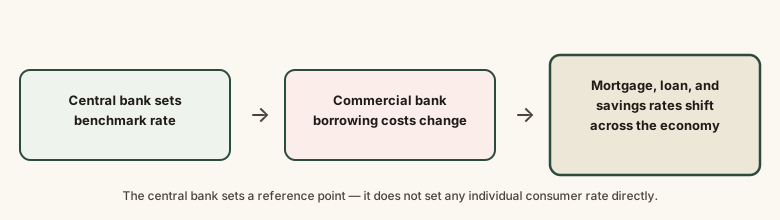
A central bank doesn't directly set the interest rate on any individual person's mortgage or savings account — it sets a benchmark rate that commercial banks use as a reference point, and that reference then ripples outward into the specific rates offered to consumers and businesses.
Common mistakes
Common Mistakes
Assuming a central bank offers the same retail services (checking accounts, personal loans) as a commercial bank.
→ Remember a central bank is a monetary policy institution, not a retail bank — ordinary personal banking happens at commercial banks.
Assuming every country has its own separate central bank with no exceptions.
→ Check for currency unions like the eurozone, where multiple countries share a single central bank rather than each maintaining its own.
Assuming central bank interest rate decisions are made directly by the elected head of government.
→ Look up the specific institutional structure — most modern central banks make rate decisions through a dedicated policy committee with some formal independence from direct political control.
Common misconception
“Raising interest rates and printing more money are unrelated tools a central bank might use interchangeably.”
These are related but distinct levers within a central bank's broader toolkit for managing the money supply and credit conditions — adjusting the benchmark interest rate is the primary, most routinely used tool, while more dramatic tools (like large-scale asset purchases, sometimes informally called "printing money") are typically reserved for periods when interest rates alone aren't providing enough stimulus, such as when rates are already near zero. They aren't interchangeable substitutes for each other in normal circumstances.
Try it yourself
This is a simplified illustration of compounding, not a forecast — real savings and loan rates respond to a central bank's benchmark rate indirectly, through the commercial banks and financial products that actually set the rate a saver or borrower sees.
What to do next
What to do next
- Look up your own country's central bank and its stated mandate (inflation target, employment goal, or both).
- Next time you hear about an interest rate decision in the news, trace how it's expected to affect mortgages, savings, or business borrowing.
- Check whether your country shares a central bank with other countries (a currency union) or has its own.
- Notice how central bank independence is discussed in reporting — it's a real, structural design choice, not just a figure of speech.