 KnowThis
Key Takeaways
Key Takeaways
- 1There is no single official global definition of "developing" versus "developed" — different institutions (the World Bank, the UN) use different real methodologies.
- 2The World Bank classifies countries mainly by Gross National Income (GNI) per capita, sorted into income bands, while the UN's Human Development Index combines income with life expectancy and education into one multi-dimensional score.
- 3The UN separately maintains a specific "Least Developed Countries" category, with its own distinct criteria and real practical consequences like eligibility for certain trade preferences and aid.
The concept
Because "developing" and "developed" aren't strictly defined terms with one universal threshold, precise policy or research contexts increasingly favor the more specific, methodologically transparent classifications — income bands, HDI tiers, or the LDC category — over the general shorthand.
Is there one single, universally agreed international definition that determines whether a country counts as 'developing' or 'developed'?
Worked examples
Example 1: World Bank income classification (baseline case)
Example 2: A country ranking differently across systems (edge case / variation)
Example 3: LDC status and real trade consequences (real-world / applied case)
Why might a country rank differently in the World Bank's income classification versus the UN's Human Development Index?
How it works (visual)
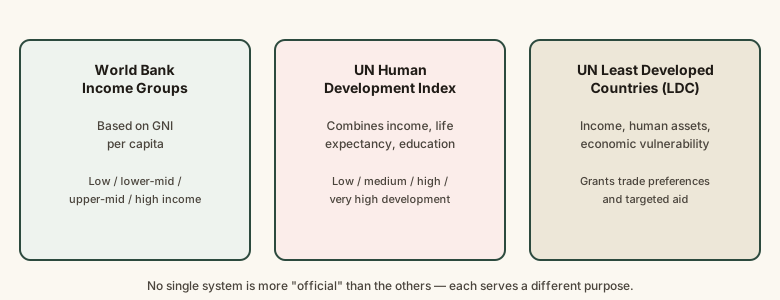
None of these three systems is more "official" than the others in an absolute sense — each serves a different specific purpose, from broad economic comparison (income groups) to holistic wellbeing measurement (HDI) to targeted international support eligibility (LDC status).
Common mistakes
Common Mistakes
Assuming 'developing' and 'developed' are precisely defined terms with one universal threshold.
→ Check which specific system (World Bank income group, UN HDI tier, LDC status) a source is actually referencing, since they use different criteria.
Assuming a country's classification is permanent once assigned.
→ Remember these classifications are recalculated periodically (the World Bank updates income thresholds annually) and countries can and do move between categories over time.
Treating the HDI as a pure income ranking.
→ Remember HDI deliberately combines income with life expectancy and education into one composite score — it's not simply a reordering of GNI per capita.
Common misconception
“The United Nations maintains one single official 'developing vs. developed' list that every country agency and news source draws from.”
The UN itself uses multiple distinct frameworks for different purposes — the Human Development Index for holistic development ranking, and a separately defined Least Developed Countries category for targeted international support eligibility — neither of which is a simple binary "developing/developed" list. The World Bank, meanwhile, has moved away from that binary language entirely in favor of its own income-group system. There is genuinely no single master list.
Try it yourself
This is a simplified illustrative average of three sub-indices for teaching purposes — the UN's actual published HDI uses a specific geometric-mean calculation and its own defined normalization method for each underlying indicator, so real HDI figures should be sourced directly from the UNDP, not recalculated with this simplified tool.
What to do next
What to do next
- Next time you see a country described as 'developing,' check which specific classification system (if any) the source is actually citing.
- Look up your own country's current World Bank income group and UN HDI tier, and notice whether they tell a consistent or different story.
- Check the UN's current list of Least Developed Countries and what specific support measures that designation provides.
- Notice when a source uses the binary 'developing vs. developed' language versus a more specific classification — the latter is generally more precise.