How Interest Rate Changes Actually Affect Investments
Interest rate changes affect investments through one mechanism: the rate used to value future cash. When market rates rise, existing fixed-rate bonds fall in price because new bonds pay more, and the fall is larger the longer the bond's duration. A 10-year bond paying 3% loses about 8% of its price if comparable rates rise to 4%, while a 2-year bond loses about 2%. Savings accounts and money market funds start paying more fairly quickly. Stocks are affected because higher rates make far-off profits worth less today and raise companies' borrowing costs, which tends to hit companies whose profits are furthest in the future hardest. Markets price expected changes in advance, so the surprise matters more than the announcement. The Federal Reserve sets a target for short-term rates, while longer-term rates are set by the bond market.
Reading time
— 5 min
Updated
— Oct 8, 2026
Fact-reviewed
— Oct 8, 2026
This entry explains how interest rates affect investment prices, cited to the Federal Reserve, the SEC's Investor.gov, FINRA and the US Treasury. It is financial literacy, not personal investment advice, and nothing here recommends any security or predicts future rates. Examples are simplified illustrations; past market behavior does not guarantee future results. For decisions about your own money, talk to a licensed financial adviser.
Key Takeaways
Key Takeaways
1Rates are the price of waiting for money. When they rise, any cash you're due in the future is worth less today, so investments that pay you later fall in price.
2Bonds show it most clearly: a 3% bond with 10 years left loses about 8% of its price if similar bonds start paying 4%. A 2-year bond loses about 2%. Longer means more sensitive.
3Savings yields rise fairly quickly, stocks react through valuations and borrowing costs, and markets move on surprises, not on decisions they already expected.
The concept
Imagine you lent a friend $1,000 and they promised $30 a year for 10 years, then your $1,000 back. A week later, banks start offering $40 a year for the same deal. If you wanted to sell your IOU to someone else, nobody would pay the full $1,000 for $30 a year when $40 is on offer. You'd have to knock the price down until the deal looked as good as the new one. That's exactly what happens to bonds when interest rates rise: their prices fall. The longer the IOU has left to run, the bigger the discount, because the buyer is stuck with the lower payment for longer. The same idea spreads to everything else. Your savings account starts paying more. Stocks get pushed around too, because a company's value is really a long string of future profits, and higher rates make far-off profits worth less in today's money. When rates fall, all of this runs in reverse.
That's why the classic idea that bonds offset stocks is a tendency, not a law. It holds best when stocks fall because of a growth scare, and fails when both fall because rates jump. Understanding the mechanism is what makes diversification realistic rather than magical.
Quick check
Why does a bond's price fall when interest rates rise?
Worked examples
The bonds and numbers below are hypothetical, using standard present-value arithmetic with annual payments. They are illustrations, not forecasts or real securities.
Example 1: One bond, one rate rise (baseline case)
A $1,000 bond with 10 years left pays a 3% coupon, $30 a year. Comparable bonds now yield 4%. Its price is the present value of ten $30 payments plus the $1,000 repayment, discounted at 4%: about $918.89, an 8.1% fall. A buyer paying $918.89 earns $30 a year plus a $81 gain at maturity, which works out to the 4% market rate. If rates had instead fallen to 2%, the same bond would be worth about $1,089.83. The bond didn't change. The alternative did.
Example 2: Same rise, different maturities (edge case)
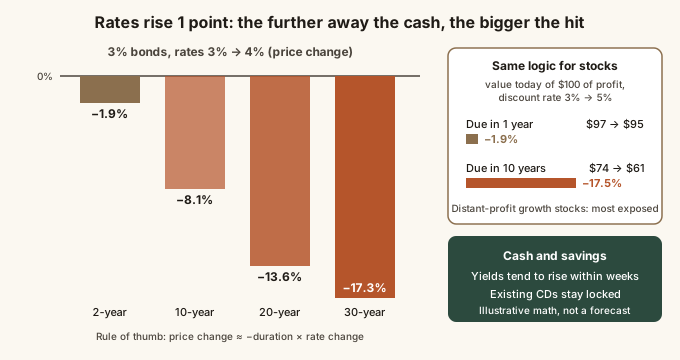
Run the same 1-point rise, 3% to 4%, on 3% bonds of different lengths. A 2-year bond falls to about $981 (−1.9%). A 10-year falls 8.1%. A 20-year falls to about $864 (−13.6%), and a 30-year to about $827 (−17.3%). That spread is duration at work. For a bond fund, the rule of thumb is the fund's stated duration: one with a duration of 6 would be expected to lose roughly 6% on a 1-point rise. It also earns higher yields as it reinvests, which over time offsets part of the price drop.
Example 3: Stocks and savings (applied)
Discounting works the same way for stock valuations. $100 of profit expected next year is worth about $97.09 today at 3% and $95.24 at 5%, a 1.9% difference. $100 expected in 10 years is worth $74.41 at 3% but only $61.39 at 5%, a 17.5% difference. A company whose value depends mainly on profits a decade out is much more exposed to rising rates than one earning steady profits now. Meanwhile, cash benefits: a high-yield savings account or money market fund usually raises its rate within weeks of a Fed increase, though by how much varies by provider. A certificate of deposit opened before the rise stays locked at its old rate until it matures.
Quick check
Rates rise 1 point. Which holding is likely to fall most in price?
How it works (visual)
What a 1-point rate rise does to different investments
Common mistakes
Common Mistakes
✕
Treating bonds as risk-free because they're 'safe'.
→ High-quality bonds have low default risk, but their prices still carry interest rate risk. Check a bond fund's duration to gauge it.
✕
Trading on the Fed announcement itself.
→ Expected moves are already in prices. What moves markets is a surprise or a change in the expected path.
✕
Assuming the Fed sets mortgage and long-term rates.
→ The Fed sets a short-term target. Long rates come from the bond market and can move in the opposite direction.
✕
Panic-selling a bond held to maturity after rates rise.
→ If the issuer doesn't default, you still receive the scheduled payments and face value. Understand the trade-off before selling at a loss.
Common misconception
“When the Fed raises rates, the stock market always goes down.”
Higher rates are a headwind for valuations, but stocks respond to the surprise relative to expectations and to what the rate move says about the economy. Markets have risen during some hiking cycles and fallen in others. The reliable relationship is the one for fixed-rate bonds: when their yields rise, their prices fall.
What to do next
What to do next
Look up the duration of any bond fund you hold; it's usually listed on the fund's fact sheet.
Check the Fed's current federal funds target range on federalreserve.gov rather than relying on headlines.
Compare current Treasury yields across maturities on the Treasury's daily yield curve page.
Check what your savings account or money market fund currently pays, and compare it with the market.
Read Investor.gov's explanation of interest rate risk before buying long-term bonds.
For how rate changes should affect your own portfolio, talk to a licensed financial adviser.
FAQ
FAQ
Related terms
Related terms
Federal funds rate
The interest rate banks charge each other for overnight loans of reserves. The Federal Reserve sets a target range for it, which anchors other short-term rates.
Yield
The return an investor earns on a bond at its current price, expressed as an annual percentage. When a bond's price falls, its yield rises.
Coupon
The fixed interest payment a bond makes, set when the bond is issued and stated as a percentage of its face value.
Duration
A measure of a bond's sensitivity to interest rate changes, in years. Roughly, a bond's price moves about duration × the rate change, in the opposite direction.
Interest rate risk
The risk that a rise in market interest rates lowers the price of an investment, especially fixed-rate bonds.
Discount rate
The rate used to convert money expected in the future into its value today. A higher discount rate makes future cash worth less now.
Yield curve
A chart of bond yields across different maturities, from short-term to long-term, at one point in time.
This entry was researched from public sources and drafted with AI-assisted tools, then edited — errors are still possible. Spot one, or want a topic covered? Read our disclaimer.
 KnowThis