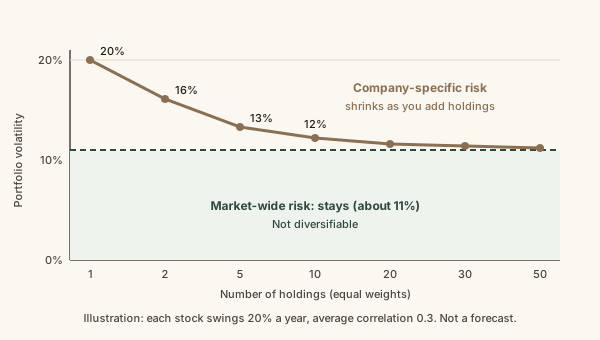
Diversification means spreading money across investments whose prices don't move in lockstep, so a loss in one is partly offset by others. The math, formalized by Harry Markowitz in 1952, shows portfolio volatility depends not only on each holding's volatility but on how they move together (correlation): two assets each swinging 20% a year, held 50/50, produce a portfolio swinging about 20% if perfectly correlated, about 17% at a correlation of 0.5, and about 14% if uncorrelated. Adding holdings shrinks company-specific (unsystematic) risk toward a floor set by market-wide (systematic) risk, which no amount of diversification removes; that floor is why diversified portfolios still fell sharply in 2008 and 2020. The SEC's Investor.gov and FINRA describe diversification as a way to manage risk, not to guarantee profits or prevent losses. Research by Bessembinder (2018) found most individual US stocks underperformed one-month Treasury bills over their lifetimes, which is the strongest practical case against concentration.
Reading time
— 5 min
Updated
— Oct 1, 2026
Fact-reviewed
— Oct 1, 2026
This entry explains how diversification works, cited to the SEC's Investor.gov, FINRA and peer-reviewed research. It is financial literacy, not personal investment advice, and no investment named here is a recommendation. The numbers are illustrations, not forecasts. For decisions about your own money, talk to a licensed financial adviser.
Key Takeaways
Key Takeaways
1Diversification works because investments that don't move in lockstep partly cancel each other's swings. How they move together (correlation) matters as much as how risky each one is.
2It removes most company-specific risk, but not market-wide risk. That floor is why diversified portfolios still fell sharply in 2008 and 2020.
3Counting holdings isn't enough: 20 stocks in one industry are still concentrated. Regulators are explicit that diversification manages risk; it doesn't guarantee profits or prevent losses.
The concept
Picture a street vendor who sells only umbrellas. Rainy weeks are great; sunny weeks are terrible. Add sunglasses to the cart and the weekly takings get much steadier, because the two products do well in opposite weather. That's diversification. It doesn't make the vendor earn more on average; it makes the income less jumpy, because a bad week for one product is a good week for the other. Investing works the same way, with one catch: most investments aren't umbrellas and sunglasses. They're more like umbrellas and raincoats, which mostly do well and badly at the same time. Spreading across them still helps, just less. And when something hits every product at once (the market closes, a recession), no mix of products protects you. That's the part of risk you can't diversify away.
In practice, most people get broad diversification through pooled funds, like index funds and mutual funds, and through mixing asset types that tend to behave differently, such as stocks and bonds. The same pooling logic is what makes insurance work.
Quick check
Which pair is likely to give the biggest diversification benefit when combined?
Worked examples
All numbers below are hypothetical illustrations of the math, not forecasts or historical returns of any real investment.
Example 1: Two assets, three correlations (baseline case)
Take two investments that each swing about 20% a year (their volatility) and put half your money in each. If their correlation is +1, the portfolio swings about 20%: no benefit at all. At a correlation of 0.5, it swings about 17.3%. At 0, it swings about 14.1%. At -1 (perfect opposites, which almost never exists in practice), the swings would cancel completely. Same two assets, same weights, same individual risk. The only thing that changed was how they move together, and it cut volatility by up to 30% in the realistic cases. Correlations aren't fixed, either: a sudden jump in rates can push stocks and bonds down together, as how interest rate changes affect investments explains.
Example 2: Adding more stocks, and hitting the floor (edge case)
Now imagine stocks that each swing 20% a year with an average correlation of 0.3 between any pair. One stock: 20% volatility. Ten stocks, equally weighted: about 12.2%. Thirty stocks: about 11.4%. A thousand: about 11%. The first ten holdings do most of the work, and then the line goes nearly flat. That flat line is systematic risk, the 0.3 correlation everything shares because every company lives in the same economy. This is exactly what investors saw in 2008 and in March 2020: broadly diversified stock portfolios still fell hard, because in a market-wide shock correlations rise and the shared risk dominates (see bull vs bear markets).
Example 3: The employee with half their savings in company stock (applied)
A worker holds $100,000 in savings, $50,000 of it in their employer's stock through a workplace plan. Their paycheck and half their savings now depend on one company. If it runs into trouble, they could lose income and savings at the same moment, which is the correlation problem at its sharpest. FINRA flags employer stock as a common source of concentration risk. Bessembinder's finding that most individual stocks underperform Treasury bills over their lifetimes is the sober backdrop: any single company, including a strong one today, carries a real chance of long-term disappointment. How much to hold is a personal decision involving taxes, plan rules and goals, which is where a licensed adviser earns their fee.
Quick check
Someone owns 25 different bank stocks and says they're well diversified. What's the problem?
How it works (visual)
Volatility falls as holdings are added, then hits a floor
Common mistakes
Common Mistakes
✕
Counting holdings instead of checking how they relate.
→ Look at sectors, countries and asset types. Several funds that all track large US companies can overlap heavily.
✕
Expecting diversification to prevent losses in a crash.
→ It reduces company-specific risk. Market-wide drops still hit diversified stock portfolios; how much stock versus other assets you hold is a separate decision.
✕
Letting one winner grow into most of the portfolio.
→ Concentration can creep in when one holding rises. Investor.gov describes periodic rebalancing back to your chosen mix for this reason.
✕
Assuming the past correlation will hold in a crisis.
→ Correlations between risky assets often rise in selloffs. Treat historical correlation as a rough guide, not a guarantee.
Common misconception
“Diversification lowers your returns, so it's for people who don't know how to pick stocks.”
Diversification lowers the range of outcomes, not necessarily the average. A broadly diversified portfolio earns roughly the market's return with far less single-company risk. Concentrating is a bet on finding the minority of stocks that, per Bessembinder's research, produced nearly all of the market's long-run gains. Buying a single hot IPO is the same bet: concentration in one company, usually one with a short public track record.
What to do next
What to do next
List what you hold by sector, country and asset type, not just by fund or stock name.
Check for overlap: funds with different names can own many of the same companies.
Note any single holding (including employer stock) that is a large share of your savings.
Read Investor.gov's asset allocation and rebalancing guide before changing anything.
For decisions specific to your situation, including taxes on selling, consult a licensed financial adviser.
FAQ
FAQ
Related terms
Related terms
Diversification
Spreading money across holdings whose prices don't all move together, so losses in some are partly offset by others.
Correlation
A number from -1 to +1 describing how closely two investments move together. +1 is lockstep, 0 is unrelated, -1 is opposite.
Volatility (standard deviation)
How widely an investment's returns typically swing around their average. A common measure of risk.
Unsystematic risk
Risk specific to one company or industry, such as a failed product or a fraud. Diversification can largely remove it.
Systematic risk
Market-wide risk, such as recessions or interest-rate shocks, that hits most investments at once. Diversification can't remove it.
Concentration risk
The extra risk of having a large share of your money in one stock, sector or asset, including an employer's stock.
This entry was researched from public sources and drafted with AI-assisted tools, then edited — errors are still possible. Spot one, or want a topic covered? Read our disclaimer.
 KnowThis