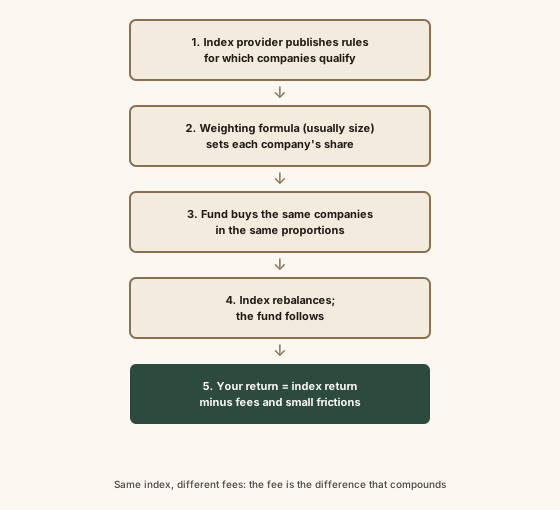
An index fund is a mutual fund or ETF that tries to match the performance of a market index, per the SEC's Investor.gov, rather than beat it by picking stocks. The index is a rules-based list maintained by a company such as S&P Dow Jones Indices: the S&P 500, for example, holds about 500 large U.S. companies chosen by a committee under published eligibility rules and weighted by the market value of their publicly available shares. Because of that weighting, the biggest companies make up a much larger share of the fund than the smallest, so an index fund can be more concentrated than '500 stocks' suggests. Index funds usually charge low fees because no one is paid to pick stocks, and S&P's SPIVA scorecards have repeatedly found that most actively managed large-company funds trail the S&P 500 over long periods. An index fund still falls when its market falls. This is general education, not investment advice.
Reading time
— 4 min
Updated
— Sep 26, 2026
Fact-reviewed
— Sep 26, 2026
Key Takeaways
Key Takeaways
1An index fund copies a published list of investments (an index) instead of paying someone to pick stocks.
2Most big indexes are weighted by company size, so the largest companies make up a much bigger slice of your money than the smallest.
3Low fees are the main advantage. An index fund still drops when its market drops.
The concept
Imagine a shopping list that someone else writes and updates, like "the 500 biggest U.S. companies, in proportion to their size." An index fund is a basket that buys exactly what's on that list and nothing else. Nobody in the fund is trying to guess which company will win. When the list changes, the basket changes. So the most important question about an index fund isn't the fund's name. It's "what list does it copy, and how does that list decide how much of each thing to hold?" Because nobody is paid to pick, the fee is usually small, and that small fee is a big reason these funds tend to do well over time.
If you're new to how shares are bought and sold, start with how the stock market actually works. Index funds are one way of owning a slice of that whole market at once.
Quick check
An S&P 500 index fund holds about 500 stocks. Does each one make up about 0.2% of the fund?
Worked examples
Example 1: What $1,000 buys (baseline case)
You put $1,000 into an S&P 500 index fund. You now indirectly own a slice of each company in the index, in proportion to its weight. If a company is 5% of the index, about $50 of your money is in it. If a small member is 0.02%, about 20 cents is. When the index rises 10% for the year, your fund rises about 10% minus its fee. You never chose any of these companies. The index's rules did.
Example 2: Same index, different fees (the part that compounds)
Two funds track the same index, which earns 7% a year before fees. Fund A charges 0.05%. Fund B charges 1%. $10,000 left alone for 30 years grows to about $75,063 in Fund A (6.95% a year) and about $57,435 in Fund B (6% a year). That's roughly $17,600 less for holding the exact same stocks. The fee is the one number that differs, which is why comparing expense ratios matters more than comparing names.
Example 3: The index goes down (real-world test)
From its October 2007 peak to its March 2009 low, the S&P 500 fell more than 50%. Every fund tracking it fell by about the same amount. That's the index fund working correctly: it delivers the market's return, bad years included. Investors who sold near the bottom locked in the loss. Those who held through the recovery didn't. Owning many companies protects you from any one company collapsing. It doesn't protect you from the whole market falling.
Quick check
In Example 2, why does Fund B end up with less money?
How it works (visual)
From an index's rules to your fund's return
Common mistakes
Common Mistakes
✕
Assuming 'owns 500 stocks' means evenly spread across 500 companies.
→ Check the fund's top 10 holdings. In a size-weighted index, a few companies can dominate.
✕
Picking an index fund by its name without checking the fee.
→ Compare expense ratios. Two funds tracking the same index can differ many times over in cost.
✕
Owning several 'different' index funds that track overlapping indexes.
→ A total-market fund and an S&P 500 fund overlap heavily. Look at what each index holds before assuming you're diversified.
Common misconception
“An index fund is safe because it's diversified across hundreds of companies.”
An index fund spreads risk across the companies in one index, which protects you from any single company failing. It doesn't protect you from the index itself falling. The S&P 500 fell more than 50% between 2007 and 2009. And because most major indexes weight by size, you may be more concentrated in a few large companies than the number of holdings suggests. Diversification lowers some risks; it doesn't remove market risk.
What to do next
What to do next
For any index fund you hold or are considering, find which index it tracks and how that index weights companies.
Compare the expense ratio with other funds tracking the same index.
Look at the top 10 holdings and what share of the fund they make up.
Check how closely the fund's past returns match its index (tracking error).
Decide in advance how you'll react to a large market drop, since the fund will fall with its index.
FAQ
FAQ
Related terms
Related terms
Index
A published, rules-based list of securities, with a formula for weighting them, used to measure a slice of the market. The index itself isn't something you can buy.
Index fund
A mutual fund or ETF that holds the securities in an index, in roughly the same proportions, to match its return.
Market-cap weighting
Weighting each company by its total market value, so larger companies take up a larger share of the index.
Expense ratio
The yearly fee a fund charges, as a percentage of your investment, taken out of the fund's returns.
Tracking error
How far a fund's return drifts from its index's return, due to fees, cash holdings, and trading costs.
This entry was researched from public sources and drafted with AI-assisted tools, then edited — errors are still possible. Spot one, or want a topic covered? Read our disclaimer.
 KnowThis