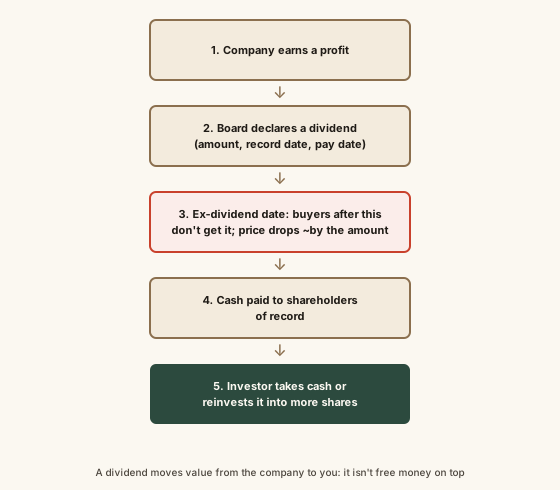
A dividend is a distribution of a company's earnings to shareholders, declared by its board of directors with a record date and a payment date; only investors who own the stock before the ex-dividend date receive it, per the SEC's Investor.gov. Because cash leaves the company, the share price typically falls by roughly the dividend amount on the ex-dividend date, so a dividend converts part of an investment's value into cash rather than adding value on top of it. Dividends are not guaranteed and can be cut, a very high yield can signal that the price has fallen on bad news, and in the U.S. dividends are taxable in the year received, with qualified dividends taxed at lower capital-gains rates, per IRS Topic 404. This article is general education, not personalized investment advice.
Reading time
— 5 min
Updated
— Sep 25, 2026
Fact-reviewed
— Sep 25, 2026
Key Takeaways
Key Takeaways
1A dividend is part of a company's earnings paid out to shareholders, declared by the board. It's a choice, not a promise, and it can be cut.
2On the ex-dividend date the share price typically drops by about the dividend, so a dividend turns part of your investment into cash rather than adding value on top.
3Judge dividend stocks by total return (price change plus dividends) and by whether the payout is sustainable, not by yield alone.
The concept
When a company makes a profit, it can keep the money to grow the business or hand some of it to the people who own its shares. That handout is a dividend. If you own 100 shares and the company pays 50 cents a share, you get $50. Here's the part most people miss: that $50 used to be inside the company, so after it's paid, each share is worth about 50 cents less. You haven't been given extra money out of nowhere. Part of what you already owned has been moved into your pocket. Dividend investing is a real strategy, and plenty of people like the steady cash, but it works because good companies keep growing, not because dividends are free. Companies first sell shares to the public through an initial public offering (IPO); young, newly listed companies often pay no dividend because they're still reinvesting.
If you're still getting your footing, how the stock market actually works covers what a share is, and stocks vs. bonds explains why a dividend isn't the same kind of promise as bond interest. Reinvesting dividends is where the real long-run effect comes from, the same mechanism as compound interest.
Quick check
A $40 stock goes ex-dividend for a $1 dividend and nothing else moves the market that day. Roughly where does it open?
Worked examples
Example 1: Calculating yield and income (baseline case)
A company pays $0.60 per quarter, so $2.40 a year. The stock trades at $80. Yield = $2.40 ÷ $80 = 3%. If you own 200 shares, you receive $120 a year before tax, paid as four $30 deposits. That's the income side. The other side is what the $16,000 of shares does over the year, which can easily be bigger, up or down, than the $120.
Example 2: The 11% yield that isn't (edge case)
A retailer paid $2.20 a year when its stock was $55, a 4% yield. Bad earnings send the price to $20, and screeners now show an 11% yield. Nothing about the dividend improved; the price collapsed. If profits keep falling, the board is likely to cut the dividend, and buyers chasing the "11%" end up with a smaller payout and a lower stock. An unusually high yield is often the market pricing in exactly that risk. Rates matter too: when savings accounts and bonds pay more, income-seekers have alternatives, one of the ways interest rate changes affect investments like dividend stocks.
Example 3: Reinvesting over time (applied case)
An investor puts $10,000 into a fund yielding 3% and turns on dividend reinvestment. Year 1's roughly $300 buys more shares, and those new shares pay dividends of their own the next year. Ignoring price changes, after 20 years at 3% reinvested, the share count has grown by about 80% (1.03 to the 20th power is about 1.81). That growth in shares owned, not the individual payments, is what long-term dividend investors are really after. In a regular taxable account each year's dividends are still taxed even though they were reinvested.
Quick check
In Example 2, why did the yield jump to 11%?
How it works (visual)
From company profit to your account: the dividend timeline
Common mistakes
Common Mistakes
✕
Buying a stock just before the ex-date to 'capture' the dividend.
→ The price typically drops by about the dividend, and in a taxable account you may owe tax on it. There's no free lunch in the timing.
✕
Ranking stocks by the highest yield.
→ Check the payout ratio, earnings trend, and whether the yield is high because the price has fallen. Sustainability beats size.
✕
Treating dividends as safer than they are because they feel like income.
→ Dividends can be cut, and the underlying stock still carries full stock-market risk.
Common misconception
“Dividends are free money you get on top of the stock's return.”
A dividend is value moving from the company to you. On the ex-dividend date the share price typically falls by roughly the amount paid, so your total wealth is about the same the moment after as the moment before. Over time, dividend-paying companies can be excellent investments, but that comes from the business growing its earnings, which is the same source of return non-dividend stocks rely on. This is why investors compare funds by total return.
What to do next
What to do next
When comparing investments, look up total return rather than yield alone.
For any individual dividend stock, check the payout ratio and whether the dividend has been cut before.
Decide whether you want the cash or reinvestment, and set your brokerage's dividend reinvestment option accordingly.
If you hold dividend payers in a taxable account, keep the 1099-DIV forms, since dividends are taxed in the year received. For personal advice, talk to a licensed professional.
FAQ
FAQ
Related terms
Related terms
Dividend
A payment a company makes to its shareholders, usually cash, out of its earnings or accumulated profits. The board decides whether and how much to pay.
Dividend yield
The annual dividend per share divided by the current share price, shown as a percentage. It rises when the price falls, even if the dividend hasn't changed.
Ex-dividend date
The cutoff date for a dividend: buy the stock on or after it and you won't receive the upcoming payment. The share price usually drops by about the dividend amount that day.
Payout ratio
The share of a company's earnings paid out as dividends. A ratio near or above 100% can mean the dividend is hard to sustain.
DRIP (dividend reinvestment plan)
An arrangement that automatically uses dividend payments to buy more shares of the same stock or fund, often including fractional shares.
Total return
The full gain or loss on an investment: price change plus dividends or other income received. It's the fair way to compare investments that pay different dividends.
This entry was researched from public sources and drafted with AI-assisted tools, then edited — errors are still possible. Spot one, or want a topic covered? Read our disclaimer.
 KnowThis