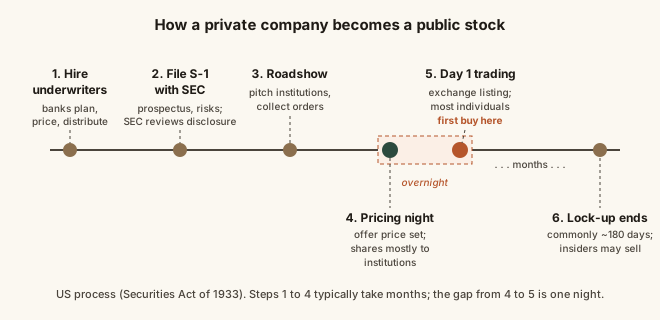
An initial public offering (IPO) is the process by which a private company first sells shares to the public and lists them on a stock exchange. The company hires investment banks as underwriters, files a registration statement (Form S-1 in the US) with the Securities and Exchange Commission containing a prospectus with audited financials and risk factors, markets the deal to institutional investors in a roadshow, and sets the offer price the evening before trading starts. Shares at the offer price are allocated mostly to institutions; most individual investors buy on the open market once trading begins, often at a different price. Money from newly issued shares goes to the company, while existing holders may also sell. Research compiled by Jay Ritter at the University of Florida shows US IPOs have risen on their first trading day by roughly 18% on average since 1980, while studies including Ritter (1991) found many IPOs underperformed comparable stocks over the following years. Insiders usually agree to a lock-up, commonly 180 days, before selling. The SEC's Investor.gov urges reading the prospectus and treating IPOs as risky.
Reading time
— 5 min
Updated
— Oct 3, 2026
Fact-reviewed
— Oct 3, 2026
This entry explains how IPOs work, cited to the SEC's Investor.gov, FINRA and peer-reviewed research. It is financial literacy, not personal investment advice, and no company named or implied here is a recommendation. Figures are illustrations or historical averages, not forecasts. For decisions about your own money, talk to a licensed financial adviser.
Key Takeaways
Key Takeaways
1An IPO is the first time a private company sells shares to the public. After it, the shares trade on an exchange like any other stock.
2Investment banks set the offer price with large institutions the night before trading. Most individuals can only buy once trading opens, often at a different price.
3US IPOs have risen about 18% on their first day on average since 1980, but research shows many lag comparable stocks over the following years. The first-day pop goes mostly to those who got shares at the offer price.
The concept
Picture a family bakery that has grown into a regional chain. The founders and a few early investors own all of it. To open 50 more shops, they need money, and they decide to sell slices of ownership to anyone who wants one. That first public sale is the IPO. But the bakery doesn't set up a stall and sell shares one by one. It hires a big bank to organize the sale. The bank writes up a long document about the business and its risks, files it with the government, tours the country pitching to pension funds and mutual funds, collects their orders, and sets a price. The night before, those large buyers receive their shares. The next morning the shares start trading on the stock market, and that's usually the first moment an ordinary investor can buy, at whatever price the market sets that day.
To buy after listing, you need a brokerage account. Some brokers offer limited offer-price allocations to retail customers, under their own eligibility rules. IPO shares also tend to enter broad index funds only after meeting the index's rules, which can take months.
Quick check
Who usually receives IPO shares at the offer price?
Worked examples
The company and numbers below are hypothetical, chosen to show the arithmetic. They are not forecasts or real deals.
Example 1: Where the money goes (baseline case)
A company sells 10 million newly issued shares at an offer price of $20. Gross proceeds: $200 million. The underwriters keep a 7% spread, $14 million, and the company also pays legal, audit, exchange and SEC registration costs, say $4 million. The company receives about $182 million to spend on what the prospectus's "use of proceeds" section described. Suppose the founders also sell 2 million of their own existing shares in the same offering. That $40 million (minus the spread on those shares) goes to the founders, not the company. The prospectus must state the split, and it's worth checking: a deal that is mostly insiders selling raises little for the business itself.
Example 2: The first-day pop (edge case)
The same shares open at $27 and close the first day at $26. Institutions that received shares at $20 are up 30% in a day. The company sold 10 million shares for $6 each less than the market immediately paid: $60 million "left on the table." An individual who bought at the $27 open is down about 4% by the close. Same stock, same day, opposite outcomes, entirely because of when and at what price each investor got in. A headline that says "IPO soars 30%" measures from the offer price, which most readers couldn't buy at.
Example 3: Day 181 (applied)
Insiders and pre-IPO investors hold 60 million shares under a 180-day lock-up, while 10 million trade publicly. When the lock-up expires, up to 60 million more shares become eligible to sell, six times the original public float. They won't all be sold, but the possibility of extra supply is why the expiry date, disclosed in the prospectus, gets watched. This is also one reason Investor.gov advises reading the prospectus before buying: the lock-up terms, who is selling, whether the company is profitable, and the risk factors are all in it. Whether any of this fits your situation, given your other holdings and diversification, is a question for a licensed adviser.
Quick check
An IPO is priced at $15 and opens at $21. Someone buys at the open and it closes at $19. How did they do on day one?
How it works (visual)
From private company to public stock: the IPO timeline
Common mistakes
Common Mistakes
✕
Assuming you'll get the offer price.
→ Most individuals buy after trading opens. Compare the price you'd actually pay with the offer price before reading anything into a headline.
✕
Treating SEC registration as a seal of approval.
→ The SEC reviews whether the disclosure is complete, not whether the company is a good investment.
✕
Skipping the prospectus.
→ Read the risk factors, the use of proceeds, how much insiders are selling, and the lock-up terms. Investor.gov recommends exactly this.
✕
Placing a market order on the first day.
→ Opening IPO prices can move sharply. FINRA and Investor.gov explain limit orders, which cap the price you'll pay.
Common misconception
“IPOs are a quick way to make money because new stocks always jump on day one.”
The average first-day gain in Ritter's data is real, but it accrues mainly to investors allocated shares at the offer price. Some IPOs fall on day one, and research beginning with Ritter (1991) found IPOs on average lagged comparable companies over the next few years. Buying at the open captures neither the pop nor any guarantee.
What to do next
What to do next
Find a company's prospectus on the SEC's EDGAR database and read the summary and risk factors.
Check whether the company is profitable and how much of the offering is insiders selling.
Note the lock-up expiry date stated in the prospectus.
Read Investor.gov's IPO explainer and its explanation of limit orders before placing any trade.
For whether an IPO fits your portfolio, consult a licensed financial adviser.
FAQ
FAQ
Related terms
Related terms
Initial public offering (IPO)
The first sale of a company's shares to the public, after which the shares trade on a stock exchange.
Underwriter
An investment bank that manages an IPO: helps prepare filings, markets the shares, sets the price with the company, and distributes the shares to investors.
Prospectus
The disclosure document in an IPO registration statement, describing the business, audited financials, risks, and how the money will be used.
Form S-1
The registration statement US companies file with the SEC to offer shares to the public for the first time.
Roadshow
A series of presentations where the company and underwriters pitch the IPO to institutional investors and gather orders before pricing.
Offer price
The price at which IPO shares are sold to the investors who receive an allocation, set the evening before trading begins.
Lock-up period
A contractual period, commonly 180 days, during which insiders and early investors agree not to sell their shares after the IPO.
Underpricing
When an IPO's first-day trading price closes above its offer price, meaning the company sold shares for less than the market immediately paid.
This entry was researched from public sources and drafted with AI-assisted tools, then edited — errors are still possible. Spot one, or want a topic covered? Read our disclaimer.
 KnowThis