 KnowThis
Key Takeaways
Key Takeaways
- 1A share of stock is a small unit of ownership in a company, not a betting slip — owning shares means owning a claim on that company's future profits and assets.
- 2Stock exchanges don't set prices — buyers and sellers do, continuously, based on what they're willing to pay or accept at any given moment.
- 3Share prices move based on changing expectations about future earnings, not just current performance — a company can report strong profits and still see its stock fall if results came in below what investors expected.
The concept
This forward-looking pricing mechanism is exactly why stock prices can seem disconnected from a company's current headlines — the market has usually already priced in what's publicly expected, and it's the gap between expectation and reality that moves prices.
A company reports higher profits than last year, but its stock price drops the same day. What's the most likely explanation?
Worked examples
Example 1: Buying a single share (baseline case)
Example 2: A stock with no trading volume that day (edge case / variation)
Example 3: A major stock index like the S&P 500 (real-world / applied case)
Why does a large company's stock price movement affect a market-cap-weighted index like the S&P 500 more than a small company's movement does?
How it works (visual)
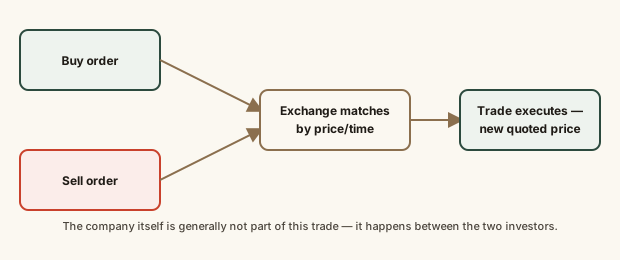
Every quoted stock price is really just the record of the most recent successful match between a willing buyer and a willing seller — not a value assigned by the company or any single authority.
Common mistakes
Common Mistakes
Assuming a rising profit automatically means a rising stock price.
→ Remember prices move on results relative to expectations, not results in isolation — a strong quarter can still disappoint if the market expected more.
Treating daily index moves as a statement about every individual stock.
→ Recognize a broad index like the S&P 500 averages many companies together — individual stocks can move opposite to the overall index on any given day.
Believing the company itself sets or controls its own stock price.
→ Understand price is set by buyers and sellers trading shares among themselves on an exchange, not by the company.
Common misconception
“Buying stock means giving your money directly to the company, and the company controls what happens to the share price.”
Once a company's shares are trading publicly, most day-to-day buying and selling happens between investors, not between an investor and the company itself — per SEC investor education materials, the company doesn't receive proceeds from these secondary-market trades, and it doesn't set or control the price; the market of buyers and sellers does.
What to do next
What to do next
- Before investing in an individual company, understand what it actually does and what investors currently expect from it, not just its recent stock chart.
- Distinguish an individual stock's movement from a broad index's movement when reading market news.
- Remember that a quoted price is the last executed trade, which may be stale for thinly-traded stocks.
- Consult a licensed financial professional or a reputable resource like Investor.gov before making investment decisions specific to your situation.