 KnowThis
Key Takeaways
Key Takeaways
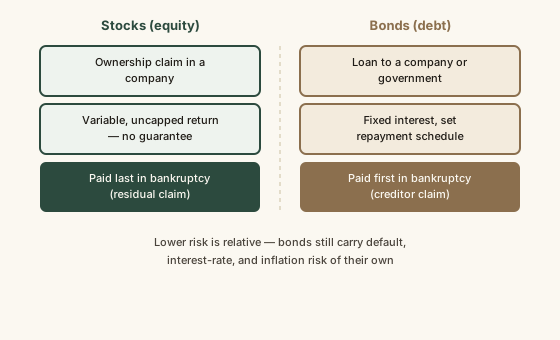
- 1A stock is an ownership (equity) claim on a company; a bond is a loan (debt) to a company or government — that structural difference, not just risk level, is what actually separates them.
- 2Stock returns are variable and uncapped but never guaranteed; bonds typically pay a fixed interest rate and return principal at maturity, but with a capped return.
- 3If a company goes bankrupt, bondholders are creditors with a legal priority claim on remaining assets, paid before stockholders, who receive only whatever is left, if anything.
The concept
This is general educational information about how these two security types are structured, not personalized investment guidance — per SEC Investor.gov, an individual's actual allocation between stocks and bonds should reflect that person's own goals, time horizon, and risk tolerance. A bond's basic loan structure — principal, a fixed rate, and a repayment schedule — mirrors the same mechanics behind an everyday consumer loan, just with the individual investor as the lender rather than the borrower. Most individual investors buy stocks and bonds through a brokerage account, and many hold both security types indirectly through a mutual fund rather than buying individual stocks or bonds directly.
A company issues both stock and bonds, then later goes bankrupt and liquidates its remaining assets. Per FINRA and SEC Investor.gov guidance, who has the stronger legal claim to what's left?
Worked examples
Example 1: Buying a single company's stock (baseline case)
Example 2: Buying a fixed-rate government bond (edge case / variation)
Example 3: The same company issuing both stock and bonds (real-world / applied case)
Why does a bond's fixed coupon rate typically mean a lower long-run return ceiling than a stock in the same company, per SEC Investor.gov and FINRA materials?
How it works (visual)
Common mistakes
Common Mistakes
Assuming bonds are entirely risk-free investments.
→ Recognize that per FINRA guidance, bonds carry real risks of their own — issuer default, interest-rate risk, and inflation eroding a fixed coupon's value — they are generally lower-risk than stocks of the same issuer, not risk-free.
Thinking a stock's return is guaranteed once you buy it, similar to a bond's coupon.
→ Understand a stock carries no repayment or return guarantee at all, per Investor.gov — its value depends entirely on company performance and market conditions.
Believing stockholders and bondholders have equal legal standing if a company goes bankrupt.
→ Recognize bondholders are creditors with a legal priority claim, repaid before stockholders — who are residual claimants entitled only to whatever, if anything, remains.
Common misconception
“Bonds are a completely safe investment, while stocks are the only 'risky' one.”
Per FINRA's investor education materials, bonds are generally lower-risk than stocks of the same issuer because of their fixed claim and legal repayment priority — but they are not risk-free. A bond issuer can still default and fail to repay; a bond's market price can fall if interest rates rise before maturity; and a fixed coupon's purchasing power erodes over time with inflation. The real structural difference is that a stock is an ownership claim with a variable, uncapped return and no repayment guarantee, while a bond is a loan claim with a fixed, capped return and a legal repayment priority — not that one carries risk and the other carries none.
What to do next
What to do next
- Before comparing a specific stock and bond, identify which one you'd actually be holding: an ownership claim with variable return, or a loan claim with a fixed, defined return.
- Read Investor.gov's and FINRA's investor education pages on stocks and bonds, linked in the sources above, for the full detail on how each security type is structured.
- Remember that 'lower risk' for a bond is relative to stocks of the same issuer, not the same thing as 'no risk' — default, interest-rate, and inflation risk still apply.
- This is general educational information, not personalized financial advice — consult a licensed financial professional before making decisions about your own portfolio allocation.